
Top High School Innovators Led with Cancer Stem Cell Research, Water Purification, and Mathematical Projects
For the 34th time, the Hungarian Association for Innovation has recognized the most innovative high school students in the country. Awards were presented to 11 young inventors and scientific creators from 10 projects at the National Scientific and Innovation Olympiad. In addition to a total of more than HUF 5 million in scholarships, the winners also earned the opportunity to participate in major European, American, and Far Eastern international innovation competitions. During the announcement of the results, the organizing Hungarian Association for Innovation also honored 18 outstanding innovative high school teachers, each with an award of HUF 800,000, while the 14 most successful innovative high schools received HUF 900,000 each at this prestigious event. The publication about the award winners and the 20 additional highlighted submissions can be read at the following link.
This year’s competition, organized by the Hungarian Association for Innovation for students aged 14-19, saw a record number of submissions—nearly 300. Following mentoring to help develop the projects, patent research, and science communication training, a 29-member jury of academics and economic experts selected 31 finalists from the 66 completed entries. These finalists competed for the 10 grand prizes and additional special awards at a two-day exhibition and competition held at the Budapest University of Technology and Economics.
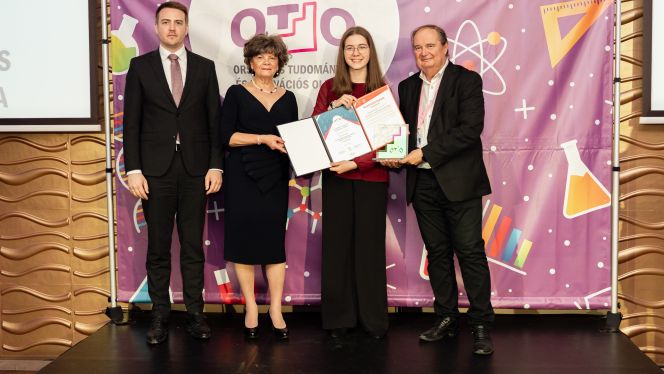
At the awards ceremony on May 31, three first, four second, and three third prizes were presented. Alongside cash prizes, the winners also received a special glass artwork by Dorka Borbás, a Ferenczy Award-winning glass designer.
First prize winners, who will also represent Hungary on the international stage:
- Lili Szokolai, a student at the ELTE Radnóti Miklós Practice Primary School and Grammar School, for her project titled “Preparation of Peptide-Drug Conjugates Targeting Tumor Stem Cells,” which enables the identification and targeted destruction of brain tumor cells using a drug (peptide conjugate) that targets the receptors of cancer stem cells.
- Zakariás Milich, a student at the Fazekas Mihály Practice Primary School and Grammar School of Budapest, for his research titled “Proofs from the Book,” in which he proved a particularly difficult theorem of the famous Indian mathematician Ramanujan using only elementary methods, without complex analysis or hypergeometric series.
- Laura Ivánka, a student at The British International School Budapest, for her “Dive&Clean” innovation project, in which she developed a novel concept for collecting marine and ocean waste with the help of divers.
Second prizes were awarded to Dániel Czapák (Medgyessy Ferenc High School, Art Vocational School and Technical School) for his project on “MVE Flexible Sensor-Based Predictive Maintenance,” Henrietta Rajhona (Kaposvári Táncsics Mihály High School) for developing a “New Type of Defibrillator,” Bercel Ágostházy (Budapest Piarist High School) for his “DIY Animation in Real Time” development work, and Csongor Balázs Kertesi (BMSZC Petrik Lajos Bilingual Technical School) for his “Complex Air Quality Analysis System.”
Third prizes went to Tamás Kránicz and Dániel Kránicz (Révai Miklós High School and Boarding School, Győr) for their work on the utilization of copper-containing microelectronic waste, Natali Júlia Hajsz (Thomas Mann Gymnasium, Deutsche Schule Budapest) for her research on producing customizable bandages for various types of injuries, and Csanád Zoltán Szél and János Dániel Ádám (BMSZC Neumann János IT Technical School) for their “Brain Wave Danger” project based on detecting brain waves.
This year, the special prize for the best cross-border submission by the Hungarian Association for Innovation was awarded to Dorka-Boróka Simon, a student at the Transylvanian Innovation Workshop, for her project titled “Cerebromics.”
The students also received additional valuable special prizes (including an IPOSZ Start Your Business training program and a scholarship from the Carpathian Basin Talent Search Foundation) and were enrolled in the Talent Passport Program announced by the National Scientific Students’ Council.
During the awards ceremony, 18 outstanding high school science teachers with an innovative mindset received recognition and cash prizes for their professional support of the next generation of scientists and innovators:
József Bacher – Révai Miklós High School and Boarding School, Győr
Sándor Bán – Szeged Radnóti Miklós Experimental High School
Sándor Beck – Kölcsey Ferenc High School, Zalaegerszeg
Bence Bolgár – Piarist High School, Budapest
Dániel Boncz – Kölcsey Ferenc High School, Zalaegerszeg
Dr. Viktória Bacsó Borbély – Medgyessy Ferenc High School, Art Vocational School and Technical School, Debrecen
Andrea Borbola – Szeged Radnóti Miklós Experimental High School
Benedek Bottka – Piarist High School, Budapest
Dr. István József Farkas – BMSZ Neumann János IT Technical School
Dr. Mihály Hömöstrei – Deutsche Schule Budapest, Thomas Mann Gymnasium
- Gábor Koncz – Kisvárda Bessenyei György High School and Boarding School
- Dr. Katalin Jámbrik Konczné – Kisvárda Bessenyei György High School and Boarding School
Zsolt Gőgh – BMSZC Petrik Lajos Bilingual Technical School
József Majoros – British International School Budapest
Zoltán Markó – Fazekas Mihály Practice Primary School and Grammar School, Budapest
László Vámosi – Kaposvári Táncsics Mihály High School
Zoltán Várady – BMSZ Neumann János IT Technical School
Zsolt Zsigó – NYSZC Bánki Donát Technical School and Boarding School
“One of the main messages of OTIO is that in the free world of science and technology, competition is not a goal, but a way of life. It takes place internationally, and successes and failures drive it forward. One should not and must not drop out,” emphasized László Jakab, Chairman of the Jury.
Dr. János Pakucs, Chairman of the Organizing Committee, stated that in September 2025, the first prize-winning projects will represent Hungary at the European Championship in Riga, at the “36th EU Contest for Young Scientists,” where young people from 37 countries will compete for the European Union prizes.
The 34th National Scientific and Innovation Olympiad was held under the patronage of the Minister of Culture and Innovation, with the support of the National Research, Development and Innovation Office, financed by the NKFI Fund, and sponsored by 4iG Nyrt.













Leave a Reply