
TECH NEWS – At a quantum informatics workshop, we got a glimpse of the future at the Bosch Budapest Innovation Campus
The second quantum revolution is just around the corner: quantum technology is undergoing such rapid development today that it could bring profound changes to our daily lives.
With the participation of leading Hungarian experts in quantum informatics and with the support of the Hungarian Bosch group, a professional conference entitled Quantum Informatics National Laboratory Workshop 2025 was held at the Bosch Budapest Innovation Campus.
At this unique scientific event, the latest trends, domestic developments, and achievements in quantum informatics were presented.
“It is now clear that quantum technology has enormous potential, and over the past decade Bosch has become a key player in this field.”
Although the development of information technology has already fundamentally changed our lives, quantum technology could open up a completely new era. With its help, we can achieve a qualitative leap in communication, computing and information technologies, and even in measurement technology and medical diagnostics.

Quantum Informatics National Laboratory Workshop 2025: a unique scientific meeting with Bosch support
At present, about twenty internationally recognized research groups consisting of physicists, engineers, mathematicians and IT specialists are working on quantum informatics topics in Hungarian research institutes and universities. The mission of the Quantum Informatics National Laboratory is to bring together professional resources and provide a suitable background for thoughtful and coordinated developments that further strengthen Hungary’s role and importance in both theoretical and applied quantum informatics.
The aim of the Quantum Informatics National Laboratory Workshop 2025 was to provide an overview of the latest trends, domestic developments and achievements in quantum informatics. The professional conference was hosted by the Bosch Budapest Innovation Campus.

Bosch among the pioneers of quantum technology
“It is now clear that quantum technology has enormous potential, and over the past decade Bosch has become a key player in this field. We were delighted to host the Quantum Informatics National Laboratory Workshop 2025, as our shared goal is for the theoretical results of quantum technology to become part of industrial production and everyday life as soon as possible,” said Dr. István Szászi, head of the Bosch group in Hungary and the Adriatic region, at the conference.
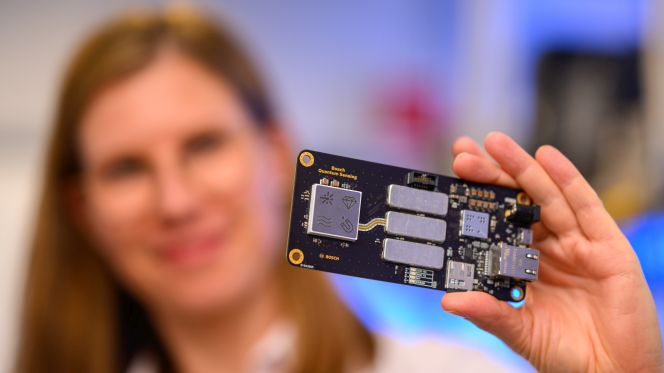
Bosch is one of the world’s leading innovative companies in the field of advanced sensors, and therefore places special emphasis on the development of quantum sensors that are much more sensitive and accurate than current technologies. Quantum sensors developed by Bosch Quantum Sensing, for example, exploit the unique properties of synthetic diamonds and could bring breakthroughs in medical technology, mobility and consumer goods. In the future, Bosch’s quantum sensors will be able to be used for electrocardiographic (ECG) measurements, to determine the precise charge level of batteries, for aircraft navigation, and even for the detection of mineral resources, with much greater precision and speed than today’s methods.
Bosch estimates that the global market for medical and mobility applications of quantum sensors could grow to several billion euros a year by the middle of the next decade. The company’s goal is to miniaturize quantum sensors to such an extent that they can be integrated into chips, enabling wide and cost-effective application. In addition to quantum sensors, Bosch also sees significant potential in quantum computers, which the company says will be used in a wide range of technological fields, such as materials science, and could bring major innovations.
The HUN-REN Wigner Research Centre for Physics works on the qualification and industrial application of quantum computers and quantum sensors
At the presentations of the Quantum Informatics National Laboratory Workshop 2025, the most topical issues in quantum technology were discussed. The aim of the HUN-REN Wigner Research Centre for Physics is to establish an atomic-based quantum informatics laboratory background and to master the latest methods, resulting in the development of new hardware, even in the field of quantum sensor-related developments. The HUN-REN Wigner Research Centre for Physics is also currently developing new methods for the qualification of quantum computers, which could be an important step towards their practical application. The institution aims to develop quantum algorithms and hybrid solutions that will enable quantum computers to be used for industrial applications.
BME: Hungary could join the pan-European quantum internet
In its presentation, the Budapest University of Technology and Economics (BME) discussed, among other things, that Hungary is working on building a domestic quantum communication network that could be connected to the pan-European quantum internet planned by the European Union and to be realized within 10 years. This would put Hungary at the forefront of quantum communication internationally. Quantum communication networks, on the one hand, make the encryption methods currently in use more secure, and on the other, may in the future be suitable for linking quantum computers located far from each other. BME experts are also developing new quantum bit solutions, as well as atomic-scale memory units based on quantum technology, which will provide the hardware basis for the computing needs of artificial intelligence.
Quantum optics laboratory at ELTE
At the event, Eötvös Loránd University (ELTE) reported on the establishment of a quantum optics laboratory. This lab will enable the experimental development of components for photon-based quantum computers (i.e., computers that use photons to store and process information) at the highest internationally available technological standards. ELTE experts at the workshop highlighted that the emergence of quantum computers also requires new solutions in software development. The institution’s researchers and professionals are currently working on software tools and interfaces, as well as on the development of quantum-resistant protocols to support the programming of quantum-based systems and to address new cybersecurity challenges.
Source: Bosch















Leave a Reply