
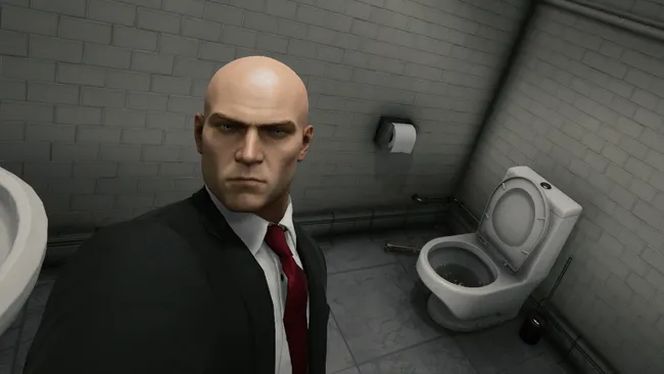
IO Interactive’s boss says Hitman 3 cost just one-fifth of Hitman 2016’s budget—because they finally had the guts to stop building new bathrooms for every game: “I swore never to do more new toilets.”
After buying its freedom from Square Enix in 2017, IO Interactive has managed to stay afloat as the world’s top self-publishing bald assassin factory, despite ballooning industry budgets and chaos everywhere else. In a conversation with The Game Business, CEO Hakan Abrak credits IO’s AAA survival to one hard-won lesson in, of all things, toilet discipline.
Abrak says that after 2012’s Hitman: Absolution—which he produced—they realized they needed to quit throwing dev time (and money) down the drain. “I swore never to do more new toilets,” he said. “‘Just do new toilets,’ right? We were just doing new everything. And it was just a throwaway.”
When IO got to work on 2016’s Hitman, they made a deliberate choice to invest in “smart, accumulated content”—what they now call their “brick system.” It meant creating assets and systems that could be reused and expanded across sequels, not tossed out each time.
The result? Each new Hitman was made on a tighter budget by maximizing what came before—and reviews only got better. “Without being too precise: Hitman ‘16, let’s say that if that was $100 million, Hitman 2 was maybe $60 million. Hitman 3 was $20 million,” says Abrak, adding that the third game still had new, unique locations. “And Hitman 3 was the highest Metacritic. It was 85, 84, and 87 Metacritic.”
The next big thing, 007: First Light, will be a “more ambitious product” (and, of course, a bigger investment)—but will use the same philosophy for long-term efficiency. “If we were to look at a sequel at one point, who knows?” Abrak says. “At IO, we have a really, really good way of trying to be efficient. That’s extremely important to us.”
That drive for efficiency kept IO from overreaching during the COVID-era “gold rush,” which left so many studios gutted or shuttered. “We could have grown a lot more,” Abrak says. “We could have taken on more projects. But I think we’ve been very mindful about growing with the pace of where our culture and our expertise could follow.”
Source: PC Gamer











Leave a Reply