
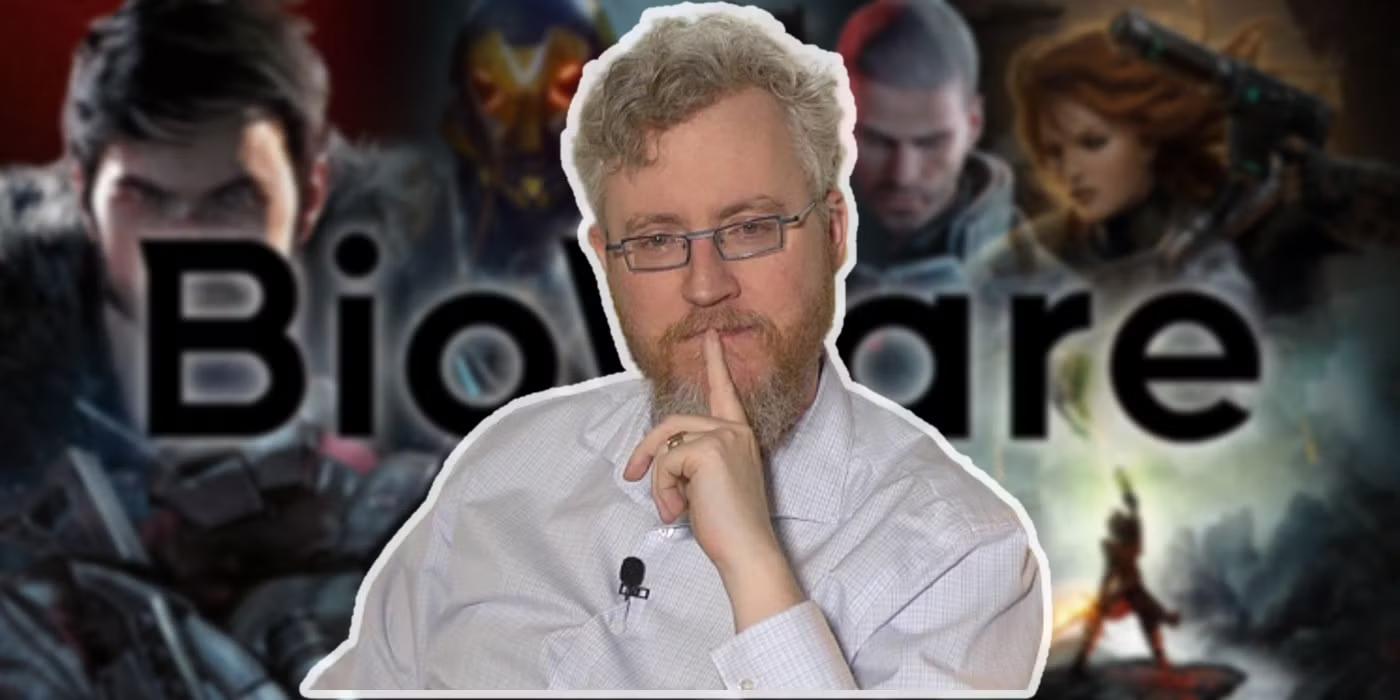
Mark Darrah believes the company’s new owners could reduce the number of studios under Electronic Arts as a result of the company’s growing debt burden.
Mark Darrah, former producer at BioWare, shared his thoughts on YouTube regarding Electronic Arts’ massive acquisition. His perspective carries weight — he spent over 20 years at the studio and witnessed firsthand how EA’s corporate culture affected not only BioWare but many other studios as well. Another major concern is that the buyers include the Saudi government’s Public Investment Fund (PIF) and Jared Kushner’s firm, Affinity Partners. Kushner is former U.S. President Donald Trump’s son-in-law. From a human rights standpoint, this is a “double nightmare”: the Saudi government is frequently criticized for abuses, and the Trump administration openly targeted DEI (diversity, equity, and inclusion) initiatives.
“Electronic Arts will have an additional $20 billion in debt on its balance sheet. Obviously, adding $20 billion requires paying a lot of interest. Based on EA’s current financials, the company nets around $1.1–1.2 billion annually. If that $20 billion carries a 5% interest rate, $1 billion a year will go toward servicing the debt. For a historically conservative company like EA, further cost-cutting will be necessary. Since most of its costs are tied to personnel, that almost certainly means layoffs and studio closures.”
Darrah added that it’s difficult to imagine a $55 billion media acquisition not serving as “sportswashing” — a way to deflect criticism of human rights abuses. “This deal is as much a PR move for the Saudi government as it is a financial one. They could steer messaging in their preferred direction. It’s hard to imagine BioWare pivoting from progressive storytelling to the opposite just because the government wants it. A BioWare game that does that would be received apocalyptically poorly.”
According to Darrah, the new ownership could dictate what they want to see. “If they want a studio to shut down for 25 years to explore a radically new way of developing games, they can do that. In the short term, this almost certainly means layoffs — not only among developers but also in finance and PR. In the medium term, we could see studio closures. In the long run, however, what’s left of EA might ultimately benefit.”
He explained that Electronic Arts has historically been reluctant to sell off its IPs because of its risk-averse nature, and executives have long been incentivized to do nothing. But once the acquisition is finalized, those incentives could change drastically — selling assets or cutting costs might become necessary to manage debt. “There is a small glimmer of hope: as a privately held company, EA will have to report its financial results over a longer time horizon, meaning it won’t need to chase quarterly growth targets.”
For now, layoffs, restructuring, and possible studio sales seem inevitable. In the longer term, however, the company that emerges from this process may be leaner — and potentially stronger.
Source: PCGamer














Leave a Reply