
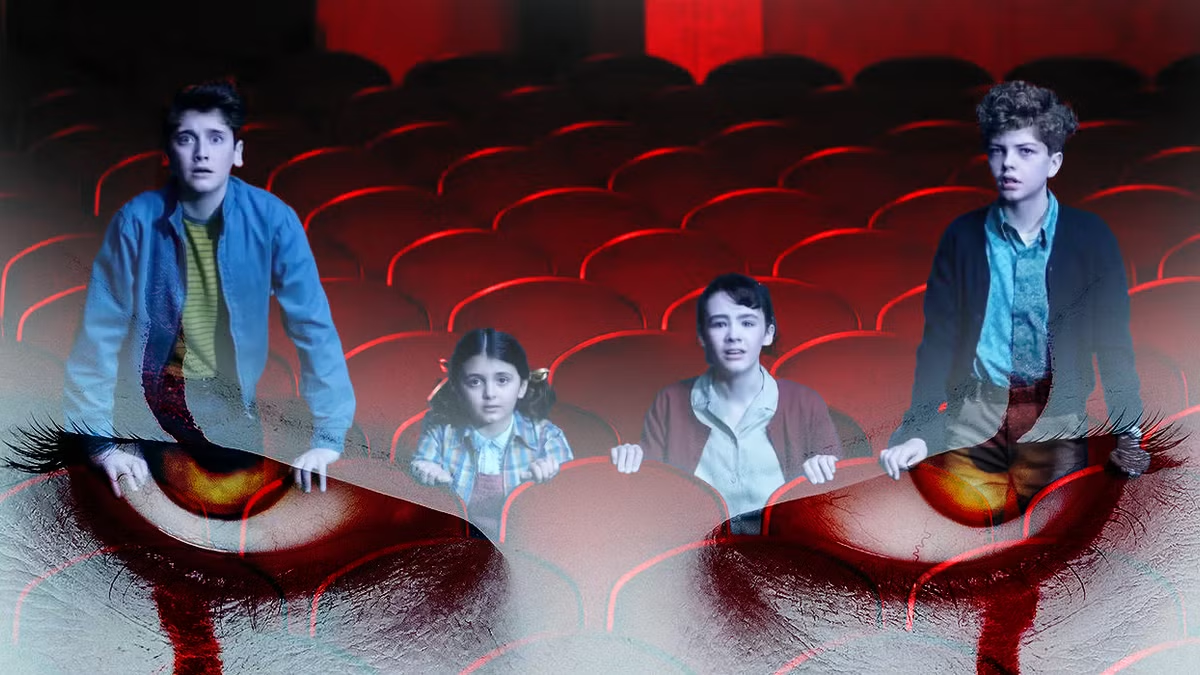
MOVIE NEWS – Without most of us noticing, the new It series has been assembling a Stephen King universe in the Marvel mold. The enigmatic Dick Hallorann returns in It: Welcome to Derry, setting up a shared world that links Pennywise’s nightmare with The Shining.
One of Marvel Studios’ greatest tricks is a shared narrative sandbox where characters hop between films, creating continuity that hooks fans and multiplies story possibilities. But the shared-universe concept isn’t new. Stephen King has spent decades doing something similar across his novels, connecting characters, places and events throughout his vast catalog. As often happens with his books, those connections have seeped into film and TV adaptations. The latest proof is It: Welcome to Derry, where an unexpected yet pivotal figure steals the spotlight: Dick Hallorann, known from The Shining.
For those who’ve seen Stanley Kubrick’s The Shining, Hallorann is the kind cook at the Overlook Hotel who recognizes Danny Torrance’s gift, the “shine,” becoming his guide and protector against the horrors in that isolated, cursed lodge. On screen, Dick is a beacon of humanity in a place built to extinguish it, and he reappears in Doctor Sleep, where, now in spirit, he continues to guide adult Danny as he confronts encroaching evil.
It: Welcome to Derry and the Expansion of the “StephenKingverse”
The character also makes a cameo in another famous King story that had already placed Hallorann inside It long before Danny’s saga. In the 1986 novel, he appears as a young Army cook in the 1930s, working at The Black Spot, a club near Derry, Maine, created for Black soldiers. White supremacists attack the club, and Hallorann uses his psychic abilities to save lives, including the father of Mike Hanlon, a future member of the Losers’ Club. This brief yet crucial role ties him to It’s cosmic threat and establishes his ability to sense and combat evil well before we meet him in the Colorado mountains.
It: Welcome to Derry not only adapts the celebrated 1986 novel but expands its narrative into what fans might call a “Stephen King universe,” a shared on-screen world similar to Marvel’s model. Set in 1962, the series explores the Black Spot tragedy with Hallorann, played by Chris Chalk, now a central figure. Here, he isn’t the wise guide we saw in The Shining but a young man struggling to understand his gift and his deepest fear: losing control of himself. As Chalk points out, “Dick is in Derry because he’s made a mistake, and that will be shown in the series.”
Hallorann as a Bridge Between Stories
This approach lets the show layer its horror: the era’s racial violence, It’s supernatural threat, and the forging of a hero who, decades later, will help save Danny Torrance. The new series also nods to other King works, such as The Shawshank Redemption and the symbolic Turtle, a benevolent force counterbalancing It and threading through King’s multiverse. Every nod and cross-interaction reinforces the sense that we’re watching a cohesive universe where individual tales feed a larger mythology, culminating in The Dark Tower saga.
A Silent Hero for a Shared Universe
Hallorann’s importance in Welcome to Derry goes far beyond a cameo. He links two of King’s most iconic strands: the fights against human and supernatural evil. In the series, his psychic abilities are crucial, allowing him to perceive the danger It poses to Derry. His appearance foreshadows the protective, empathetic nature we later see at the Overlook Hotel, keeping his evolution consistent over time. This framing makes It: Welcome to Derry not just a prelude to the films but a point of convergence for King fans, enriching the experience for readers of the originals and sparking curiosity in newcomers.
Dick Hallorann embodies what makes a Stephen King universe work: empathy, courage and an attunement to the supernatural. His Derry chapter reinforces the idea that evil, human or cosmic, recurs over time, and that goodness and bravery can, too. Newly arrived on HBO Max, It: Welcome to Derry not only adds a chapter to the saga of the demonic clown but also shows how King, decades before Marvel popularized the format, was already weaving a web of interconnected stories and characters.
Source: 3DJuegos




![Koshmar: The Last Reverie Looks Like an Action Adventure Trapped Between Dreams and Madness on PC and Consoles [VIDEO]](https://thegeek.games/wp-content/uploads/2026/04/theGeek-Koshmar-The-Last-Reverie-302x180.jpg)




Leave a Reply