
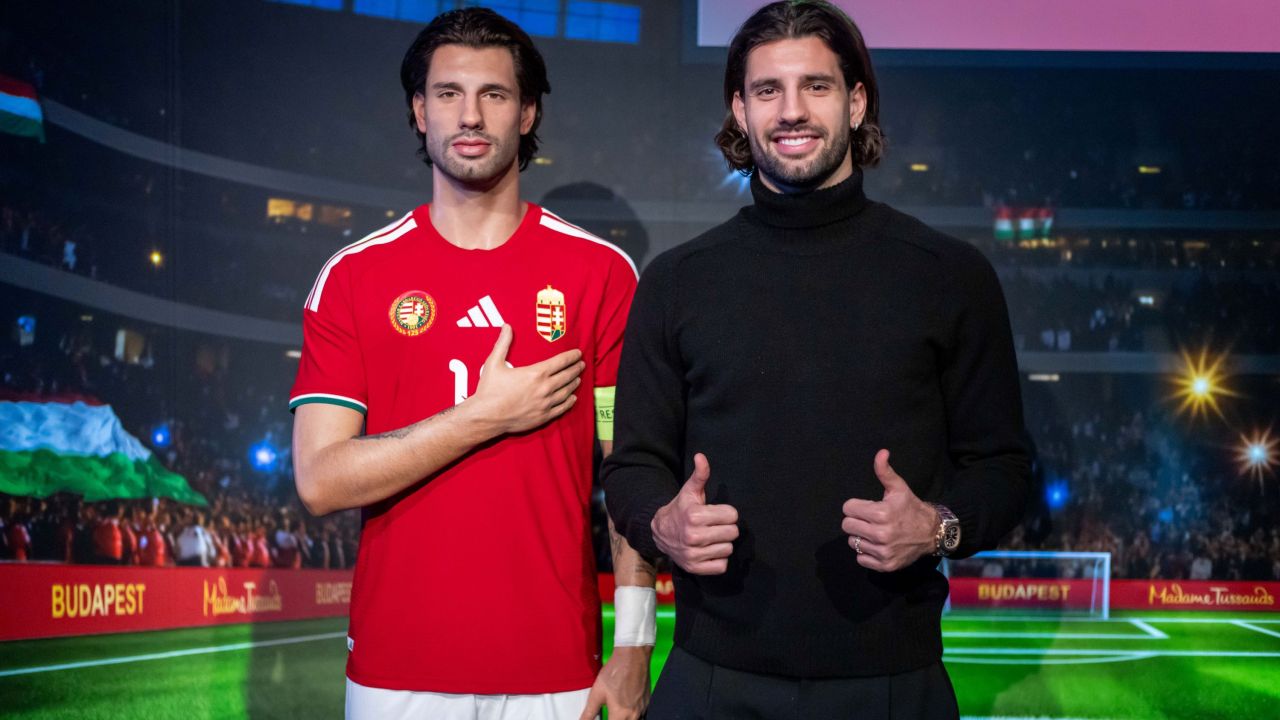
While a smiling wax figure of Dominik Szoboszlai is unveiled at Madame Tussauds Budapest, the real player is coming off a 3–0 defeat with Liverpool at Manchester City, a World Cup qualifying collapse against Ireland in Budapest and a blunt public dressing down from psychiatrist Imre Csernus. Hungary’s captain is being immortalized in wax just as his most difficult spell on the pitch is unfolding.
Being turned into a wax figure is one of the clearest signs that a sportsman has crossed over into pop-culture icon status. At the new sports room of Madame Tussauds Budapest, Dominik Szoboszlai now stands alongside legends such as Ferenc Puskás, László Papp, Katinka Hosszú, Cristiano Ronaldo, and Lionel Messi. In theory, this should be a straightforward feel-good story. In practice, the timing could hardly be more awkward.
The unveiling comes just days after a heavy defeat with Liverpool in Manchester and a disastrous World Cup qualifier at home to Ireland, where Hungary lost 3–2 in the 96th minute. As tourists in downtown Budapest queue up to take selfies with a life-size Szoboszlai in a national team jersey, the real captain is dealing with the fallout from a brutal week, political VIP attention in the stands, and hard questions about his leadership on and off the pitch.

A bad night at the Etihad with the prime minister watching
The uncomfortable narrative starts at the Etihad Stadium. Earlier in November, Liverpool travelled to face Manchester City and were comprehensively beaten 3–0. According to British and Hungarian reports, Hungarian Prime Minister Viktor Orbán watched the game from a VIP box, his presence noted several times by the TV cameras as Szoboszlai struggled along with the rest of Liverpool’s midfield.
The Hungarian international started the match but never managed to impose himself. City dominated possession, Liverpool’s press was easy to bypass, and the evening ended with a three-goal defeat that raised fresh doubts about Jürgen Klopp’s rebuilt side and about Szoboszlai’s current form. For a player widely marketed as Hungary’s new global star, it was a grim performance to have associated with shots of the country’s prime minister in the stands.
On its own, Orbán’s presence could be dismissed as little more than a curiosity. Seen in the context of what followed, however, it adds to the strange sense that politics, image-building, and football reality have become uncomfortably tangled around Hungary’s most high-profile player. In the skybox sits the political leader, in midfield a visibly struggling playmaker whose wax double is already being polished for the spotlight back home.
Heartbreak against Ireland and a captain in tears
Only a few days later came an even more painful blow. In a packed Budapest stadium, Hungary hosted Ireland in a crucial World Cup qualifier. On paper, Marco Rossi’s team were favourites. The home side had been on an impressive run for years, and many fans saw this as another step toward cementing Hungary’s status as a stable tournament contender.
Instead, the night turned into a nightmare. Hungary conceded late, lost 3–2, and saw a valuable point slip away in the sixth minute of added time. TV pictures showed Szoboszlai, captain’s armband on his arm, sinking to his knees at the final whistle, then pulling his shirt over his face as he walked toward the Kurva. In post-match comments, he admitted that the team “still owes something” to the supporters and tried to clarify a goal celebration that had been interpreted by some as overly self-focused.
This latest collapse did not just hurt Hungary’s World Cup dream, it killed it off completely, and it sharply raises the question of whether the narrative – ‘golden generation’, ‘world-class captain’ – has been sprinting far ahead of what we actually see on the pitch.

Madame Tussauds: immortality in wax, unease in the fanbase
All of this would already be a difficult backdrop for any star. What makes Szoboszlai’s situation particularly striking is that, in the middle of this sporting turbulence, he is being immortalized in wax. At the downtown attraction of Madame Tussauds Budapest, a life-size Szoboszlai in full Hungary kit has just joined the permanent collection. The player himself attended the ceremony and sat down with legendary TV commentator István Hajdú B. to talk about the experience.
Szoboszlai praised the work of the artists and described the figure as a recognition of his achievements. He noted that “for any player, having a Madame Tussauds wax figure is a huge honour, a kind of immortality”, and stressed how much it meant to him to be shown in the national team shirt alongside Puskás, Ronaldo and Messi. The club’s press materials proudly explain how specialists measured everything from the distance between his eyes to the precise tone of his hair and spent weeks hand-painting his tattoos.
There is nothing inherently wrong with any of this. For a small football nation, having a player who is both a Premier League starter and a tourist attraction in the capital is genuinely remarkable. But the timing matters. Coming straight after a humiliating defeat in Manchester and a gut-punch loss to Ireland, the wax figure risks looking less like a celebration of a completed achievement and more like a slightly premature monument to a story that is still being written.
Csernus’ diagnosis: too much stardom, not enough substance
The sense of dissonance was sharpened by psychiatrist Imre Csernus, who gave a scathing assessment of the national team after the Ireland match. In a radio interview, he argued that several members of the squad, including its biggest stars, are not mentally equipped for the pressure they now face. In his words, “stardom and lack of knowledge” cannot coexist forever. Sooner or later, the gap between image and reality will be exposed.
Without turning the discussion into a personal attack, Csernus used Szoboszlai as an example of a player who carries enormous symbolic weight without always showing the leadership that should go with it. Being captain, he suggested, is not just about walking out first or giving interviews. It is about radiating certainty when others are crumbling, and about making the right choices in the most stressful moments. Against Ireland, in his view, that mental backbone was missing across the team.
For many Hungarian fans, who have watched Szoboszlai’s rapid rise with pride, hearing such blunt words from a well-known psychiatrist felt jarring but also, perhaps, oddly honest. The image of the captain weeping on the pitch, Orbán in the VIP box a few days earlier and a brand-new wax statue in the city centre combine into a collage that is hard to reconcile with the idea of an unshakeable world-class leader.
Where does Szoboszlai go from here – and what do we expect of him?
It is important to remember that Szoboszlai is still relatively early in his career. He has already achieved more than any Hungarian outfield player in decades, earning a move to Liverpool FC, scoring in the Premier League and becoming the undisputed focal point of the national team. For a generation of young fans, he is living proof that a player from Székesfehérvár can make it to the highest level of European football.
At the same time, football is relentlessly present-tense. Past glories do not buy much patience when results turn sour. World Cup qualifiers are unforgiving, and life at a club like Liverpool leaves little room for extended dips in form. When, in that context, the political leadership makes a high-profile appearance at a heavy defeat and a wax museum rushes to fix your likeness in place among the legends, the gap between branding and performance becomes impossible to ignore.
To his credit, Szoboszlai has not blamed anyone else. His social media posts after the Ireland loss focused on responsibility rather than excuses, and he publicly acknowledged that the team owes the supporters more. The harder part will be turning those words into a sustained change on the pitch – not just in terms of goals and assists, but in the less glamorous work of tempo control, defensive positioning and emotional regulation under pressure.
For Hungary as a football country, the temptation will be to keep building statues, literal and metaphorical, around its current flagship player. Some of that is understandable. After years of searching for a new hero, the instinct to hold up Szoboszlai as a symbol of national resurgence is strong. Yet the events of the past weeks suggest that the healthier path would be to slow down the canonization process and allow reality to catch up with the marketing.
Ultimately, the wax figure at Madame Tussauds will not decide Szoboszlai’s place in football history. That will be determined by what happens in stadiums, not in tourist attractions. If he leads Hungary to a World Cup and re-establishes himself as a dominant force at Liverpool, the statue will be a fitting, even touching, tribute to a career that matched the hype. If not, it may come to be seen as a symbol of a moment when a country fell in love with an idea faster than the player could realistically deliver on it.
For now, the contrast between the flawless wax smile and the very human frustration on the pitch remains striking. It is up to Szoboszlai – and to those around him – to decide whether this awkward overlap will be remembered as a temporary wobble on the way to greatness, or as the start of a more sobering reappraisal of what Hungary can reasonably expect from its brightest star.
Source: Index, Nemzeti Sport, 24.hu, Forbes






![[TGA 2025] Star Wars: Galactic Racer Focuses on High-Stakes Podrace Runs [VIDEO]](https://thegeek.games/wp-content/uploads/2025/12/theGeek-Star-Wars-Galactic-Racer-302x180.jpg)
![[TGA 2025] LEGO Batman Is Back, and This Time the Legend Needs Allies: Legacy of the Dark Knight [VIDEO]](https://thegeek.games/wp-content/uploads/2025/12/theGeek-LEGO-Batman-Legacy-of-the-Dark-Knight-302x180.jpg)




Leave a Reply