
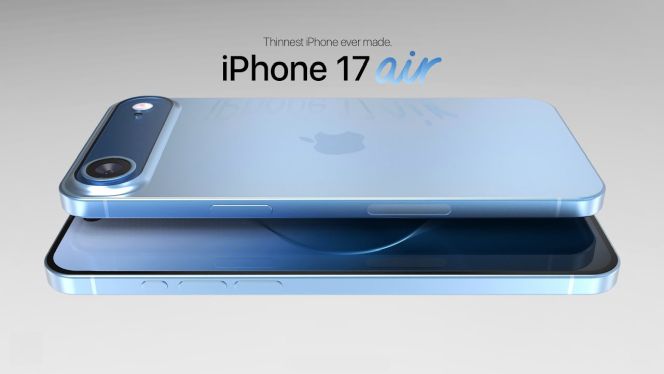
TECH NEWS – Earlier, there were rumors that Apple’s slim smartphone was in high demand in China, but that might not be the case.
Initial reports indicated that the Apple iPhone Air was a hit in China because it came with an eSIM card, a novelty in a country where eSIM cards for smartphones were unavailable until a few weeks ago. Counterpoint Research published sales figures for the Chinese smartphone market and noted that smartphone sales grew by 8% in October compared to the previous year, largely due to a 37% increase in Apple iPhone sales. Eighty percent of these sales were concentrated in the new iPhone 17 family. According to Counterpoint’s October Market Pulse Monthly Smartphone Sell-Through Tracker, the base model iPhone 17 had the strongest sales in China compared to the iPhone 16 series.
The iPhone 17 Pro and Pro Max are also selling well in the world’s largest smartphone market. Xiaomi took second place in October for the first time in over a decade. This marks the best start to the December quarter for Apple, with total sales far exceeding the previous peak in October 2021. In October, a quarter of the smartphones sold in China were iPhones — a milestone achieved only once before, in 2022, when Apple faced fewer competitors in the premium segment. However, the publication makes no mention of the iPhone Air, which could cause concern regarding sales momentum.
Back in October, Counterpoint noted that the iPhone Air accounted for 3% of Apple’s sales in China and the US, while the iPhone 16 Plus accounted for 4%. This indicates a slowdown in sales momentum. However, Counterpoint made no mention of the ultra-thin version, raising doubts about the iPhone Air’s sales in China. This coincided with Apple’s decision to postpone the release of the iPhone Air 2 until spring 2027. Initial rumors suggested the delay was due to Apple wanting to equip the ultra-thin version with a dual camera. However, Mark Gurman of Bloomberg claims the delay is more likely related to the upcoming A20 chip. This chip would use TSMC’s 2nm process with Wafer-Level Multi-Chip Module (WMCM) packaging. This allows components, such as the SoC and DRAM, to be integrated directly at the wafer level.
Due to TSMC’s manufacturing constraints with the 2nm node, Apple’s decision to delay the launch of the iPhone Air until spring 2027, alongside the iPhone 18 and iPhone 18e, rather than releasing it in the fall, could effectively manage the limited supply of the A20 chip. Apple has always expected the iPhone Air to account for 6–8% of annual iPhone sales. Thus, the ultra-thin smartphone remains useful to Apple as an experimental platform for testing new technologies.
Source: WCCFTech, Counterpoint Research






![Koshmar: The Last Reverie Looks Like an Action Adventure Trapped Between Dreams and Madness on PC and Consoles [VIDEO]](https://thegeek.games/wp-content/uploads/2026/04/theGeek-Koshmar-The-Last-Reverie-302x180.jpg)




Leave a Reply