
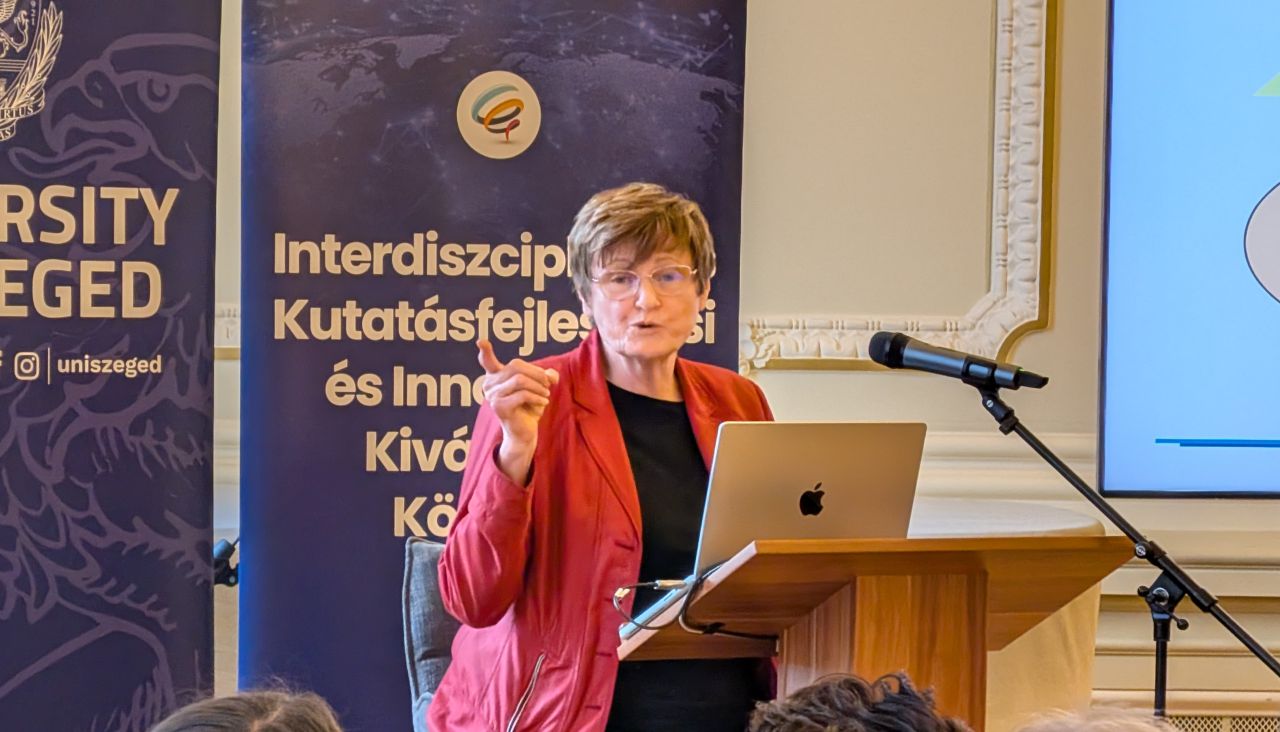
TECH NEWS – A Nobel atmosphere, a shift in healthcare and a strategic industrial partnership came together at the 13th Innovation Day of the University of Szeged. The event was opened by Rector László Rovó, who reminded the audience that the Nobel Prize is “in the air” in Szeged, as the university has already given four Nobel laureates to Hungary.
Veronika Varga-Bajusz, State Secretary at the Ministry of Culture and Innovation, added that 12 Hungarian universities are now among the top 5 percent of institutions worldwide, and within this group the University of Szeged is one of the flagships. In 2024, SZTE filed 20 patent and 16 trademark applications, acquired 25 new intellectual properties, while its revenues from corporate R&D programs exceeded HUF 2 billion. Gábor Szabó, president of the Hungarian Innovation Association, stressed that only what is new and produces tangible economic results on the market can truly be called innovation, and this requires a high tolerance for failure.
The day’s guest speaker was Nobel laureate biochemist Katalin Karikó, who in her lecture entitled “From Innovation to Industrial Application” walked the audience through several decades of mRNA therapy: from the fundamental discovery in 1961 to test-tube synthesis in 1984, the clinical trials that began in 2000 and finally the mRNA-based vaccines that came into widespread use in 2021. She recalled how, together with Drew Weissman, she developed the modified nucleoside mRNA technique that prevents mRNA from triggering an excessive immune response, thereby paving the way for Covid-19 vaccines and other therapies. She described her career as a long, obstacle-filled journey in which she had to persevere despite lack of funding, rejected grant applications and the high costs of patenting. To underline how that struggle ended, she pulled her Nobel medal out of her pocket as a message that it really is possible for an idea to grow into a world-changing therapy. She also warned that we must fight against misinformation, and that scientists need to take an active role in public science communication. Speaking about artificial intelligence, she said that she herself asks questions of AI systems, but in her experience ChatGPT is still “stupid”, often giving wrong answers, so it cannot replace professional expertise and critical thinking.
At the event, SZTE chancellor Judit Fendler also announced that the university is launching a large-scale population screening pilot project across Csongrád-Csanád County. The program will focus on three pillars: a small rural municipality (Ruzsa), a district seat (Szentes) and a mobile screening bus that will collect data over a five-year period. The backdrop is sobering: Hungary’s health indicators lag far behind the OECD, EU and Visegrád averages. In alcohol consumption, smoking and obesity the country is well above the average, while participation in preventive screening programs is extremely low. Only 30 percent of women aged 50–69 attend mammography screening (compared to 54 percent on average in the OECD and more than 80 percent in Scandinavia), participation is 26 percent in cervical screening and just 3 percent in colorectal screening. Fendler pointed out that the healthcare system itself determines at most 20 percent of a person’s health status, while the rest depends on individual lifestyle and prevention.
The strategic cooperation agreement between the University of Szeged and Roche Hungary was also signed at Innovation Day. The aim of the document is for the parties to support each other’s research, development and educational activities and to launch new joint innovation projects. The planned cooperation will focus on neurology, immunology, oncology, cardiology, diabetology, rare diseases, ophthalmology, laboratory medicine and pathology. At the center are 21st-century digital health solutions, improvements in healthcare organization and doctor–patient communication, as well as the strengthening of prevention, public education and health literacy.
The event also included the presentation of the SZTE Innovation Awards and the mandates of the SZTE Proof of Concept Fund 2025, highlighting developments such as a “green brick”, the E-dia competence assessment educational software and an AI-based toxicology measurement system, all of which already point the way toward the market. According to Roche’s leaders, the new agreement is not a mere formality, but an exemplary alliance between a global health industry player and a high-prestige research university. Innovation Day in Szeged thus showed how ideas can turn into useful technology, how university research can become therapies applied at the bedside, and how a regional center can become a key player in helping the Hungarian population live longer, healthier lives.






![Koshmar: The Last Reverie Looks Like an Action Adventure Trapped Between Dreams and Madness on PC and Consoles [VIDEO]](https://thegeek.games/wp-content/uploads/2026/04/theGeek-Koshmar-The-Last-Reverie-302x180.jpg)




Leave a Reply