
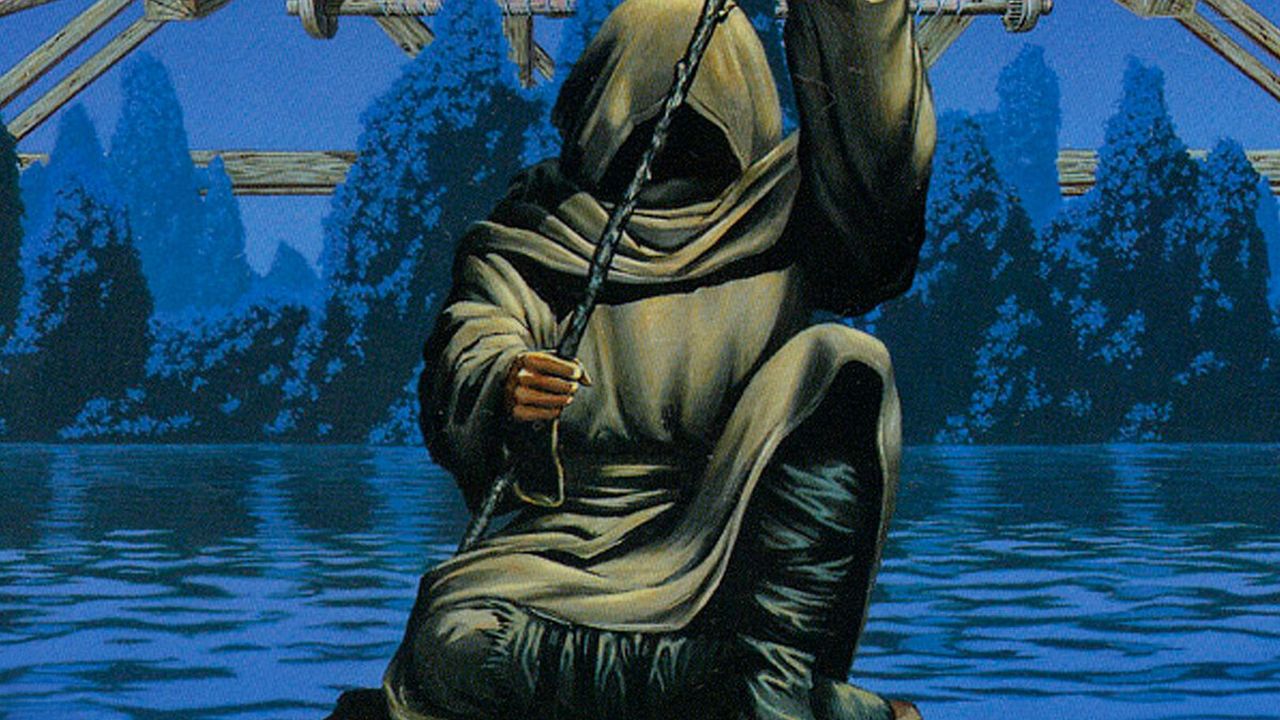
RETRO – Loom is far more than a video game remembered from childhood. Thirty-five years after its release, it remains such a strange exception in the history of graphic adventure games that it is difficult to fit into any single category. Among LucasArts’ legendary creations, this is one of the most personal and original works, driven not by the usual big creative names but by Brian Moriarty’s singular vision.
It may be the delicately woven structure of its story, the completely unique interface, or the almost inexplicable atmosphere that permeates the entire game, but Loom has always stood apart from the crowd of graphic adventure games. Its style did not consciously seek to break away from established formulas, as, being one of LucasArts’ earliest titles, the very idea of a “standard” had not yet truly existed. It was simply different.
As a child, with inexperienced eyes but an open imagination, I could already feel this difference. Whenever I return to the various locations of Loom, I am overcome by a feeling that would be unfair to dismiss as mere nostalgia. This runs far deeper. This game fundamentally shaped my ideas about fairy tales and the fantasy genre.
The Guild of Weavers, who not only create garments but weave reality itself through magic while maintaining the order of the universe, remains one of the most brilliant ideas in video game history for me. A concept brimming with immense potential. There was undeniably something entirely different about Loom. And that difference did not stem from a mechanic or a technical trick, but from one person: Brian Moriarty.
“I was fascinated by the possibilities. What if we made the programming and storytelling of these games far more sophisticated? What if we packaged them in a box and sold them like books?” Moriarty once said.
His career took shape at Infocom after a stint at ANALOG Computing, where he joined the studio and created his most renowned works: Wishbringer, Trinity, and Beyond Zork. These text adventures relied solely on the written word and the player’s imagination, and they served as direct precursors to Moriarty’s later move toward graphical adventures.

A Call from Skywalker Ranch
A single phone call changed everything in Moriarty’s life. He received a job offer from a distant place in California, Nicasio, from Skywalker Ranch. Infocom was a respected company, but nothing could compete with receiving a business card bearing the Lucasfilm logo, working in a private office with three different computers, and having a full development team at one’s disposal – including Ron Gilbert.
All this while being able to walk across George Lucas’ property and even hold the actual Holy Grail prop from Indiana Jones and the Last Crusade. Yet what truly struck him were two rules spoken by Steve Arnold, head of Lucasfilm’s games division.
“We have two rules. First: don’t lose money. Second: don’t embarrass George.”
Those two sentences ultimately meant one thing: freedom. A kind of creative freedom Moriarty felt was increasingly absent at the more traditionally minded Infocom, and which he sought every day of his life.
One day, while wandering through one of the Ranch’s outbuildings, the Barn, and thinking about his next fantasy project, he stumbled upon a pile of technology magazines. One cover featured futuristic circuit patterns and a strange word: LOOM.
The word carries multiple meanings. It can refer to a tool used for weaving threads, but as a verb, it can also signify a threatening, ominous approach. The name was born, and with it the idea that led Moriarty to the story of the Guild of Weavers.
A loom that tells the history of the world. A society organized into guilds. Weavers who create magic. Even decades later, Loom remains a peculiar exception within the LucasArts catalog, especially considering that the studio would later build its adventures almost entirely around humor.
The myths of Loom are not rooted in Nordic fantasy traditions but draw far more from Greek and Roman mythology. One of the best examples is the name of the Council that rules the Guild of Weavers: Clotho, Lachesis, and Atropos – the same names as the Moirai, the goddesses who weave the thread of human fate.

A Cassette That Tells the World’s Story
Today, we return to Loom with different eyes. It is easy to notice that the story and puzzles are short and simple, yet the core idea holds far greater potential. That is precisely why it is difficult to talk about Loom’s story without revealing too much. Moriarty, however, had already thought of this.
The original release included a special extra: a cassette that, in many countries – including Spain – was never released. This was the Loom Audio Drama. Thirty minutes of audio in which Mother Hetchel, an elderly weaver, tells Bobbin Threadbare the origins of the world, the guilds, and past events.
This audio drama serves as an ideal entry point into the world of Loom without spoiling the experience of discovery within the game itself. In fact, it can also reveal new details for those who have already completed the game. It is no coincidence that many explicitly recommend listening to the cassette before playing.
According to the world’s lore, two ages and two Shadows preceded the present. The Age of the Great Guilds brought prosperity to humanity. People’s thirst for knowledge was boundless, and they sought to dominate nature through industry. Progress, however, came hand in hand with arrogance.
Rivalry between the guilds escalated to the point where each craft formed its own organization, building vast cities of knowledge where they jealously guarded their secrets. There was only one guild that desired neither power nor politics: the Weavers.
Their community was small and closed, organized by birth. Their garments and fabrics were admired worldwide, but over time their craft transcended the material world. The Weavers began to work magic with light and music, reshaping reality itself.
Fear from the other guilds eventually forced them to retreat to a mysterious, fog-shrouded island named Loom. When the threat of the Third Shadow emerged, children of the guild were born sick or dead.
Lady Cygna then turned to the Council, requesting permission to use the Great Loom. The Council refused. Cygna secretly wove a gray thread, from which a child was born. When Atropos discovered her deed, Cygna was exiled, and the child was raised by Mother Hetchel.

A World Not Told by the Game
Today, replaying Loom is particularly fascinating. Without guidance, it is easy to get stuck, but in the 1990s this was natural. Players sat in front of the screen with pencil and notebook. In the case of Loom, they did not jot down items, but spells.
The game broke away from verb-based interfaces. Spells consisted of patterns of four musical notes. Playing a pattern in reverse produced the opposite effect, while palindromic melodies worked identically in both directions.
That is why Loom is not something you simply play, but something you discover. The player first learned the notes, then understood their effects through experimentation. The difficulty modes reinforced this further: in expert mode, one could rely solely on sound and color.
Many fans consider this the most authentic way to experience the game, as it perfectly mirrors Bobbin’s learning process. The Weavers create magic solely from light and sound, and expert mode forces the player to do the same. Moriarty believed in this so strongly that he even hid extra scenes for those who chose this mode.

An Adventure Game That Does Not Explain Itself
As mentioned earlier, Loom can cause no small amount of frustration. If the player does not learn – or write down – the spells and their reversed versions, nothing and no one will later help recall them. Unlike other interfaces, patterns are not saved. If you later need to turn gold into straw or paint white green, you had better come prepared.
This may seem like a minor drawback, yet Lucasfilm’s – and later LucasArts’ – core philosophy was always to avoid dead ends at all costs. These principles were already laid out in the design documents for Zak McKracken and later appeared in the manuals of nearly every LucasArts game. This concept deliberately positioned itself against the other major player of the era, Sierra.
The rules were clear: do not let the player die, do not trap them in unwinnable situations, and above all, avoid parser-based interfaces that require typing commands. Such systems were notorious for driving players to madness.
Moriarty, however, does not absolve himself of all responsibility. He acknowledges that certain decisions in Loom artificially extended the game. These included the long delay between a puzzle and its solution, or the inclusion of a specific maze reminiscent of similar sections in Indiana Jones and the Last Crusade or even The Legend of Kyrandia.
Despite this, anyone who has ever hit a dead end in a Sierra game or wandered mazes for hours is more likely to forgive these choices. These solutions were trademarks of the era. Moriarty himself admits that such design elements often served to justify the 40-dollar price tag – well over 70 euros today – and to stretch playtime beyond twelve hours.
As can be seen, justifying the price through length rather than quality is far from a modern phenomenon. It was already a defining consideration during the golden age of graphic adventure games.
It is worth examining this mindset further, as another debate that remains relevant today already preoccupied developers back then: whether players actually finish games. The irony is obvious. Audiences demanded long games to justify the price, yet the proportion of players who truly reached the end was surprisingly low.
Unsurprisingly, the most successful and popular games were those that players actually completed. Going against this trend, Moriarty deliberately designed a short game. For Loom, he envisioned a playtime of roughly three hours.
The manual once again included the developer’s philosophy – a rare and noteworthy gesture – distilled into a few core principles: encouraging imagination, avoiding frustration through unnecessary length or dead ends, and above all, ensuring that Loom could be finished. Moriarty firmly stood by these principles, even if the game’s simplicity and brevity did not escape criticism.

A System That Trains the Ear
Despite all this, Moriarty created a unique gameplay system that both sparks curiosity and sharpens the player’s hearing. Discovering spells is not purely a logical process, but a perceptual one. Some spells may even vary slightly between players, likely to discourage easy sharing of solutions, though these differences are minimal.
Moriarty’s original concept was not primarily based on musical notes, but on gestures. At the time, the mouse was one of the most significant technological innovations, and he envisioned a system in which mouse movements – much like the drawing mechanics later seen in Okami – would summon magic.
This idea ultimately had to be abandoned, as one of the studio’s core requirements was that the game run on computers that did not yet support a mouse, where the cursor could only be controlled via the keyboard. This compromise prevented the realization of a gesture-based system.
If there is one element of Loom that has burned itself permanently into my memory, it is the music. It is remarkable how easily we relegate sound to the background, even as its impact remains undeniable. I still feel this today when playing Final Fantasy VII Remake: no matter how detailed Midgar appears, it is the music that gives the world its true weight.
The same holds true for Loom, only much earlier in the medium’s history. The game’s artistic direction and animation – shaped by Mark Ferrari as illustrator and background artist, and by Gary Winnick as designer, illustrator, and animator – were revolutionary for their time.
An extraordinary level of detail was achieved despite extremely low resolution, complemented by close-ups and cinematic transition scenes. This quality was also reflected in one of the most beautiful cover artworks in video game history, painted by Ferrari himself.
Before examining these elements in greater depth, however, one aspect deserves special attention: Loom’s unique sound design.
Whenever Bobbin cast a spell, he raised his arm, and the staff rang out with each note. Certain sequences, such as Open or Transcendence, remain vivid in my memory to this day. What truly lingered, however, was the sound that followed each attempt, paired with a blue or red visual cue indicating success or failure.
This short motif – like the entire soundtrack – was built from seven excerpts of Tchaikovsky’s Swan Lake. Moriarty’s favorite composition had a profound influence on the game, giving it its dreamlike, suspended atmosphere. The visual style, inspired by Disney’s Sleeping Beauty, likewise draws from a Tchaikovsky ballet.

When Technology Was Still a Limitation, Not a Solution
At the time, I never had the opportunity to play Loom under ideal conditions. I had to make do with the PC Speaker, the computer’s internal speaker, which attempted to reproduce sounds through various frequencies of often irritating beeps. Meanwhile, I could only imagine what the AdLib or the legendary, almost mythical Roland MT-32 must have sounded like.
In the case of Loom, these expensive sound cards were truly capable of interpreting the MIDI soundscape through which George Sanger – better known as The Fat Man – adapted Swan Lake. A special patch was even created to take advantage of the Roland’s advanced synthesis.
Behind Sanger’s unusual appearance stood not only an excellent composer, but a true genius of translating orchestral music into computer sound. His dedication went so far that he attended a performance of Swan Lake with a computer on his back, meticulously recording the rhythm of each section.
For me, all of this only became truly audible much later, during the Sound Blaster era. That was when I fully understood how much work and creativity lay behind the sound of Loom and other graphic adventure games. One thing, however, was still missing: the Audio Drama, which existed only in English and was produced with extraordinary care.
Moriarty had access to Skywalker Ranch’s finest production resources in the Sprocket System building, now home to Skywalker Sound and THX. Professional British actors were hired for the recordings, and the sessions were conducted in an unconventional manner: instead of separate studios, all actors were gathered together, either indoors or outdoors, depending on the scene’s requirements.
Loom represented a true paradigm shift in both sound and graphics. Lucasfilm games at the time used CGA and EGA systems, offering just four or sixteen colors. The 256-color VGA standard had not yet become widespread, demanding genuine ingenuity to suggest depth.
Mark Ferrari began experimenting with dithering during work on Zak McKracken. This technique creates optical color blending through the fine alternation of two colors, allowing the human eye to perceive shades not actually present in the palette. It broke the tyranny of sixteen colors.
However, this technique encountered another form of tyranny: programmers claimed it was impossible to compress this amount of information onto disks in an acceptable way.

A Quiet Technical Rebellion
Ferrari was frustrated, knowing with certainty that the path he had chosen was the right one. As he later recalled – as quoted by CGM – one morning after finishing his work on Zak McKracken, he sat down and created a panoramic image: a sunset with a crescent moon, stars, and oak-covered hills, all richly detailed in EGA graphics using the dithering technique.
He then left the image on his monitor as a silent protest and went to lunch. When he returned an hour later, he found Steve Arnold and Ron Gilbert deep in a heated debate about why such a solution would be impossible to compress. Within two months, the solution was found, and Loom became the first game to fully benefit from this breakthrough.
With this, Lucasfilm entered a new technological era led by Loom. This direction carried forward into another classic, The Secret of Monkey Island, until 256 colors finally became standard.
Beyond the technical achievements, the artistic concept was heavily influenced by Disney’s 1959 animated film Sleeping Beauty, particularly the iconic visual style of Eyvind Earle. The film’s compositions, color usage, and animation techniques left a deep impression on Moriarty, Winnick, and Ferrari. A glance at the color palettes or certain characters and locations – such as the resemblance between Chaos and Maleficent – makes these inspirations unmistakable.
There was, however, one more name without which the visual picture would be incomplete: Steve Purcell. Best known for Sam & Max, he was responsible for character designs, animations, illustrations, and the close-up portraits that periodically interrupted the story. It was a general rule that whenever spectacular animation was needed, Purcell was called. Bishop Mandible’s unforgettable and anything-but-subtle scene also bears his signature.
From here, only one step leads to one of Loom’s most intriguing debates: the question of versions. EGA or VGA. Sixteen colors or two hundred and fifty-six. At first glance, the choice may seem simple, but reality is far more nuanced, as the VGA version introduced numerous changes that ultimately disrupted the unity of the original work.

When More Colors Meant Less
Purcell’s striking character close-ups, which lent enormous personality to the adventure, vanished in this version, along with portions of the dialogue. Without them, for instance, we would never learn that Cobb, Bishop Mandible’s assistant, is actually the same pirate who advertises the game in a famous Monkey Island scene.
Certain situations also lost their emphasis. One such example is the final autumn leaf scene, originally designed as a kind of tutorial for learning mouse controls. With the new color palette, these subtle details faded into the background.
This is why many fans consider the FM-TOWNS version to be the best. It offers VGA graphics while restoring the cut scenes, though at the cost of losing voice acting and relying on rather disappointing sound effects.
It is not difficult to guess which version Brian Moriarty prefers. The EGA version – the one he himself worked on. In an Arcade Attack interview, he put it this way: “Almost every creative decision in Loom was shaped by the hardware limitations of the time. More pixels and more colors only serve to highlight those limitations. The 256-color updates that followed the original EGA version make this painfully clear. They not only make the original design look dated, but also obscure certain gameplay mechanics. The version currently sold on Steam and other digital stores is a mutant. It is based on the 1992, voiced, 256-color CD release, from which nearly a third of the dialogue is missing. Horror. Horror.”
Moriarty’s criticism is not unfounded. Nearly a third of the VGA version’s dialogue was indeed cut, resulting in the loss of crucial explanations and narrative elements from a game that was already fundamentally story-driven.
This was the result of another limitation of the era: not file size per se, but the CD-ROM format’s notorious 74-minute maximum length. This forced LucasArts to drastically cut the script. The task was assigned to science fiction writer Orson Scott Card.
The music did not escape unscathed either. Entire guild areas fell silent in a game where the soundtrack was an essential component. The entrance to the Blacksmiths’ Guild is a particularly telling example: in the original version, the player is greeted by magnificent music, while the VGA version offers only the endless hammering of smiths.
Naturally, the VGA version also brought improvements, and some backgrounds did indeed look better, though this is largely a matter of taste. Overall, however, the technological leap represented by Loom is best understood through the EGA version.
When I listen to Moriarty’s talks or read interviews from the past three decades, I sense a hint of bittersweet regret in his words. He was a brilliant creator, but his career did not unfold as fortunately as that of some of his contemporaries in the world of graphic adventure games.
Ron Gilbert, creator of Maniac Mansion and The Secret of Monkey Island, went on to direct projects such as The Cave and Thimbleweed Park. Tim Schafer built an extraordinarily productive career with titles like Day of the Tentacle, Grim Fandango, and Full Throttle. Moriarty’s path took a different direction.

Freedom Comes at a Price
To this day, Brian Moriarty remains an enthusiastic advocate of text adventure games, believing that the video game industry has sacrificed vast interactive potential on the altar of spectacular but extremely costly visuals. In his view, these production costs inevitably limit the depth of interaction.
He claims to still write such games, though he has no intention of ever releasing them commercially. While he says he met the most creative and fascinating people of his life at Infocom, he has never hidden the reason for his departure: freedom.
From a company founded by MIT-trained geniuses, he moved to the LucasArts giant, where – somewhat ironically – he truly found that freedom during the development of Loom. His next project, The Dig, was far less fortunate.
The science fiction adventure game that sparked Steven Spielberg’s interest in video games went through three different attempts before finally being released under the direction of Sean Clark. Moriarty, however, exited the project during its second iteration.
Though he has never spoken about it entirely openly, his statements outline a small personal tragedy. In an interview with Adventure Classic Gaming, he said: “The development of The Dig coincided with a period of rapid transformation at LucasArts. The first SCUMM games, including Loom, were made by very small teams, with two or three programmers and a handful of artists. We started with only a rough story outline and invented the details along the way. As costs and teams grew, this approach became unsustainable. Design, code, and art had to be locked down in advance, discussed in meetings, tracked in spreadsheets. The Dig began under the old method but was completed under the new one. The transition was extremely difficult, and there were casualties. I was one of them.”
In Moriarty’s reflections, the reception of Loom often carries a bittersweet tone. The game was short and simple compared to other graphic adventures, but he never considered that a flaw. Brian wanted everyone to be able to finish the game.
He knew that players’ favorite titles were those they actually completed, a fact supported by research conducted by Mike Dornbrook, Infocom’s vice president of marketing. In opposition to the increasingly dominant hardcore gamer mentality, Moriarty chose accessibility.
Some of the criticism was openly malicious, and even competitors mocked him. In Space Quest IV, for example, a game appears advertised as “the easiest-to-finish title ever made.” Its name: BOOM. Its creator: a certain Morrie Brianarty.
A Game That Does Not End, but Lives On
Despite its simplicity, Loom remains a magical creation to this day. It projected a visual style and atmosphere rarely seen at the time of its release, while also raising the technological bar. Its story and mechanics continually suggest that far more potential lay within the game than what was ultimately shown. Inevitably, this raised the question of sequels.
Brian Moriarty spoke on several occasions about his plans. According to his vision, a second installment, FORGE, would have explored the world of the Blacksmiths’ Guild through the eyes of Rusty, a character already present in the original game. A third episode, THE FOLD, would have focused on the Shepherds’ Guild, concluding the Great Guilds Trilogy.
These ideas, however, never progressed to official production. According to Moriarty, he was busy with other projects at the time, and there was simply no significant interest in continuing the story – at least not in an official capacity.
A few years ago, however, a group of fans decided to revive this idea and began developing FORGE. The project continued to feature Rusty as its protagonist and introduced new guilds, such as miners, lumberjacks, florists, and winegrowers. Development has since stalled: no updates have appeared since 2015, although the first chapter remains playable on the project’s website.
Today, Brian Moriarty is a professor – yes, Professor Moriarty – in the Interactive Entertainment and Game Development program at Worcester Polytechnic Institute. Freedom remains central to his thinking. He believes that if an author is concerned with what will or will not work for their audience, they are no longer exercising true creative freedom.
During his GDC 2015 talk, Moriarty visibly grew emotional when recalling the moment he wrote the complete backstory of the Weavers and the other guilds. The entire process began with the sight of a single magazine cover. For him, creation does not come from a muse or a sudden flash of inspiration, but from a kind of premonition – an intuitive recognition.
It is like slowly recognizing the final shape of a garment while weaving it. That is the true mystery of Loom. A game not born from a predetermined plan, but from its creator’s intuitive discovery, encouraging the player to do the same. Not to learn mechanics through explanations, but by trusting their own senses.
Learning to weave spells here becomes a symbol of coming of age. Ultimately, Loom is an inspiration that strives to reach the state that gives its name to the game’s first and last spell: transcendence.
-theGeek-
Source: 3djuegos






![Vampire: The Masquerade - Bloodlines – Prepare for Your Final Sunset! [RETRO-2004]](https://thegeek.games/wp-content/uploads/2025/10/theGeek-Vampire-the-Masquerade-Bloodlines-302x180.jpg)


Leave a Reply