
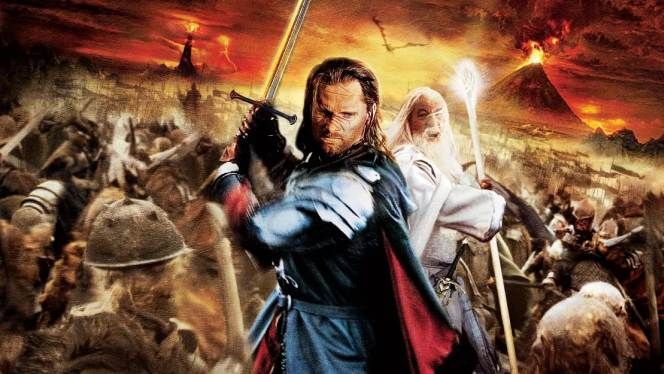
MOVIE NEWS – The scene in The Lord of the Rings featuring 60,000 skulls wasn’t created with CGI: someone hand-painted them and placed them individually. One of the sequences Peter Jackson invented for The Return of the King ultimately proved to be one of the most challenging.
I don’t mean to make you feel old, but we’ve just entered 2026, and this coming December, The Return of the King will be 23 years old. Even so, it’s always worth revisiting The Lord of the Rings and looking back at the films that revolutionized epic fantasy cinema, especially what happened behind the scenes. Do you remember the scene at the end of the trilogy where Aragorn, Legolas, and Gimli are almost swept away by a wave of skulls?
Peter Jackson wasn’t exactly like Nolan in rejecting CGI outright, but in this case he did just that: beyond the environment, there were no visual effects. Instead, more than 60,000 hand-painted skulls were used and placed for a sequence lasting just 52 seconds.
That’s also why mentioning the extended editions isn’t arbitrary. If you’ve only seen the theatrical version, this scene will come as a surprise, as it’s part of the extended cut of The Return of the King, specifically the story arc that takes Middle-earth’s most peculiar trio to the Paths of the Dead. After speaking with the King of the Dead and his spectral army, and proving Aragorn a worthy successor to Isildur, the sequence is cut in the theatrical version, and we don’t see them again until the Battle of the Pelennor Fields.
In the extended version, however, shortly after the King of the Dead laughs at Aragorn’s plea, there are still two scenes that fill in the gap until the landing at Osgiliath. The second makes it clear how they obtain the ships to reach the port and, incidentally, eliminate the Corsairs of Umbar. The first is the one at the center of this discussion. After Aragorn says, “I am heir of Isildur, fight for me and I will see the oath fulfilled, what do you say?”, the wights vanish, seemingly ignoring his plea and leaving viewers with questions.
Next, the mountain cracks open and thousands of skulls erupt from its walls, nearly dragging the trio into the abyss. The scene concludes with a dramatic glimpse of the pirate fleet arriving in Gondor, seemingly ending the mission in failure – at least as Jackson originally intended.
In fact, this sequence, with Aragorn on his knees contemplating defeat, appeared in one of the film’s trailers, but it didn’t make it into the theatrical release. As a result, anyone who only watched the original 3-hour-and-21-minute version missed it. While the scene doesn’t add much, disrupting the pacing of the plot and diminishing the impact of seeing the Dead disembark at the end of the battle, it still serves as another example of the saga’s handcrafted spirit.
The skulls in The Return of the King aren’t in the book, but they were a nightmare to film
According to WETA Productions’ behind-the-scenes featurette (via MiddleEarthUpdates), the initial plan was to use just 200 skulls and replicate the rest using CGI, similar to what was done with the orc hordes stationed at the gates of Minas Tirith. However, as the scene was rehearsed, the number grew exponentially in order to give weight and realism to the avalanche of skulls: first 2,000, then 6,000, then 10,000 and 20,000, finally reaching 60,000. Each skull was hand-painted, making the sequence one of the most laborious and monotonous tasks of the entire production.
To make filming feasible, the team combined life-size skulls with miniature versions, using visual tricks such as shooting wider sequences with scale models and intercutting them into the live-action footage to create a convincing sense of scale. Even so, filming was extremely complicated, especially the sequences with miniatures. The skulls had to fall at a very specific angle to be believable, but the structure was so unstable that any vibration could cause a total collapse.
Furthermore, after each take, the crew – and the actors themselves – had to collect the skulls one by one and reposition them by hand. Over time, this even led to jokes, with the actors tossing them into the sacks from various distances as if it were an impromptu basketball game.
The curious thing is that, although the scene adds nothing to the main narrative, it was entirely Jackson’s invention for the film. In J. R. R. Tolkien’s novels, the Path of the Dead has a very different tone. Aragorn travels there accompanied by Gimli, Legolas, and the Grey Company, composed of 30 rangers from the North. Surrounded by unseen presences and a constant sense of terror, Aragorn raises the banner of Gondor and calls upon the Dead for aid, which is followed by the slaughter of the Corsairs.
There are no physical avalanches of skulls, but rather an atmosphere of death, betrayal, and guilt that underscores the weight of the Mountain Men’s broken oath. Jackson’s adaptation transforms that intangible horror into an explicit visual experience, sacrificing literal fidelity for cinematic impact. More importantly, the skull sequence has become one of the symbols of the trilogy’s spirit: a work that championed craftsmanship and creative ambition.










Leave a Reply