
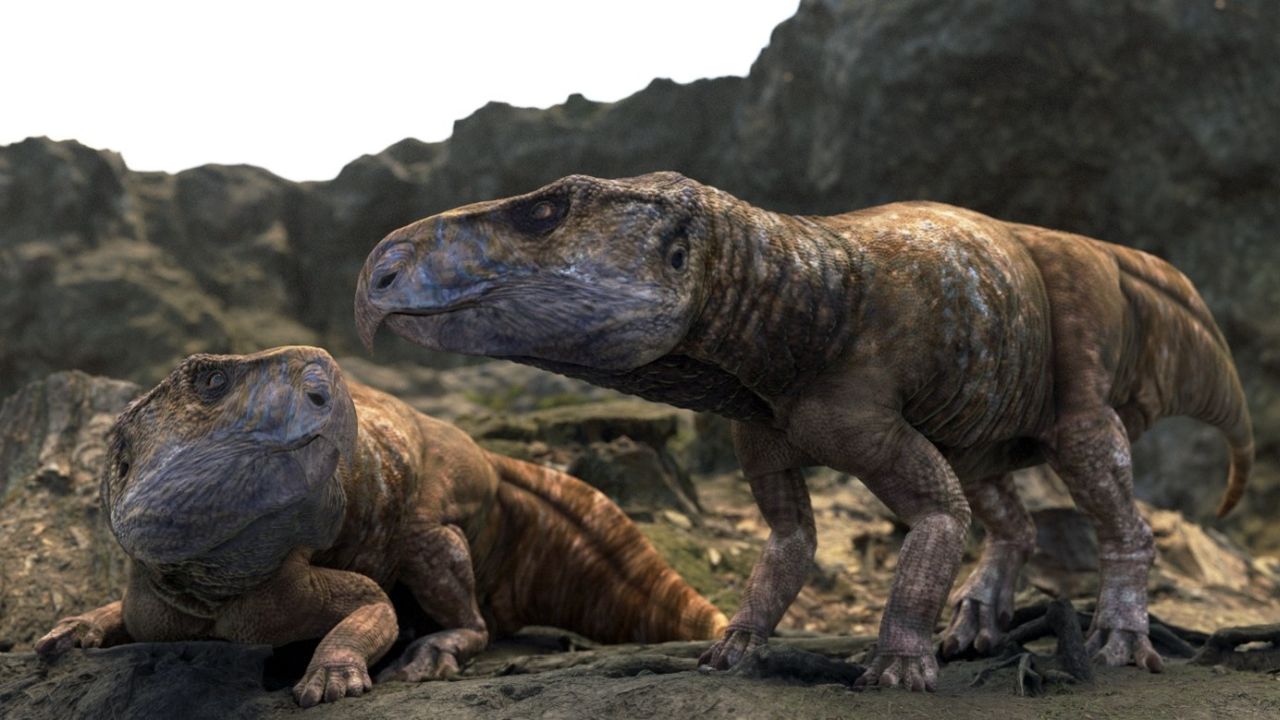
After twenty-five years of continuous research, the Iharkút dinosaur site has delivered another major scientific breakthrough. A newly discovered skull from the area does not simply clarify the identity of a controversial species, but fundamentally reshapes how scientists understand dinosaur evolution across Eurasia.
The Iharkút fossil site has spent a quarter of a century redefining what we know about Europe’s Late Cretaceous ecosystems, yet the latest discovery stands apart from all previous finds. Thanks to this newly unearthed skull, researchers have now demonstrated beyond doubt that Ceratopsia dinosaurs – frilled and horned herbivores – lived in Europe during the Cretaceous period.
Ceratopsians, the group that includes Triceratops and other frilled dinosaurs, were previously considered extremely rare in Europe. In contrast, they were widespread in Asia and North America, leading to the long-held assumption that Europe lay outside their evolutionary range. The new Iharkút material clearly shows that this assumption was incorrect.
Detailed analyses confirm that Ajkaceratops belongs within the Ceratopsia. This dinosaur lived around 85 million years ago, at a time when Europe was not a single landmass, but a chain of islands scattered along the margins of the Tethys Sea. A new study published today in Nature further reveals that several rhabdodontid ornithopod dinosaurs, previously regarded as relatives of Iguanodon and known only from Europe, were in fact Ceratopsians as well.
The study is led by Susannah Maidment (Natural History Museum, London, United Kingdom) and Attila Ősi (Eötvös Loránd University, Budapest, Hungary). Together with their international research team, they have resolved one of the most significant long-standing questions surrounding Europe’s herbivorous dinosaurs.
Although Ceratopsians were common in North America and Asia, evidence from Europe had been limited to a handful of poorly preserved, fragmentary, and often controversial fossils. The recent discovery of new Ajkaceratops material prompted researchers to reassess the species. Since its first description in 2010, Ajkaceratops had remained taxonomically contentious, with some scientists classifying it as a frilled dinosaur and others aligning it more closely with Iguanodon, albeit with ceratopsian traits.
By combining the newly discovered skull with CT imaging and repeated analyses of evolutionary relationships, the research team reached a definitive conclusion. They determined that Ajkaceratops was not only a true Ceratopsian, but that Mochlodon, previously described from Iharkút as a rhabdodontid, belonged to the same species. The analyses also showed that several other dinosaurs long classified as rhabdodontids had been misidentified and were in fact Ceratopsians.
Confirming the presence of Ceratopsians in Europe fills a major gap in understanding how these dinosaurs dispersed across the Northern Hemisphere. The findings also encourage a broader re-evaluation of the distribution and lifestyles of Europe’s Mesozoic herbivores.
The Importance of Museum Collections
The authors emphasize that the study highlights the crucial role of museum collections. By applying modern analytical techniques to existing specimens, scientists can reassess long-held interpretations and uncover new insights into dinosaur evolution.
This process contributes not only to a deeper understanding of individual species, but also to a more complete picture of the history of life on Earth.
Source: 3djuegos



![Altera: Even Penguin Soldiers Could Be Out to Get Us! [VIDEO]](https://thegeek.games/wp-content/uploads/2026/03/theGeek-Altera-302x180.jpg)
![Lizard State: If There’s No Sam Fisher, Indie Devs Fill the Gap! [VIDEO]](https://thegeek.games/wp-content/uploads/2026/03/theGeek-Lizard-State-302x180.jpg)








![Altera: Even Penguin Soldiers Could Be Out to Get Us! [VIDEO]](https://thegeek.games/wp-content/uploads/2026/03/theGeek-Altera-300x365.jpg)
![Lizard State: If There’s No Sam Fisher, Indie Devs Fill the Gap! [VIDEO]](https://thegeek.games/wp-content/uploads/2026/03/theGeek-Lizard-State-300x365.jpg)
Leave a Reply