
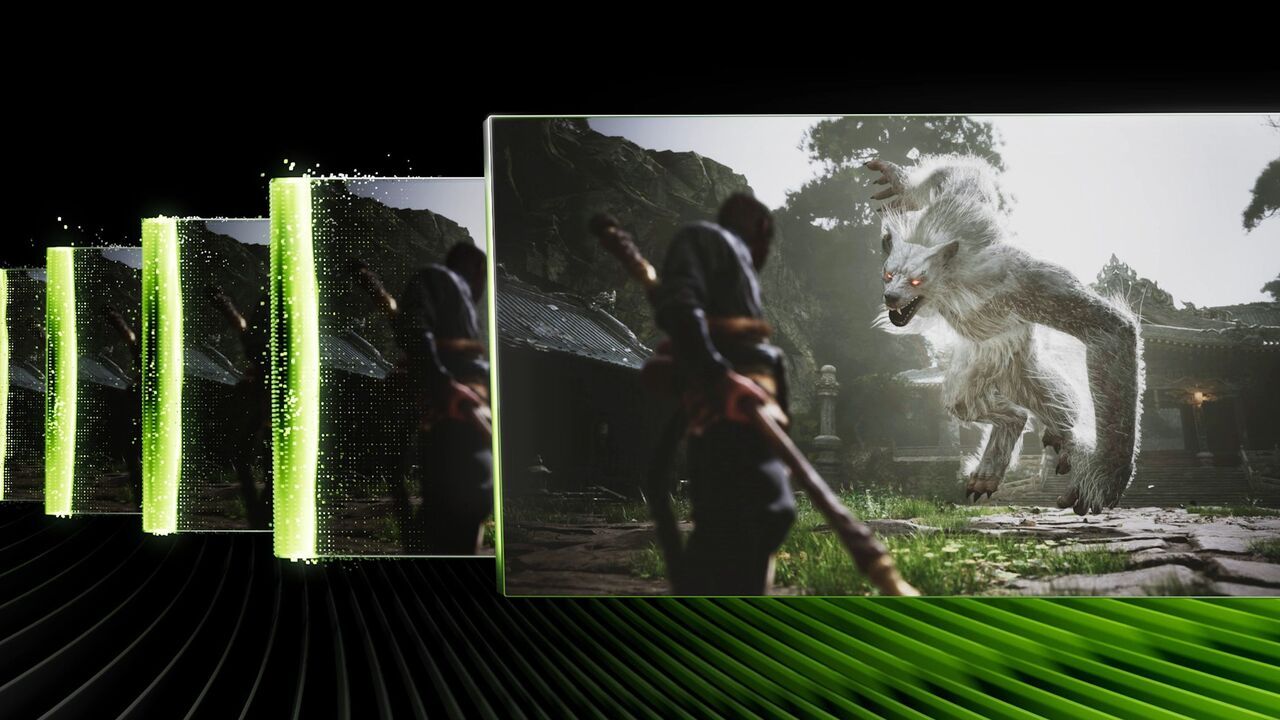
TECH NEWS – At CES, Nvidia unveiled a new level of DLSS technology featuring dynamic multi-frame generation.
The company released the second-generation Transformer model of its DLSS Super Resolution algorithm, which enhances resolution. Initial tests showed that older GeForce RTX graphics cards struggle to cope with Nvidia DLSS 4.5, which was trained on a much larger and more accurate dataset requiring five times the computational power. Fortunately, users of these cards can still use older models, such as CNN or the first-generation transformer model, which run games much faster. NVIDIA DLSS 4.5 is not really about increasing speed but ensuring the highest possible quality. It proves its power through a deeper understanding of scenes and a smarter use of the game engine’s pixel patterns and motion data. This results in improved lighting, sharper images, and better motion clarity, as demonstrated in an early comparison with Red Dead Redemption 2.
In Black Myth: Wukong, the previous resolution scaling algorithm operated in logarithmic space to reduce flicker. However, this resulted in muted lighting, clipped details, and broken shadows in high-contrast scenes. DLSS 4.5 Super Resolution operates directly in linear space, which is used by games. This allows it to preserve the full color range and details of neon signs and bright reflections. This could indirectly lead to HDR gaming under Nvidia DLSS 4.5. The other half of DLSS 4.5, Dynamic Multi Frame Generation, will not be publicly available until spring. In addition to enabling 6X mode (five extra frames in addition to the actual frame), the update introduces an intelligent system that targets the maximum refresh rate of the display.
In the CES demo of Obsidian’s The Outer Worlds 2, the system was set to the 240 Hz refresh rate of the available 1440p display. “If you went to a scene where it went up to 300 FPS, you’d see it lower the multiplier because you’d be generating frames that would just be thrown out. This is a smarter way to use it. If you approach one of the windows, the scene will become much brighter. You’ll see your frame rate increase, and then it’ll start lowering the multiplier because it’ll know you don’t need to generate that many frames. If you go over here, your frame rate will drop because this is a more intense scene, so it’ll start raising the multiplier again,” said an Nvidia spokesperson.
Nvidia also promises improved frame timing and greater accuracy in rendering in-game user interfaces, as shown in the video. The former will be particularly important, although we will have to wait for the public release to test it.
Source: WCCFTech















Leave a Reply