
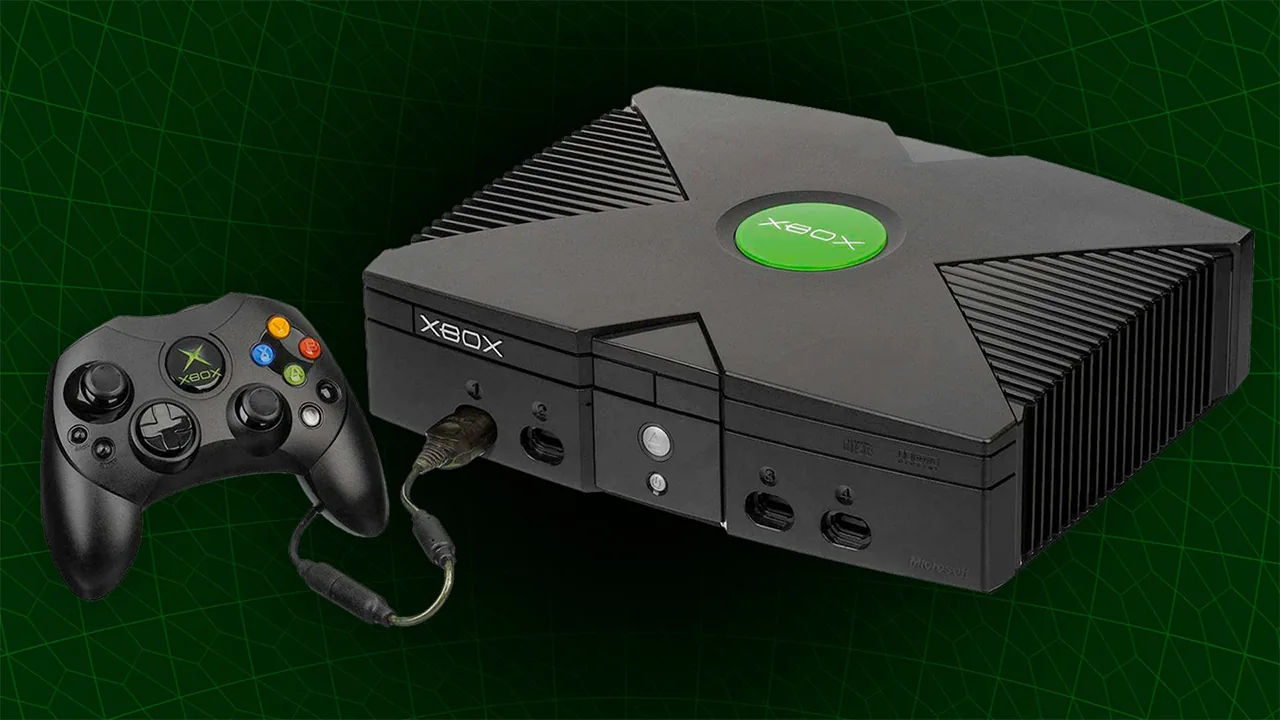
RETRO – Twenty-five years ago, Microsoft pulled off something that truly felt unlikely at the time: it stepped into the console business and left us with a machine that’s still remembered as one of the era’s best. Now we’re taking a look back at the hardware and the features that defined the original Xbox.
“This is an insult to me and all my work” – those were the blunt, hard-edged words Bill Gates, Microsoft co-founder, allegedly threw at the original Xbox development team when he learned the console wouldn’t be built on Windows (inside the company, the moment would later be remembered as the Valentine’s Day Massacre). In the end, it took the intervention of one of the people in the room to make everyone see the state of the console market at the dawn of the new millennium: if the Redmond company didn’t enter, Sony and its PS2 would remain essentially unchallenged. What they didn’t grasp at the time was the scale of the consequences that dropping the DirectX Box direction would have – and how heavily that decision would shape the company’s future.
The early years weren’t exactly a victory lap, either: even after launch there were bumps, swings in momentum, and plenty of internal uncertainty. Still, what remained was a genuinely interesting console that, almost quietly, laid down a number of cornerstones modern systems still build on, while also becoming home to franchises people truly loved. And with 2026 marking the console’s 25th anniversary, it’s time to talk specifically about the original Xbox: its hardware, and the unique calls that have continued to define the brand’s foundations to this day.
“X Marks the Spot”
We’ve touched on this in a previous retrospective, but it’s worth going back to. The goal of Xbox was to bring the PC’s multimedia capabilities into every living room, and in the process push Microsoft into that market. That objective grew out of PlayStation’s massive success and Sony’s messaging at the time: the Japanese company made it clear its next console aimed to dominate the entire home entertainment space. After a few failed negotiation attempts, those statements were taken as an attack by Microsoft – and they set in motion the machine that would eventually become the Xbox division.
Inside an original Xbox. The classic PC resemblance is immediately obvious – the most striking difference is what you see where you’d expect a conventional motherboard setup. || Image: iFixit.
To reach that goal, the developers accepted a hard truth: they needed a visible foothold in the industry, and what better way to do that than to lean on a sector with stronger hardware and deeper experience – the PC world. The team leading the project knew that if their console was going to stand out against everything else on the market, it had to import PC tools and features that could go toe-to-toe with what the PlayStation 2 offered. From the moment the PlayStation 2 launched in 1999, the work largely revolved around a single question: how do we put something on shelves that’s better, faster, smarter, and more appealing than that console?
Hardware With Personality
One quick look inside the original Xbox is enough to prove the “living room PC” line wasn’t just marketing. The console was built around DirectX 8.1 and development tools Microsoft had previously collaborated on with Sega during the Dreamcast era. But Xbox development moved at a brutal pace, driven by the company’s ambitions and its late entry into the sixth console generation. As a result, a significant chunk of the hardware wasn’t built from scratch in the traditional console way – it was sourced from existing products and then adapted to fit a home console’s needs. That’s what gave the Xbox such a distinct character for its time, often feeling closer to a PC than to a typical console.
Technical specifications: the original Xbox
| Main processor | Pentium III (Coppermine) at 733 MHz |
| Graphics processor | Nvidia NV2A (GeForce 3) at 233 MHz – 20 GFLOPS in floating point calculations |
| Memory | 64 MB DDR SDRAM at 200 MHz in a Dual-Channel configuration |
| Storage | 8-10 GB hard drive at 5,400 RPM |
| Audio | Nvidia MCPX with Dolby Surround support |
That PC DNA shows up in tangible details like the optical drive and, especially, the hard drive – a trailblazing move for consoles at the time that would later pay off big for the system’s online capabilities. The CPU is another clear example, essentially a revised Intel Pentium III with relatively minor tweaks to frequencies and form factor. And then there’s Nvidia’s NV2A, a chip derived from the company’s GeForce 3 line. Specs like these were almost unthinkable in a console back then, and they genuinely surprised people at the time – on paper, the first Xbox sat closer to a mid-range PC than to any of its direct competitors. That became one of the console’s defining traits.
Laying the Groundwork for Online Console Gaming
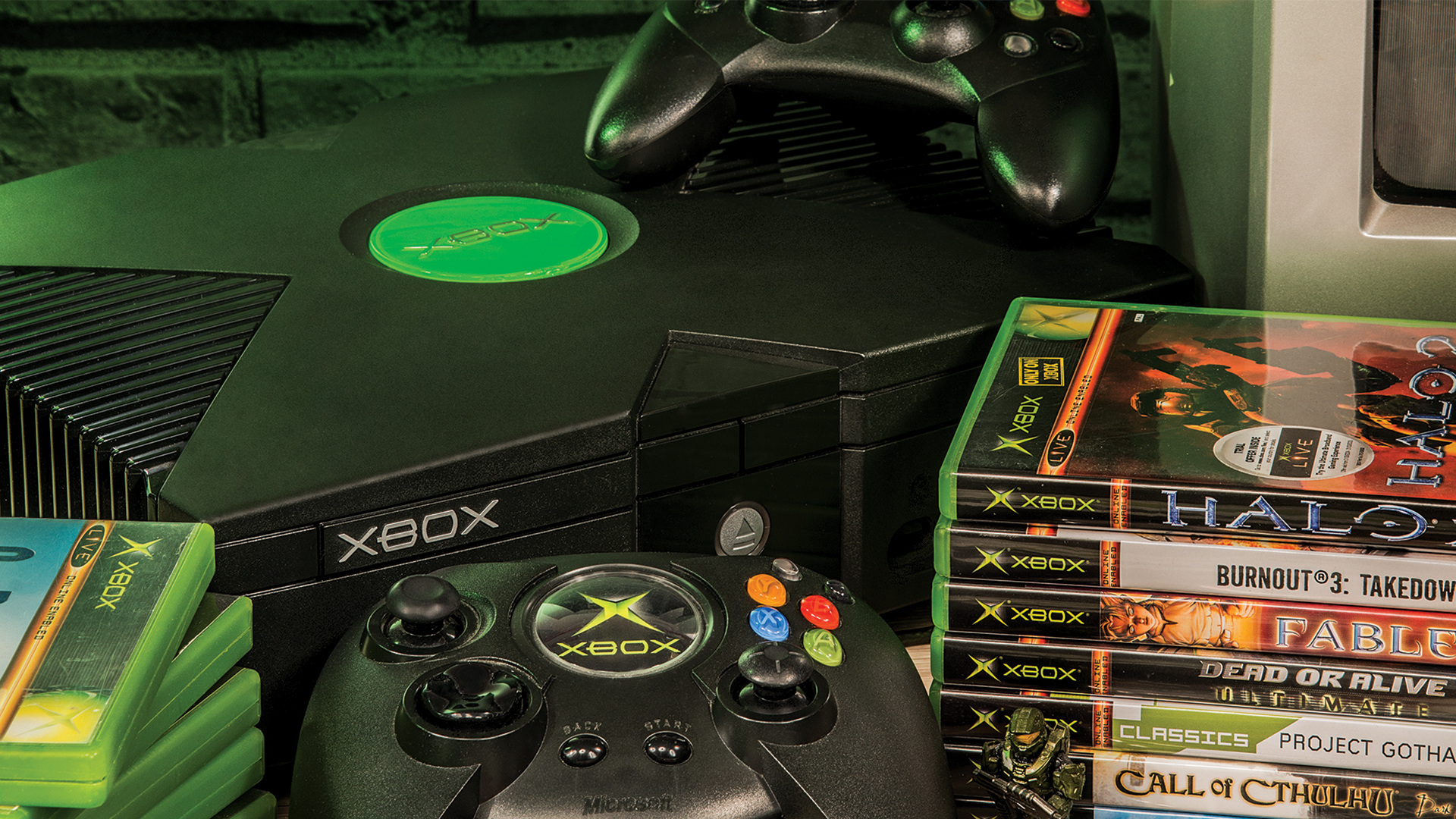
The Xbox wasn’t the top-selling console of its generation, but it left a deep mark on how later generations would standardize services and design expectations. It shipped with an integrated 100 Mbit Ethernet connection, and Microsoft – a company built around software and services – used that to show why online gaming would become the next major leap for consoles. The concept had been explored earlier, including on systems like the Dreamcast, but Microsoft wanted to push it further, broader, and more aggressively. That became the console’s biggest strength and one of its clearest selling points: online play and online services at a time when none of it was truly established on consoles.
If you wanted to play online outside of PC, Xbox was effectively the only truly serious option – and that’s exactly where the American company put its focus. That effort produced Xbox Live, the name the service still carries today. The idea was straightforward: leverage Microsoft’s infrastructure to launch a platform that made online gaming more convenient and social. Voice chat, friends lists, and a number of features we now treat as standard across consoles trace back to this service as an early model.
Another notable step was Xbox Arcade, which arrived shortly before the generational jump to the Xbox 360. Arcade was essentially a streamlined console version of what PC users were already used to: a platform where you could buy, download, and play games directly on your console. Today that model is normal on every platform, and it had already proven its value on PC for years. In many ways, these services may have had the biggest long-term impact on the industry – and now we’re watching the concept evolve into more sophisticated offerings like Game Pass and PS Now.

A Catalog of Future Stars
As important as the hardware and the service layer were, every console is ultimately defined by its games – and the first Xbox was no exception. Its online component attracted a wave of titles that were built to take advantage of those features, and many of them were shooters with roots in PC. That landscape was supercharged by the arrival of Halo and Master Chief, which pushed the platform into the front row of big-budget action – a genre that would expand dramatically in the next generation. On top of that, several Sega games associated with the Dreamcast era also found their way to the console, helped along by the DirectX 8.1 environment and the ease of transition.
What stood out across many of those releases was how close they looked to mid-range PCs of the time. With Microsoft’s tools smoothing out the path, PC-to-console ports were easier to produce, and the console’s hardware gave those games the technical headroom to really shine. It wasn’t just that something “ran” – it was that performance and visuals often felt unusually strong within the console space.
What Problems Did the Console Face?
Even though the console found real success in the Americas, its reception outside the continent was noticeably cooler. The Xbox arrived late to Japan and Europe, landing in markets where the PS2 was already an outright sales phenomenon and had effectively taken control of the commercial landscape. Microsoft was fighting uphill against an established market that, in practice, revolved around a single platform. Underwhelming marketing in Europe and a poor reception in Japan both contributed to the system slipping under the radar in a lot of places.
Its biggest weakness was also tied to one of its greatest strengths: the hardware. The console really was more powerful than its rivals, but it was also more expensive – the launch price, for example, was $479. Plenty of players saw little reason to move to a pricier platform that didn’t yet have a built-in user base, so Microsoft had to introduce cost-cutting measures to bring the price down and boost sales – with mixed, and ultimately only moderate, results.
Still, the Redmond team took note of the original Xbox’s pain points. For its successor, it doubled down on what worked – services, games, and an online-first focus – then came back hard just four years after the first launch. That approach delivered the console that would become Microsoft’s most successful system to date.
-theGeek-
Forrás: 3djuegos







![Vampire: The Masquerade - Bloodlines – Prepare for Your Final Sunset! [RETRO-2004]](https://thegeek.games/wp-content/uploads/2025/10/theGeek-Vampire-the-Masquerade-Bloodlines-302x180.jpg)




Leave a Reply