
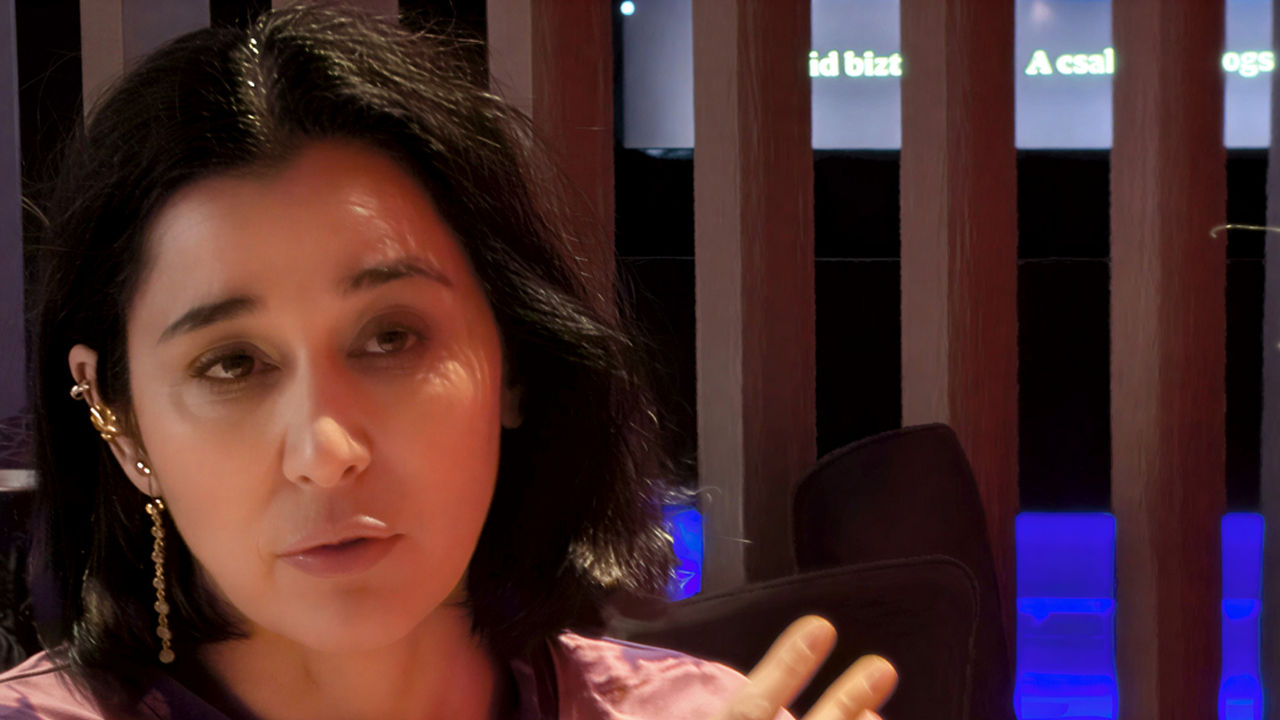
MOVIE INTERVIEW – In connection with Feels Like Home, we spoke with Dorka Gryllus about thriller atmosphere, a sensitive nervous system, acting instinct, collaboration with directors, and what makes working in Germany different from working in Hungary.
After Feels Like Home, Dorka Gryllus spoke with striking honesty and without any varnish about how crime and thriller-adjacent roles often find her, while as a viewer she has a particularly hard time with this genre. She also talked about not being the type who hunts for roles, preferring to build from what finds her, while at the same time being capable of moving things toward herself if she really wants to make something happen. By the end of the interview, she also spoke quite concretely about the differences between German and Hungarian production culture.
In the conversation below, we move from specific scenes in Feels Like Home to genre roles, the importance of shared thinking, and then to questions of actors’ rights and working conditions. At several points, Dorka Gryllus describes with real precision how her acting instincts work and what is needed for a job to function at a truly high level.
theGeek: Watching the world of Feels Like Home, I kept thinking of a surreal story with a crime-thriller atmosphere. It also brought several of your films to mind, including Weekend and The Butcher, The Whore And The One Eyed Man. Am I right in feeling that crime and thriller stories somehow gravitate toward you?
Dorka Gryllus: I would rather say that I choose what comes my way. That is why, for example, I also played in Apatigris, which is a completely different type of world, much more playful and lighter in tone. So I am not interested only in roles like this, I am happy to work in things with a very different register as well. At the same time, of course, I also see that crime- or thriller-adjacent projects often find me, and part of that comes from the fact that I also work in Germany, where a great many productions of this kind are made.
theG: Is the crime line really that dominant there?
G.D.: Yes, very much. In Germany, a very large share of film and television work is crime-related. It is simply a genre that excites people. Suspense, fear and tension have an effect on the nervous system that many viewers enjoy experiencing.
theG: While you are saying you do not like these films as a viewer.
G.D.: Yes, exactly, I do not. I have a very sensitive nervous system. As an actor, that can often be an advantage, because this kind of sensitivity can be used very well for certain types of roles. But that same sensitivity is also why, as a viewer, I often cannot handle these films, because they affect me deeply.

theG: So acting in a hard thriller is fine, but watching one is a different story?
G.D.: Yes, that is roughly the situation. You have to play it, and I even enjoy the work in it, but as a viewer I handle it much more poorly.
theG: And do you watch your own films back?
G.D.: Not always. Sometimes it just works out that I do not. You shoot something, time passes, other jobs come, life brings other things, and by the time there would be an opportunity, you have already slipped out of the window for it. Sometimes it is online for a while and I still do not get around to watching it. It happens that a film simply passes me by like that.
theG: Do you have a dream role you have wanted for a long time but still have not gotten? Or is it really more that you choose from what comes, and you do not actively go after roles?
G.D.: I do have my own ideas. That was the case, for example, with my recent directing work, Csak jöttem szólni, hogy megyek, which I wanted to make. Or our production Üvegfal with Kornél, which we perform at the Lóvasút, that was also something we wanted, and the same goes for our short film Zuniverzum, in which I also performed with Kornél and Somi.
theG: So it is not “role hunting” in the classical sense, but rather building from your own ideas?
G.D.: Yes, more like that. If I really want something, I think about how it could be made.
theG: Do you prefer acting or directing?
G.D.: I love both, but they are different kinds of work. They do not ask for the same kind of energy. And there is also the separate question of whether someone can direct themselves.

theG: Have you directed yourself yet?
G.D.: No, I have not tried that yet. I do not know what it would be like.
theG: A lot of actors reach a point where they feel they would stage certain situations differently, or place themselves differently in a scene. Does that come up for you?
G.D.: Fortunately, lately I have not really worked with directors where that came up as a problem. But it is completely natural in a job for everyone to say what they feel and what they think. That is not necessarily an argument. It is part of the shared work.
theG: So for you, the actor giving feedback and proposing ideas is completely basic?
G.D.: Of course. I think a job becomes truly good when everyone’s feelings and thoughts are in it. That is what makes it alive.
theG: Was there anything like that in this film, where you also brought in or suggested a concrete idea?
G.D.: Yes. Obviously the director led many things, but if I felt something, or something occurred to me, I said it, or I simply did it. For example, I remember a moment at the killing scene when it occurred to me that in this situation this woman would, in my view, light a cigarette. That felt very exact for the character, and it was great that Gábor always listened to everyone very kindly, and then of course he decided what would stay. It was wonderful to shoot in the atmosphere he created.
theG: Your character in this film seems to operate in a different dynamic than several of your earlier roles. There is subordination, conflict, and at the same time the balance of power keeps changing. Was that harder to play?
G.D.: I am glad I got to play this role. That was what mattered to me. I do not really tend to look at it as “I would rather have played the other role.” That is a slightly strange way of framing it for me. I look at what can really be done inside the role I have.
theG: What can we expect from you next? Is there a film already that you can mention?
G.D.: Regarding a Hungarian film, I cannot really say anything right now that is definitely coming. At the moment, this film is more in focus.
theG: And possibly a German project?
G.D.: Yes, I recently shot a crime drama in Germany, and it will be on television soon. A story set in Thuringia.
theG: What is different about working in Germany compared to Hungary? As an actress, what is the most important difference?
G.D.: The position of actors is a bit different. They are more self-aware, they are more aware of their rights, and they are also better at enforcing them. They can negotiate better positions for themselves. You can feel that very clearly.
theG: Can you give a concrete example of that?
G.D.: I would rather put it in general terms and say they are more confident. They say much sooner what they want and what they think. More things are set down in advance to make sure an actor can work well. There is much more attention paid to time, energy and working conditions. And part of that is also that the actor pays closer attention to their own energy.
theG: Do you see change in that here at home?
G.D.: Maybe yes, it does feel as if something has started. There are actors who are willing to take a stand on these questions, and that matters.










Leave a Reply