REVIEW – Horror games built around “true events” usually go one of two ways: either they carry something genuinely unsettling inside them, or they use the claim as cheap bait and hope you will do the rest of the work yourself. On paper, Apartment No. 129 had a decent shot at standing out, mixing a Turkish urban legend, satanic panic, and Islamic mysticism into a setup you do not see every week. The trouble is that before the game can turn any of that into real dread, it buries itself under lazy level design, exhausting text dumps, and action that feels barely assembled. It still lands a few ugly little moments, but overall it feels less like a memorable horror game and more like a promising idea left to rot in the hallway.
The premise is strong. According to the legend, in 2009 two young women living on the top floor of apartment building 129 in Turkey held a candlelit satanic ritual, and that night something went badly wrong. Residents described violent shaking, shattered glass, and furniture thrown around, even though instruments registered no earthquake at all. The building emptied out, people disappeared from it, and the place was left to decay with the story still clinging to its walls. Into that mess walks Emir, a paranormal content scavenger who decides that entering a cursed apartment block with a camera is somehow a smart career move.

The Building Has More Personality Than the Guy Walking Through It
As a protagonist, Emir is barely more than a flashlight, a viewpoint, and a handful of lines. He is not especially interesting, he hardly changes, and for most of the game he feels less like the center of the story than the thing being dragged through it. The game clearly wants him to matter, but most of the time he just lingers in the middle while the setting tries to carry him. That leaves the entire experience with a hollow center it never really fills.
The story itself is not so much told as dumped on top of you through documents, notes, and dense chunks of tiny text. Not in a sharp or elegant way, either, but with the tired confidence of a game that seems to think quantity can impersonate depth. The religious side of the horror – Quranic references, faith, possession, divine judgment – should have been one of its strongest assets, because at least it gives the game a flavor most Western horror projects never touch. Instead, those ideas often just hang there, as if the game understands they are supposed to feel important but has no clue how to turn them into something alive inside the experience itself.
The live-action opening and ending do not save it. In theory, leaning into filmed sequences could have added something raw or unnerving. In practice, the acting is stiff, the visuals look painfully cheap, and the whole thing has the awkward energy of a student production wearing horror makeup it did not earn. Instead of deepening the unease, those scenes keep puncturing it. When a horror game’s attempt at realism weakens its atmosphere instead of reinforcing it, that is not a minor slip. That is rot in the foundation.

The Hallway Goes On Forever, and the Level Design Has the Nerve to Call That a Plan
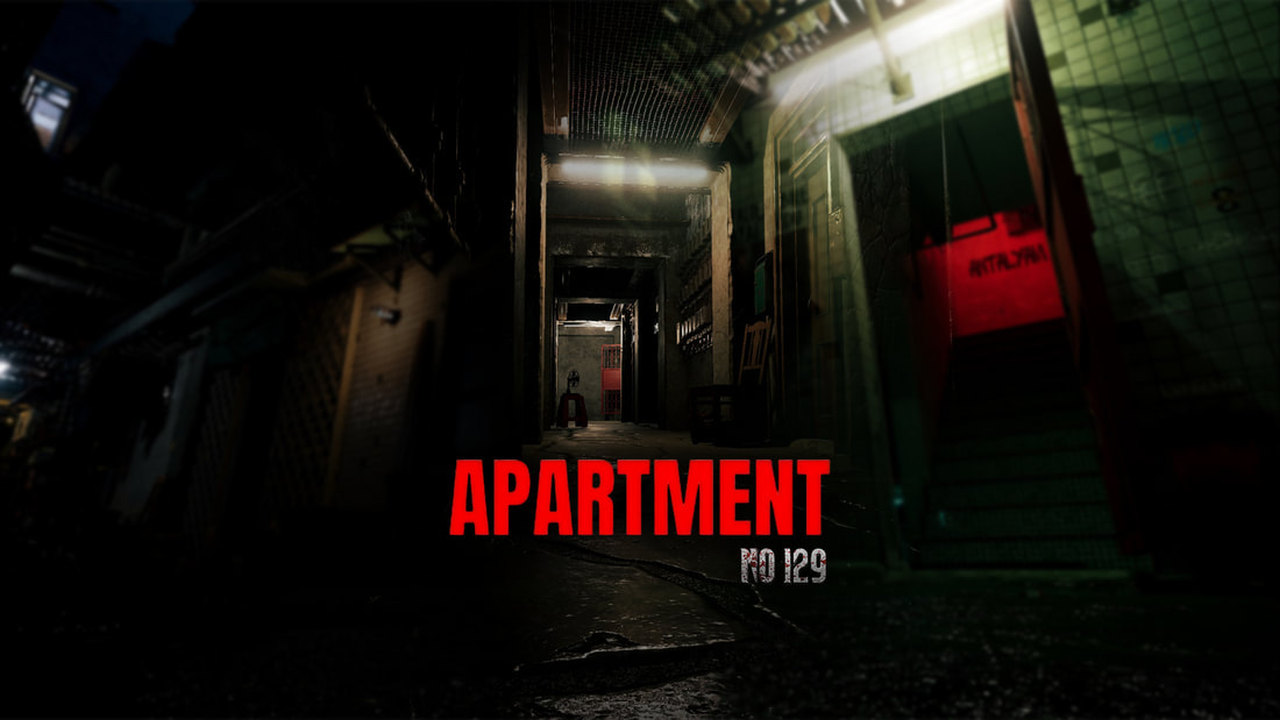
Apartment No. 129 does not fall apart because it borrows familiar horror tricks. It falls apart because it does absolutely nothing interesting with them. The apartment building never feels like a place people once lived in and later abandoned in fear. It feels like a bin of reused assets lined up in slightly different combinations. Apartments repeat, rooms echo one another, and the whole structure lacks any real internal logic. It is not dreamlike in a deliberate way, and it is not unnerving in a surreal one. It is just lazy.
That kills exploration almost immediately. You are not opening doors because you are curious what might be behind them, but because you are hoping this time it might not be the same room again with the furniture moved two feet to the left. The game occasionally hints that this repetition might be part of some paranormal distortion, but it never commits to that idea in any meaningful way. There is no real in-world logic binding the confusion together, no hostile force shaping the space into something intentionally uncanny. What remains is copied floor plans, dead wandering, and the unmistakable sense that somebody wanted to be done with this in a hurry.

Combat Flails, Survival Sits There With Full Pockets
The action side stands on even shakier legs. Emir can swing an axe and fire a pistol, but calling what follows a combat system takes a fair amount of generosity. Hit detection feels unreliable, enemy movement feels arbitrary, and the weapons themselves barely communicate impact. Firing the pistol feels like throwing scraps of paper into a draft. It is not harsh, not tense, not satisfying – it is just there because the game apparently felt like it had to put something there.
The survival horror layer is not in much better shape. There is too much ammunition, too much healing, and far too little pressure, which means the game lets go of the one thing this genre normally lives on: controlled strain. The interface makes it worse. It often fails to tell you clearly how much damage you took or how much healing you used, so wasting resources out of sheer uncertainty becomes easy. The flashlight system is its own little joke, because the pistol light is basically there forever, neatly gutting the tension that should have come from managing light in the dark.
The game seems aware that atmosphere alone is not enough, so it leans hard on cheap jump scares. Not as seasoning, but as support beams. Some of them still make you jolt because your body works, not because the horror is doing anything especially clever. After a while the whole thing grows irritating instead of frightening. Mission structure only makes that worse: mysterious notes keep sending you back and forth, creating endless return trips through spaces that are no longer dangerous, tense, or even mildly interesting. You are not revisiting places because the game has recontextualized them well. You are revisiting them because it wants to stretch a short runtime without doing the hard work.
The Console Version Looks Like It Clocked Out Before Release
The console port does not help the picture much. Camera sensitivity in the early going feels so wildly off that unless you dive into the menu and fix it yourself, the game almost seems actively annoyed that you are playing it. The interface screams “PC leftover” in all the wrong places, and several interactions feel like they were dragged across platforms without anyone bothering to make them pleasant on a controller. Number-pad puzzles are a particularly ugly example, thanks to a cursor that crawls around like it resents your existence. It is exactly the kind of small misery that piles up into the feeling that the game does not respect your time.
And that is what makes the whole thing frustrating rather than merely bad. There is still something in here. The setting is unusual, the legend has teeth, and the religious layer gives the game a flavor of its own when it works. Every now and then, Apartment No. 129 hits a grim, claustrophobic note that lets you glimpse the nastier, sharper game it might have been. Then the bad combat, the overexplaining, the cloned rooms, and the sloppy presentation come stumbling back in. In the end, it sticks in the mind less as a disaster than as a waste. The building deserved better than this.
-Gergely Herpai “BadSector”-
Pros:
+ The Turkish urban-legend setup and religious angle give it a more unusual base than most low-rent horror games
+ It occasionally stumbles into real unease
+ At least it is short enough not to torture you forever
Cons:
– Lazy, repetitive level design and too much empty wandering
– Bad combat, weak feedback, and survival mechanics with no bite
– Clumsy live-action scenes, overexplained storytelling, and a rough console port
Developer: Dead Witness
Publisher: Dead Witness
Genre: first-person psychological horror game
Platforms: PC, PlayStation 5, Xbox Series X|S
Apartment No. 129
Gameplay - 4.2
Graphics - 5.4
Story - 4.7
Music/audio - 5.8
Ambience - 5.2
5.1
WEAK
Apartment No. 129 is most frustrating not because it is outright terrible, but because there was clearly a better game trapped inside it. The location, the legend, and the religious layer all give it material strong enough to build a real identity around, but the execution keeps dragging it back into the swamp. There are a few decent moments and a few effective chills, but overall it feels less like a finished haunting and more like a curse that lost interest halfway through.