MOVIE REVIEW – Some films arrive with that dangerous air that tells you they could become either a serious piece of work or a prestige project hopelessly drunk on its own intelligence. The Wizard of the Kremlin spends most of its running time balancing right on that line: it is gripping, icily relevant, and now and then so infatuated with its own political sophistication that it nearly forgets it is supposed to function as cinema too. Assayas still pulls you into it, but at times the film feels less like drama than like poison served in silk gloves.
Olivier Assayas’s first English-language feature, The Wizard of the Kremlin, is undeniably potent – and it would be odd if it were not, considering that it circles one of the most unsettling stories of power in recent history. By charting Vladimir Putin’s rise from the edge rather than the center, it also follows the Faustian apprenticeship of the strategist at his side, fictionalized here as Vadim Baranov and played by Paul Dano. The film’s clearest weakness is that such dense material too often gets trapped inside dialogue and exposition – historical, political, and philosophical in equal measure.

Power, vanity, and cold sweat
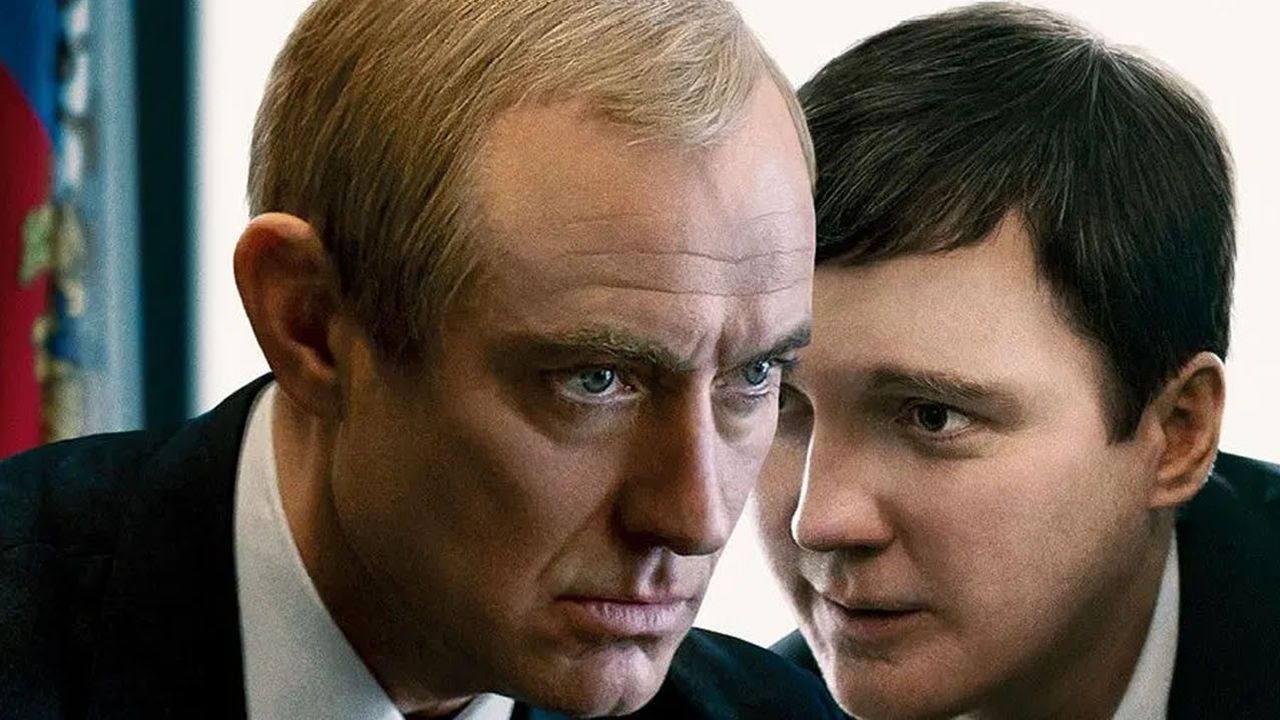
After Carlos and Wasp Network, Assayas once again steps into terrain that clearly suits him, and his adaptation of Giuliano da Empoli’s 2022 bestseller reconstructs Russia in the 1990s and 2000s with flair, scale, and rich detail. It also gives room to several striking performances, including Jude Law’s Putin, even if Paul Dano at times slips too visibly into mannerism. As an expansive corridors-of-power drama, The Wizard of the Kremlin exerts a formidable spell, though it often does so less as living cinema than as an elegant and highly functional piece of docudrama. That exact mix should give it a healthy afterlife among upscale niche audiences following its Venice competition launch, while also likely defining the ceiling of its reach beyond Assayas’s usual cinephile crowd.
Assayas’s screenwriting partner here is Emmanuel Carrère, the writer-filmmaker behind Between Two Worlds, who has spent years chronicling Russia’s violent metamorphoses. The opening caption insists that the film is “an original work of fiction,” yet, much like da Empoli’s novel, it plainly operates as a disguised portrait of Vladislav Surkov, the adviser who stood beside Putin for two decades and was once branded “the architect of the Russian political system.” Here he appears as Vadim Baranov, introduced by the film’s narrator, Jeffrey Wright, as the kind of man whose disappearance from power only deepened his pull as a legend.

From the dacha to the Kremlin in a handful of filthy decisions
The story begins in 2019, with Wright playing an American writer who has come to Russia to research a book on Yevgeny Zamyatin, whose 1920s dystopian novel We dissected totalitarian power with unnerving foresight. He is soon summoned to Baranov’s country dacha, where this fellow admirer of Zamyatin proceeds to unravel his life story in exhaustive detail. From there, the film slips back to the post-glasnost years, when Russian society – its youth especially – suddenly caught the taste of freedom, and that intoxicating moment is neatly condensed in a riotous avant-punk party where the still slightly awkward Baranov encounters Ksenia, Alicia Vikander’s enigmatic, cynical, volatile presence, first seen in the middle of a rock-dominatrix performance.
The two become lovers, though she later leaves him for the flashy entrepreneur Dmitri Sidorov, played by Tom Sturridge with charismatic swagger in a role that very clearly draws on Mikhail Khodorkovsky. Meanwhile, Baranov moves from avant-garde theatre into trash television, where the basic commandment is brutally simple: do not be boring. From there, he rises into the orbit of media magnate Boris Berezovsky, becoming his right-hand man in a world where manipulation through television kept the fading Boris Yeltsin in power.
But the Kremlin needs a new face, preferably one who will not threaten Berezovsky’s own influence, so he and Baranov turn to FSB chief Vladimir Putin, hoping to manufacture him into their puppet candidate. Putin initially performs reluctance, then accepts the role – and in the same instant makes it obvious that he is no one’s puppet. For quite a while, the film keeps Baranov’s supposed wizardry slightly abstract, beyond the fact that he is icily composed enough to tell the truth to power without blinking.
Cynicism, tailored to measure
Later, however, the method reveals itself: he assembles mutually hostile eccentric factions, including extremist biker gangs and the National Bolshevik Party led by literary celebrity Eduard Limonov, then repackages them into a manipulable “official opposition.” The same mind also builds Russia’s troll-farm logic, the cyber strategy designed to keep the West in a permanent fog of confusion. The screenplay is packed with incidents and ideological confrontations, and Assayas pushes it forward with brisk, elegant direction and a lavish mise-en-scène that captures both the mood of a society in transition and the sudden eruption of capitalist excess.
Even so, the film never fully comes alive as a flesh-and-blood character study, although Dano does chart Baranov’s path from young countercultural operator to pampered bureaucrat intoxicated by his own cleverness. He can make the character feel vulnerable one moment and demonic the next, but that muted, silky performance occasionally slips into a mannered register that starts brushing up against John Malkovich territory. Vikander’s disenchanted glamour figure often feels less like a convincing Russian enigma than a bored British upper-class woman playing one – not helped by the fact that so many of the accents remain stubbornly English – so she frequently registers more as a shimmering image than a fully formed person.
The strongest work comes instead from Will Keen and Jude Law: the former makes Berezovsky twitchy, slippery, and unpleasantly alive, while the latter turns Putin into something nastier than a mere bureaucrat, a dead-eyed administrator fused with raw political id, simmering with barely contained fury at his enemies and at history itself.
-Gergely Herpai “BadSector”-
The Wizard of the Kremlin
Direction - 8.2
Actors - 7.6
Story - 8.4
Visuals/Music/Sounds/ - 7.4
Ambience - 7.8
7.9
BON
The Wizard of the Kremlin is at its sharpest when it stops trying to explain power and simply shows how it stains everything it touches - people, institutions, memory, even history itself. It is not a flawless film, because it talks too much, admires its own intelligence too openly, and sometimes leaves its characters gasping beneath the exposition. But once Jude Law’s frostbitten Putin locks into this silk-lined political nightmare, Assayas delivers something that lingers under the skin in a very ugly way.






![Altera: Even Penguin Soldiers Could Be Out to Get Us! [VIDEO]](https://thegeek.games/wp-content/uploads/2026/03/theGeek-Altera-300x365.jpg)
![Lizard State: If There’s No Sam Fisher, Indie Devs Fill the Gap! [VIDEO]](https://thegeek.games/wp-content/uploads/2026/03/theGeek-Lizard-State-300x365.jpg)