
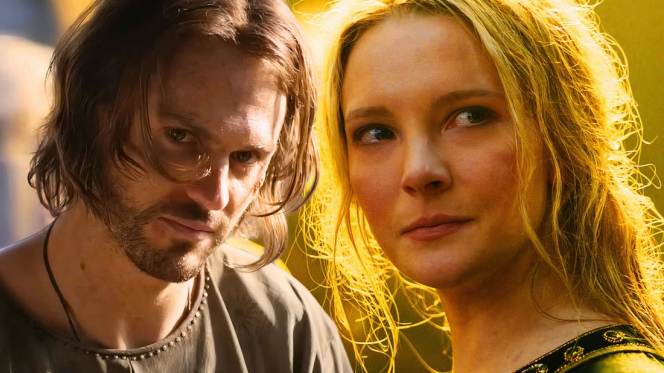
MOVIE NEWS – Fantasy has become one of the fastest-growing genres in book sales over the past few years, yet truly great fantasy television remains surprisingly rare. The Lord of the Rings: The Rings of Power returns with Season 3 in 2026, and while Prime Video’s series remains deeply divisive, it is now moving toward one of Middle-earth’s most catastrophic and essential stories.
Fantasy has been one of the fastest-growing genres in terms of book sales in recent years, but despite the massive appeal of Game of Thrones and the many Hollywood fantasy projects developed throughout the 2020s, genuinely strong fantasy television is still difficult to find. Mediocre Netflix fantasy shows are everywhere, yet very few series capture the feeling of the early seasons of Game of Thrones or Peter Jackson’s The Lord of the Rings movies. For anyone who feels that absence, The Lord of the Rings: The Rings of Power Season 3 remains one of the most important fantasy returns of 2026.
J. R. R. Tolkien’s The Lord of the Rings is, without exaggeration, one of the greatest foundational works in fantasy literature, and Peter Jackson’s movie trilogy proved to film audiences that Middle-earth was not just a literary obsession, but a monumental screen world that could actually work. Amazon made a prequel series even though plenty of people were skeptical from the start, and while The Lord of the Rings: The Rings of Power is not exactly the most universally praised television show currently running, the strength of Tolkien’s world is still present inside it. That is why it may be worth putting HBO’s Harry Potter series and House of the Dragon Season 3 aside for a moment, because the officially returning 2026 season of The Lord of the Rings: The Rings of Power may still deserve another shot.
The Rings Of Power Is A Divisive But Rewarding Lord Of The Rings Adaptation
The divisive reception surrounding The Lord of the Rings: The Rings of Power makes it clear that audiences have a wide range of emotions about the series, and that is perfectly understandable. Anyone who has read a great deal of Tolkien can recognize at least some of the complaints, because there are fair criticisms to be made about the show’s writing, pacing, and several of its creative decisions. At the same time, after years of nostalgia for Peter Jackson’s The Lord of the Rings trilogy and even The Hobbit movies, Amazon’s adaptation still offers one thing that should not be dismissed too easily: it brings viewers back to Middle-earth. In a television fantasy landscape packed with forgettable, disposable shows, that alone still has value.
There is also plenty to appreciate in the series. Bear McCreary’s score has remained a constant presence for many fans since The Lord of the Rings: The Rings of Power first aired, because it captures Middle-earth with a kind of magic that echoes Howard Shore’s original work without simply copying it. The music is not just decorative, either; it gives emotional shape to a vivid, expensive, carefully designed world. For all of the show’s flaws, Amazon clearly did not set out to make a cheap fantasy imitation, but a production that at least visually and musically tries to stand close to Tolkien’s legacy.
The Lord of the Rings: The Rings of Power is still a flawed series, but Season 2 made major improvements. Charlie Vickers’ portrayal of Sauron and his chemistry with Charles Edwards’ Celebrimbor created one of the strongest fantasy storylines television has delivered since Game of Thrones, at least in terms of mythic weight and character tension. The Siege of Eregion also provided an appropriately epic, visually forceful, and emotionally heavy conclusion to that arc. The most important part, however, is that Season 3 could become even bigger, because the series now appears to be moving toward an adaptation of one of Tolkien’s greatest stories.
The Rings Of Power Season 3’s Númenor Plot Could Tell One Of Tolkien’s Greatest Tales
The Lord of the Rings is, of course, Tolkien’s most famous and greatest story, but a major reason Middle-earth has endured is the immense history he built around it. The Third Age depicted in Peter Jackson’s movies presents a version of Middle-earth in which magic and the fantastical have faded over time, making it very different from the mythic battlefield of divine beings, monsters, and overwhelming powers that defined the First Age. At the end of The Silmarillion, Tolkien tells the story of Akallabêth: The Downfall of Númenor, one of the rare post-First Age moments in which Middle-earth’s divine powers, the Valar, directly interfere in the affairs of mortals.
Without spoiling too much of what the series may still depict, The Lord of the Rings: The Rings of Power has been foreshadowing the Downfall of Númenor since Season 1, and with the planned time jump for Season 3, it now seems clearer than ever that this will be the next logical step. The Númenor storyline was pushed to the side in Season 2 while Eregion took focus, but now the show may be ready to return to the island kingdom and depict one of Tolkien’s most divine and catastrophic tales. In epic fantasy terms, the scale of the next season could be enormous, with the Númenóreans, the Valar, and Sauron all occupying the board at once.
This is where The Lord of the Rings: The Rings of Power could finally justify itself in full. The series has often struggled to balance fidelity to Tolkien, modern streaming drama, and the expectations of an intensely demanding fan base. The Downfall of Númenor, however, contains everything great fantasy needs: pride, lust for power, divine judgment, political decay, Sauron’s manipulation, and the fatal self-destruction of an entire civilization. If Amazon can bring that storyline to the screen with the necessary weight, rhythm, and severity, Season 3 may be more than a return to Middle-earth; it could be the moment when the series finally grows into the scale of its own ambition.
Source: MovieWeb








![The System Requirements for Fable Are In! [VIDEO]](https://thegeek.games/wp-content/uploads/2026/08/vnews-05-fable-1280x720-1-302x180.png)



Leave a Reply