
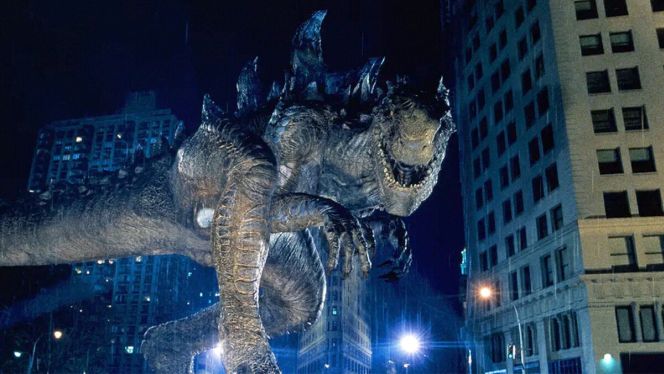
MOVIE NEWS – Roland Emmerich’s 1998 Godzilla was so poorly received in Japan that six years later, the Japanese took their revenge in their own way. Godzilla: Final Wars publicly humiliated the Hollywood kaiju. Despite everything, the TriStar Pictures production was a box office hit.
After the success of Stargate and especially Independence Day, Roland Emmerich and his favorite screenwriter at the time, Dean Devlin, were hired by TriStar Pictures to create a live-action remake of Godzilla… and they failed. The film was critically panned, and while it wasn’t a commercial disaster, it left a bad taste in audiences’ mouths. This led Hollywood to lose interest in the kaiju for 16 years and left many in Japan quite angry with what Hollywood had done.
The film, starring Matthew Broderick and Jean Reno, among others, was widely criticized for being boring, absurd, and full of the genre’s usual clichés. This might have been overlooked if its true star, the monster, had looked a bit more like the original creature. The film eliminated key elements of Godzilla’s mythology (why doesn’t he have his atomic breath?) and redesigned the creature, making it resemble a mutant Tyrannosaurus rex that could easily appear in the new Jurassic Park, all created by computer with a “so-so” finish for the time that took away its “soul,” as Kenpachiro Satsuma, the actor who played Godzilla in seven Japanese science fiction and fantasy films, once criticized. And we haven’t even talked about his attitude, which some fans described as skittish, very different from the Toho beast that so many of us know and that we magnificently saw in Godzilla: Minus One in 2023.
Zilla, a Kaiju Sent by Aliens to Invade Earth
It didn’t feel very Godzilla-like, and while it did a lot to popularize kaiju outside of Japan, viewers and artists in the Asian country were deeply bothered by the approach that Roland Emmerich and his team took regarding the king of the monsters, so much so that they didn’t hesitate to take revenge six years later with the premiere of Godzilla: Final Wars, a live-action released in 2004 for the 50th anniversary of the franchise. In this film, an alien race, the Xiliens, releases a horde of kaiju all over the world to manipulate humanity. Among the monsters that unleash chaos on Earth is Zilla, although in the film he is directly called a “tuna-eating bug” (“sardine face” in the Latin Spanish dubbed version), which was none other than the Godzilla from the TriStar Pictures blockbuster mentioned above.
Toho didn’t consider him worthy of his name and used this feature film to perform a small retcon, renaming him simply Zilla, without the “God.” In other words, he wasn’t a god. But they didn’t stop there. They also pitted him against the real Godzilla in a battle that lasted a breath. With the creature publicly humiliated, Japan got its revenge on Hollywood in its own way, although it must be said that Patrick Tatopoulos, production designer and father of the monster in Roland Emmerich’s film, didn’t take it badly and was even thrilled that his creation had its seconds of glory in this Godzilla: Final Wars.
Of course, the saga’s website does not directly link it to the kaiju seen in Roland Emmerich’s film: “Although it is said to resemble a creature that attacked New York City in 1997, the origins of the enormous kaiju known as Zilla are unknown. Its primary weapons are simple brute strength and a high jumping kick, but its agility and speed are unprecedented for a kaiju of its size,” they detail. And this is its story. Do you think it deserves a new chance in a movie? Or is it better to leave it buried?
Be that as it may, Hollywood learned its lesson and knew how to develop a saga with Godzilla that, despite its flaws, has managed to make a place for itself in the hearts of fans in the MonsterVerse saga, where it has appeared in four of its five films, and we will soon see it again in theaters with the release of Godzilla x Kong: Supernova, set for this coming March 26, 2027.
Source: 3djuegos





![MobLand Season 2 Returns with Blood, Chaos and a New Trailer [VIDEO]](https://thegeek.games/wp-content/uploads/2026/08/SKYSHOWTIME_MobLand_S2_1-302x180.jpg)


![Gears of War E-Day Is Getting a Limited-Edition Xbox Controller! [VIDEO]](https://thegeek.games/wp-content/uploads/2026/08/theGeek-Gears-of-War-E-Day-controller-302x180.jpg)


Leave a Reply