
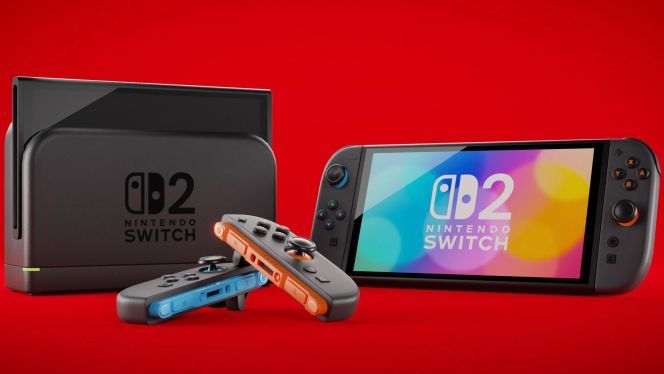
It’s difficult to discern how Nvidia’s upscaler is used. Compared to the PC, the image characteristics are slightly different on the Big N’s new console.
In this week’s episode of the Digital Foundry podcast, the editors responded to a listener’s question by highlighting Nintendo‘s extensive use of Nvidia‘s upscaler. They noted it was difficult to confirm this before launch because the Switch 2‘s DLSS visuals differ from those on PC. Still, based on certain visual elements, it’s possible to tell if a game uses Nvidia DLSS on the system (for example, in the Pokémon Scarlet/Violet update).
They also pointed out that Nvidia DLSS will likely offer different modes on the Nintendo Switch 2, just as it does on PC. The most widespread version appears to be a lightweight mode, which easily upscales resolution to 1080p in handheld mode and 1440p or 4K when docked, but doesn’t do a great job reconstructing the image during motion. The most glaring example is Fast Fusion, where Nvidia DLSS is used to upscale to 4K in docked mode. Image quality is fine in stills, but not so much in motion.
Hogwarts Legacy also appears to use this lightweight DLSS mode; however, the game’s slower pace and higher base resolution result in better output, even though it’s different from the PC upscaler’s results. However, it seems that at least one other DLSS version is available to developers, since the Cyberpunk 2077 implementation seems closer to the PC version than what’s found in other launch titles.
Following the early sales of the Nintendo Switch 2 console (more than 3.5 million in four days, reportedly selling twice as fast as the original Switch), market analyst DFC Intelligence bumped up its 2025 forecast. The long-term forecast remains unchanged. DFC Intelligence still predicts that Nintendo Switch 2 could sell up to 100 million units by the end of 2029:
“The Nintendo Switch 2 is now the key driver of industry growth for 2025. DFC increased its Switch 2 unit sales forecast from 15 million to 16 million. If manufacturing could meet demand, the Switch 2 could sell as many as 20 million units, but DFC considers this unlikely as Nintendo is expected to be conservative with supply. Consistent with its historically conservative approach, Nintendo projects 15 million Switch 2 sales by the end of the fiscal year in March 2026. When the original Switch launched in March 2017, Nintendo initially projected 10 million units, but ultimately sold 15 million units in that period. Based on that, Nintendo’s 15 million projection inspires confidence that they’ll ramp up supply and weather any tariff issues,” wrote DFC.
So far, the Switch 2 has achieved a number of impressive results.





![MobLand Season 2 Returns with Blood, Chaos and a New Trailer [VIDEO]](https://thegeek.games/wp-content/uploads/2026/08/SKYSHOWTIME_MobLand_S2_1-302x180.jpg)


![Gears of War E-Day Is Getting a Limited-Edition Xbox Controller! [VIDEO]](https://thegeek.games/wp-content/uploads/2026/08/theGeek-Gears-of-War-E-Day-controller-302x180.jpg)




Leave a Reply