
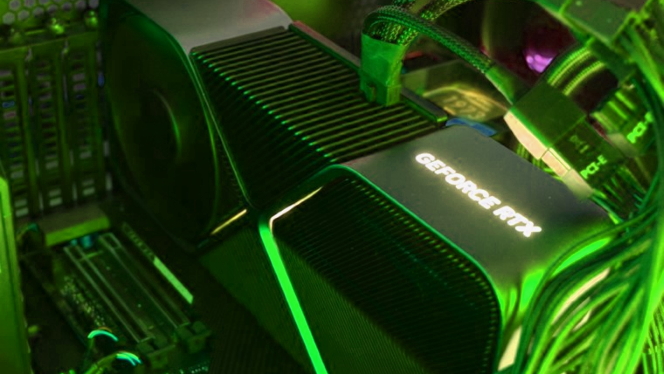
TECH NEWS – Nvidia has officially unveiled the desktop version of its latest card, and it’s not only outdated but also overpriced.
Following the laptop release, the GeForce RTX 5050 is now debuting on desktops. It’s the seventh GPU based on the Blackwell architecture, built around the GB207 chip, featuring 2,560 CUDA cores and 8 GB of GDDR6 VRAM. (The laptop model includes GDDR7, meaning this desktop version is already cutting corners.) With a 128-bit memory bus and 320 GB/s bandwidth, the GDDR6 VRAM clocks in at 20 Gbps—faster than the RTX 3050 and 4050. It comes equipped with fifth-generation Tensor cores and fourth-generation ray tracing cores. AI performance peaks at 421 TOPs, nearly six times that of the RTX 3050.
The card has a 130W TDP, and Nvidia recommends a 550W power supply. It uses a single 8-pin power connector, with a base clock of 2.31 GHz and a boost clock of 2.57 GHz. Priced at $250—just like the RTX 3050—it will not have a Founders Edition. Nvidia is leaning heavily on DLSS 4 to sell it, claiming up to 4× performance gains. However, they also released non-DLSS benchmark data for popular eSports titles like Apex Legends, Counter-Strike 2, and Overwatch 2, where performance increases hovered around 50–60%. Compared to the laptop RTX 4050, gains are more modest—about 10–20%.
According to Nvidia, the desktop RTX 5050 will hit shelves in the second half of July. Still, $250 for this level of performance is laughable—and the same goes for the RTX 5060 at $300. Nvidia’s offering will compete against Intel’s Arc B50 with 12 GB VRAM ($250) and Arc B570 with 10 GB VRAM ($220). Both rival cards offer more than 8 GB of VRAM, making Nvidia’s decision to stick with GDDR6 and limited memory appear miserly. All things considered, this is a poor value proposition.














Leave a Reply