
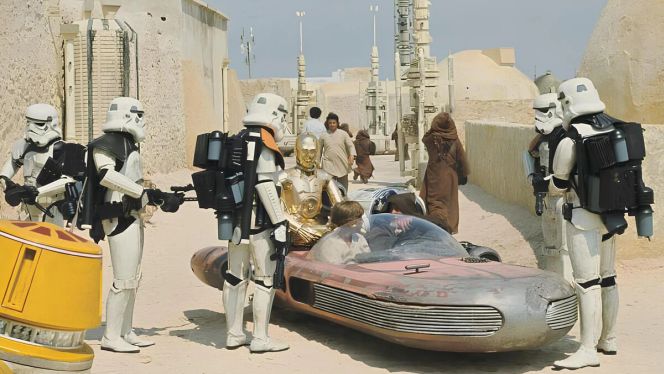
Luke’s landspeeder in Star Wars never actually floated, but George Lucas pulled off one of the most brilliantly absurd tricks in movie history. Here’s how the legendary filmmaker convinced audiences that this peculiar “flying” vehicle was gliding over Tatooine’s sands.
Today, CGI can conjure up just about any effect a director wants, but back in the 1970s, filmmakers had to get creative. One of the most iconic moments in Star Wars: A New Hope comes when Luke races across the deserts of Tatooine in his landspeeder—seemingly floating above the sand.
In reality, the vehicle was rolling along on wheels, but no matter how closely you look, you’ll never spot them. That’s thanks to a genius move by George Lucas and his crew: they attached a mirror along the side of the speeder, reflecting only the ground below and making the wheels disappear from view.
From every angle that focused on Luke’s ride, this simple effect hid the wheels perfectly, selling the illusion that the landspeeder was truly hovering. The trick worked best in wide shots, where dust and distance helped sell the magic. For close-ups, though—like the arrival at Mos Eisley—they needed a different approach.
This time, Lucas suggested smearing Vaseline (which he jokingly called “the force field”) onto the camera lens filter. That blurred the inner part of the shot and masked any unwanted reflections in the mirror. In the original release, this trick even left a whitish-orange haze on the screen, but by the 1997 re-release, digital effects replaced it completely.
In the end, these tricks showcased the boundless creativity of a team working with limited resources but endless imagination. It’s the kind of cinematic magic that worked perfectly on screen, only noticed by the most eagle-eyed fans.
Source: Vidaextra






Leave a Reply