
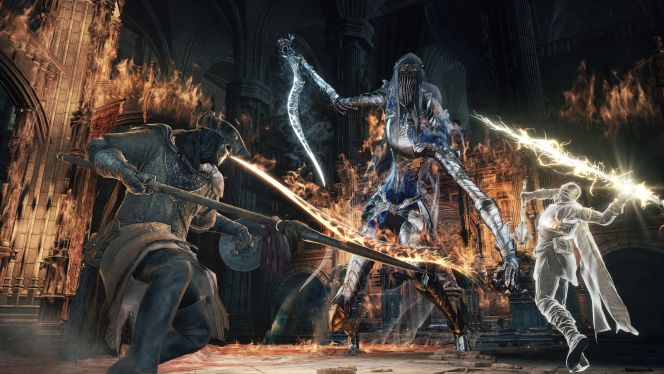
If you look at a creature and immediately think of Dark Souls, you’re not alone—and the reason lies in Miyazaki’s peculiar artistic obsession. The legendary FromSoftware director insists every design he approves carries a principle of purity and dignity. This mysterious approach isn’t just about avoiding the grotesque: behind every character, setting, and story is a tragic fate or a fallen legend. As recently unearthed insights from the design studio reveal, every being in the world of Dark Souls—no matter how fearsome or twisted—has something of an art piece within.
Anyone who’s played a Dark Souls title has faced all sorts of dark fantasy abominations: shambling undead, fanged and clawed beasts, and tattered, malformed, or emaciated warriors. What’s surprising is that director Hidetaka Miyazaki sees it as a design obsession to dignify each character in some way.
In 2012, Japan saw the release of the art book Dark Souls Design Works (later brought West by Udon; there’s a book for each game, and two more for Elden Ring). These volumes feature interviews with Miyazaki and other FromSoftware leads, and one segment tackles this very idea of dignity.
“Few people believe me when I say this, but it’s very important to me to implement some sort of refinement, elegance, and dignity,” Miyazaki explained when asked about his habits. “I often tell designers that I won’t let through any work that is expressly grotesque or visceral. This is due to my personal taste, and I apply it to every design I approve.”
He admits it’s a tough idea to describe, urging fans to check the concept art in the book for proof. Veteran studio artist Masanori Waragai illustrates the point with a memorable anecdote.
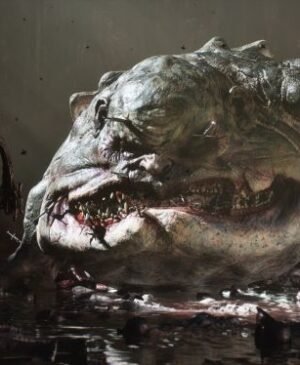
Even the pitiable Pinwheel has dignity: he mournfully carries the corpses of his family, tormented by grief and guilt. “I remember when I was drawing the undead dragon, I sent a sketch that showed a dragon inundated with worms and maggots and other foulness. Miyazaki sent it back to me saying, ‘This isn’t dignified, don’t rely on filth to represent the undead dragon. Why don’t you try to show the deep wail of a magnificent beast doomed to descend slowly and inexorably into ruin?’”
Still, Miyazaki is flexible enough to adapt his obsessions to the needs of his worlds; that’s why environments like the Flooded City remain crude and grotesque by design, even if you can still sense his love for cold and mournful fantasy beneath the surface.
It’s Not Just a Dark Souls Thing
Personally, I think we’ve all absorbed this unique design mindset as part of Dark Souls’ identity, often without ever consciously picking it apart. In retrospect, you’ll spot countless examples of creatures, supporting characters, stories, or environments where FromSoftware hints at former glory followed by disgrace.
We complained about Patches in Dark Souls, yet FromSoftware allowed players to pull such a vile trick on an NPC that the game itself calls you out for it.
Think of Gwyn, Artorias, or even all of Anor Londo—the same pattern repeats: legends or grand figures toppled by the curse. It’s far from exclusive to the first Dark Souls, too.
Even Hewg, the chained, barnacle-ridden blacksmith in Elden Ring, preserves his dignity through pride, conviction, and perseverance. This nuanced approach might be subtle, but it’s surely helped Dark Souls cement itself so deeply in pop culture.
Of course, how the game delivers these themes is just as crucial: in Dark Souls, you rarely get answers from cinematics. Instead, you’re trusted to piece together the story like a puzzle and truly immerse yourself in its meaning.
Source: 3djuegos











Leave a Reply