
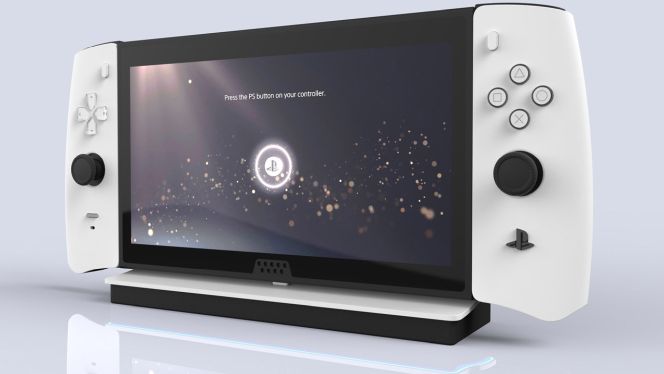
After Monday’s code name leaks, the specs for the PlayStation 6 and Sony’s next handheld are out in the wild: according to a leaked 2023 AMD presentation, YouTuber Moore’s Law Is Dead reveals what gamers can expect from the next generation.
The leaks say Sony is aiming for a relatively conservative system: the main priority is lower power than the base PS5 (target: 160W TBP). The new chiplet design uses 8 Zen 6 cores and 40–48 RDNA 5 Compute Units clocked above 3GHz.
While there are fewer Compute Units than the PlayStation 5 Pro’s 60, higher clocks and RDNA 5’s IPC improvements mean each CU is significantly stronger. The memory bus is also narrower than the PS5 Pro (160 or 192 bits vs. 256), but ultra-fast GDDR7 is expected to hit 32Gbps, so bandwidth will range from 640GB/s to 768GB/s—well ahead of the PS5 Pro’s 576GB/s.
Overall, rasterization performance is expected to be over three times that of the PS5, and the PlayStation 6 could reach GeForce RTX 4080 levels (though direct console-to-PC GPU comparisons are never exact). Ray tracing performance could see a 6–10x leap thanks to new AMD tech.
Backward compatibility for PS4 and PS5 is expected. Production may start mid-2027, with a store launch in late 2027 or early 2028, likely at $499.
The Project Canis handheld will use a monolithic 3nm die with 4 Zen 6C cores, 12–20 RDNA 5 Compute Units at 1.6–2.2GHz, and 128-bit LPDDR5X 7500 RAM. Target power is 15W, with rasterization performance at about half that of a base PS5. It’ll support microSD and M.2 SSD storage, haptics, dual mics, touchscreen, and USB-C for fast charging and video out.
This handheld should easily outperform the Xbox Ally X, but the main move is that it’ll launch alongside the PlayStation 6 at around $400–$500.
Meanwhile, the next-gen Xbox (Magnus) may pack 11 Zen 6 cores and 68 Compute Units—enough to beat the PS5 Pro, but not the PlayStation 6. Microsoft could launch it earlier, aiming to repeat the Xbox 360 strategy, but it won’t arrive before 2027.
Keep in mind these specs are from an old presentation and may have changed. We won’t know for sure until 2026 at the earliest. Stay tuned!
Source: WCCFTECH

![The Nintendo Switch 2 Keeps Pace with the Xbox Series S Even in the Case of the Oblivion Remaster! [VIDEO]](https://thegeek.games/wp-content/uploads/2026/08/oblivion-remastered-switch2-1280x720-1-302x180.jpg)


![Marvel’s Wolverine Is Getting a Limited-Edition Console, Cover, and DualSense Controller! [VIDEO]](https://thegeek.games/wp-content/uploads/2026/08/wolverine-ps5-bundle-1280x720-1-302x180.jpg)
![Phantom Blade Zero: From Pre-Orders to State of Play [VIDEO]](https://thegeek.games/wp-content/uploads/2026/08/phantom-blade-zero-1280x720-2-302x180.jpg)




![The Nintendo Switch 2 Keeps Pace with the Xbox Series S Even in the Case of the Oblivion Remaster! [VIDEO]](https://thegeek.games/wp-content/uploads/2026/08/oblivion-remastered-switch2-1280x720-1-300x365.jpg)

![Marvel’s Wolverine Is Getting a Limited-Edition Console, Cover, and DualSense Controller! [VIDEO]](https://thegeek.games/wp-content/uploads/2026/08/wolverine-ps5-bundle-1280x720-1-300x365.jpg)
Leave a Reply