
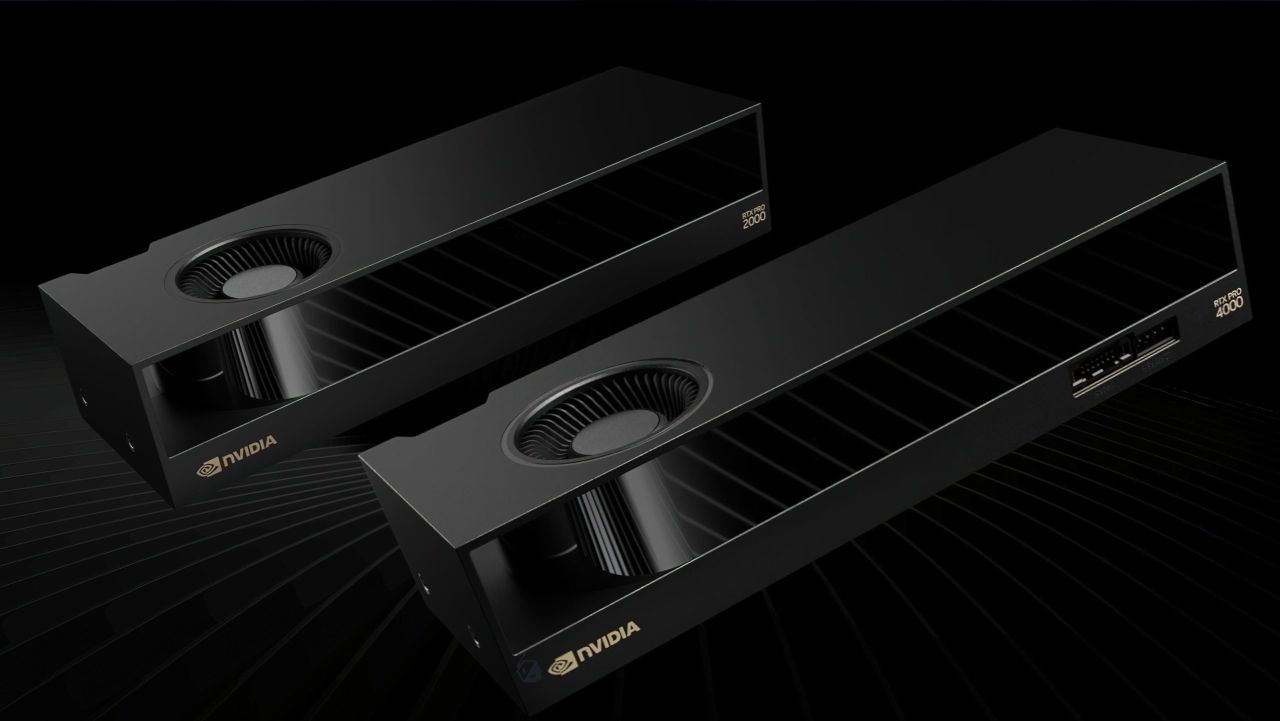
TECH NEWS – One of them is even smaller in size, so the latest Nvidia architecture’s power can be deployed in small form factor (SFF) machines as well. Nvidia has concentrated on securing its workstation GPU ecosystem, as RTX Pro GPUs are widely used not only for professional rendering but also in the AI segment, particularly for inference workloads.
To make the RTX Pro Blackwell GPUs more accessible, the company unveiled the RTX Pro 4000 SFF and RTX Pro 2000 models at Siggraph. These offer not only top-tier performance but also practical form factors. Starting with the SFF model, it replaces the previous-generation RTX A4000 SFF and delivers up to 2.5x higher AI performance, 1.7x higher ray tracing capability, and 1.5x more bandwidth — all at the same power consumption.
The card features 24 GB of GDDR7 ECC memory, four Mini DisplayPort 2.1 connectors, and a compact form factor compliant with SFF certification, making it suitable for smaller machines. It packs 8,960 CUDA cores on the GB203 chip and offers 432 GB/s of memory bandwidth over a 192-bit bus.
Nvidia also launched the RTX Pro 2000, a lower-performance variant with 16 GB of GDDR7 ECC memory, a 70W TDP, and four Mini DP 2.1 ports. It boasts significant generational improvements, including 1.6x faster 3D modeling, 1.4x faster CAD performance, and 1.6x faster rendering. It uses the GB206 chip with 4,352 CUDA cores and 288 GB/s of memory bandwidth on a 128-bit bus.
Pricing has not been disclosed, but major system integrators such as Dell are expected to distribute them. HP and Lenovo will likely follow suit, offering them in their workstation lines (Dell Precision, HP Z, Lenovo ThinkStation), which are also attractive on the second-hand market.
Low-power yet powerful GPUs — why doesn’t the GeForce lineup get anything like this?


Source: WCCFTech, Nvidia, Nvidia












Leave a Reply