
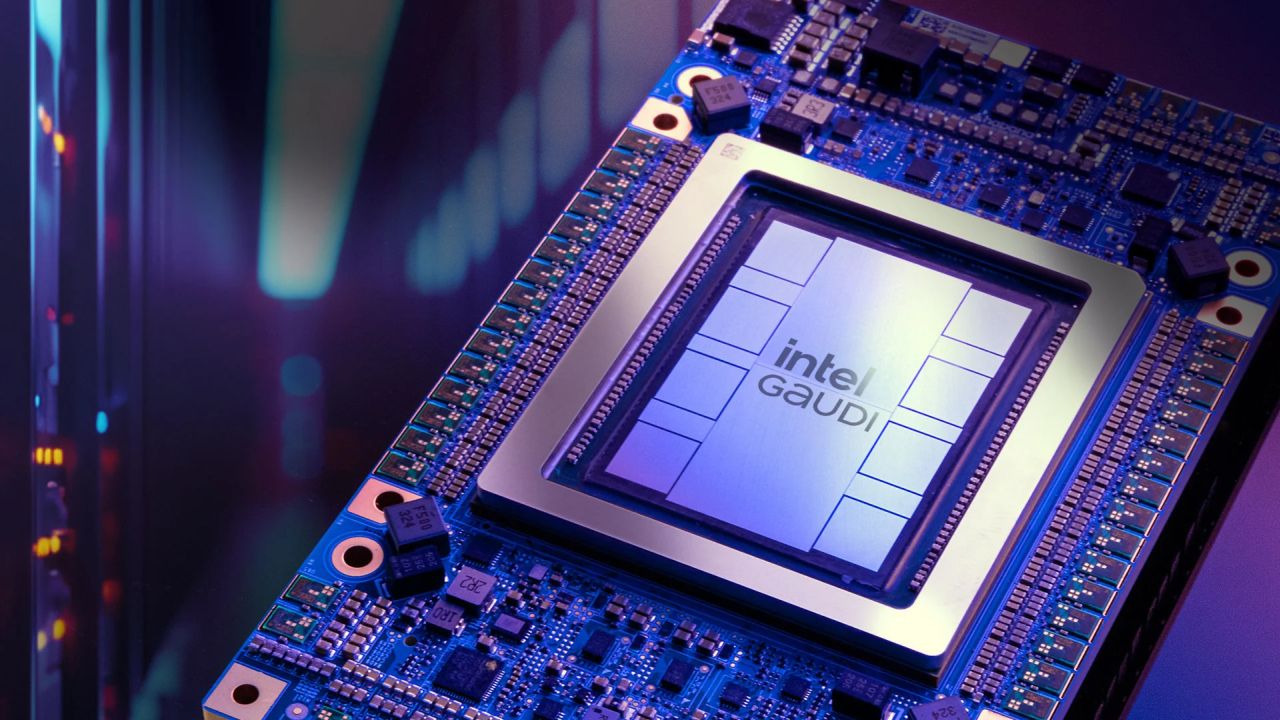
At the OCP Global Summit, one of the biggest surprises came from Intel and Nvidia: the two tech giants have teamed up, bringing Intel’s Gaudi 3 AI chips into Nvidia’s Blackwell ecosystem to create a hybrid rack-scale platform that merges both companies’ strengths.
Intel has reportedly integrated its Gaudi 3 rack-scale architecture into Nvidia’s Blackwell technology stack, aiming to deliver a hybrid AI system with significantly improved performance. Intel’s AI lineup — particularly the Gaudi family — has struggled to gain real traction against dominant players like Nvidia and AMD. Now, Intel seems to have found a way to give Gaudi new life by embedding it into Nvidia’s powerful infrastructure.
According to SemiAnalysis, Intel will offer a new rack-scale configuration that combines Gaudi 3 AI chips with Nvidia’s Blackwell B200 GPU and ConnectX networking. The idea is to have the Gaudi 3 handle the “decode” side of inference workloads, while the B200 takes care of the more aggressive “prefill” operations. Since Nvidia’s Blackwell GPUs excel in large matrix computations, this division of labor makes practical sense for performance optimization.
Intel just took another step on combining forces 🔥 with NVIDIA by integrating their new Gaudi3 rack scale systems together with NVIDIA B200 via disaggregated PD inferencing. Intel claims that compared their B200 only baseline, and inferencing system using Gaudi3 for decode part… pic.twitter.com/jAKin6rgZx
— SemiAnalysis (@SemiAnalysis_) October 18, 2025
The system focuses on memory bandwidth and Ethernet-based scalability. Each rack integrates Nvidia ConnectX-7 400 GbE NICs and Broadcom Tomahawk 5 (51.2 Tb/s) switches to ensure full “all-to-all” connectivity. SemiAnalysis notes that each compute tray features two Xeon CPUs, four Gaudi 3 AI chips, four network interfaces, and one Nvidia BlueField-3 DPU, with a total of 16 trays per rack.
This setup positions the Gaudi platform as a cost-efficient decoding engine within Nvidia’s AI ecosystem. Intel claims the hybrid rack system delivers up to 1.7× faster prefill performance for smaller, denser models compared to baseline B200-only configurations — though these figures still await independent verification. For Intel, this could finally turn Gaudi into a profitable product line, while for Nvidia, it reinforces its reputation for world-class networking capabilities.
However, the Gaudi AI software stack remains immature, limiting its real-world deployment potential. With the Gaudi architecture expected to phase out in the coming months, it remains uncertain whether this hybrid rack-scale solution can achieve mainstream adoption in the fast-moving AI hardware market.
Source: WCCFTech



![The Head of Take-Two Is Lying About the Price of Grand Theft Auto VI! [VIDEO]](https://thegeek.games/wp-content/uploads/2026/08/gta-vi-1280x720-1-302x180.jpg)









![The Head of Take-Two Is Lying About the Price of Grand Theft Auto VI! [VIDEO]](https://thegeek.games/wp-content/uploads/2026/08/gta-vi-1280x720-1-300x365.jpg)

Leave a Reply