
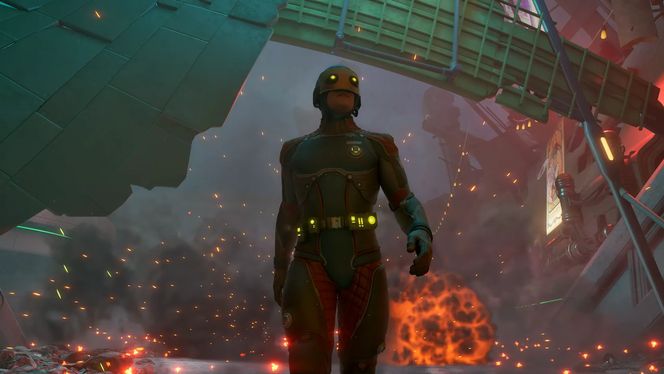
If there is one thing that has always defined Obsidian, it is how the studio smuggles very human, very real-world issues into its fictional universes. The Californians have done it in their Fallout titles, but it is in The Outer Worlds and its upcoming sequel that their commentary on capitalism is the sharpest. Even so, director Brandon Adler stresses that The Outer Worlds 2 is not designed as a lecture; it does not want to convert players or hammer home a blunt political message about today’s world, even if its portrayal of power and abuse inevitably feels very familiar.
From Adler’s point of view, Obsidian is essentially holding up a distorted mirror. The studio already applied this grounded, human approach within the Fallout universe, but with The Outer Worlds duology, they pushed the idea to the limit, using a corporation-ruled sci-fi world to talk about reality. The director insists that the goal is not to educate or to raise awareness in a didactic way, let alone to change anyone’s ideology, even if the way the games show hierarchies and abuses of power could hardly be clearer.
Speaking on the My Perfect Console podcast, Adler explains that Microsoft never stepped in to water down that vision or to police their script. According to him, “They never told us, ‘You can’t say that.’ They literally never asked us to review anything,” so there was no list of forbidden topics and no requests to tone down the satire. He even says the corporation seemed surprisingly relaxed about jokes that some might interpret as digs at giant companies. As he puts it with a laugh, “Maybe if we had gone too far they would have said something, but it didn’t happen,” meaning that line was never crossed in Microsoft’s eyes.
The Outer Worlds Targets Elites, Not Ideas
Adler also makes it clear that Obsidian never set out to deliver a narrow political sermon or a direct attack on modern capitalism. Under the creative leadership of Leonard Boyarsky, the studio prefers to step back and look at power structures from a broader angle, inside fictional settings. In his words, The Outer Worlds is really about how elites mistreat those without power and about how far a corporation can go, if taken to the extreme, in squeezing both workers and consumers. All of this is filtered through absurdist humor, where people inside the game world treat as normal things that, from the outside, look completely unhinged.
The sequel, however, pushes that idea further. Beyond the megacorporations, The Outer Worlds 2 widens its cast of factions with groups like the authoritarian Protectorate and the Order of the Ascendant, a science-obsessed cult that borders on fanaticism. Adler stresses that these are not meant as hot takes on today’s headlines, but as reflections of patterns that have existed for as long as we can remember. “That’s why many people think we’re talking about the present. But this happens constantly; we see it repeating itself time and time again,” he notes, pointing out that the cycle keeps coming back in different guises.
Throughout the conversation, Adler returns to the same basic idea: Obsidian does not want to preach at the player, it wants to present messy situations and let people decide for themselves. “I don’t like video games to be moralistic,” he says, explaining that he prefers stories that do not hand out a tidy moral at the end. For that reason, The Outer Worlds 2 is being built to show the pros and cons of each worldview in a relatively neutral way, which already led to wildly different readings of the first game. Some players walked away convinced it was a critique of capitalism, while others argued it was actually anti-communist. As Adler puts it, “The truth is, we show how we believe these ideas would develop. The final decision is up to the player,” so Obsidian simply sketches the consequences and leaves the verdict to whoever is holding the controller.
Source: 3djuegos








Leave a Reply