
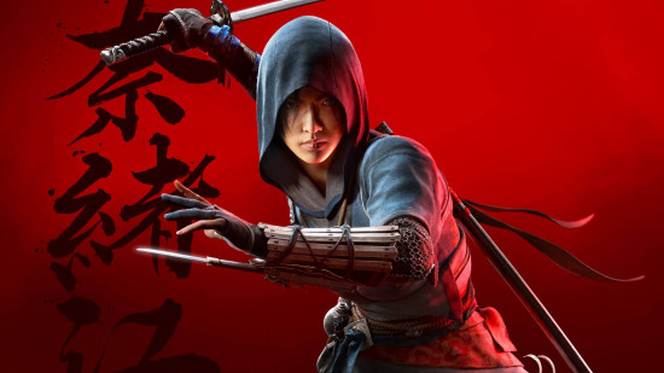
Considering the performance of the available hardware since June, Ubisoft had to scale back the game a bit, which is understandable.
About a month ago, Ubisoft confirmed that Assassin’s Creed Shadows will be released on December 2 for the Nintendo Switch 2. The game’s engine, the latest version of Anvil, includes significant technological improvements that propel the franchise into the next generation. These improvements include extensive ray tracing (RT) effects, such as global illumination and reflections; fluid simulation–driven dynamic wind and rain that affect trees, foliage, and leaves; and physics-based procedural cloud and weather simulation that constantly shapes the clouds.
The engine also features a Nanite-style micropolygon system that virtualizes geometry. This allows it to render extremely detailed terrain and assets while smoothly adjusting triangle density based on distance. It also features extended destruction physics, improved cloth and material interactions, and reworked terrain and asset streaming. This system is built around the aforementioned virtualized geometry, which keeps dense villages and varied terrain loaded without taxing the CPU or storage bandwidth. Additionally, there is deeper integration of GPU instancing and mesh shaders. This reduces CPU load and efficiently renders many small objects.
However, the Nintendo Switch 2 is much less powerful than the platforms on which the game was first released: the PlayStation 5, Xbox Series, and PC. According to Bruno, Ubisoft’s lead programmer, the developers had to redesign the appearance of the world and the interaction between the game systems of Assassin’s Creed: Shadows. Basic simulation systems, such as those for clouds and clothing, were kept but significantly optimized and sometimes reduced to reduce GPU load. Global illumination uses a built-in solution that is already used on low-spec PCs and the Xbox Series S to save RAM rather than relying on the console’s hardware ray tracing support to implement RTGI. Additionally, Ubisoft reduced all parameters (LOD, draw distances, texture resolution, and object streaming) in each scenario and only reduced the number of NPCs in dense nodes when necessary to maintain performance.
The developers used the Nintendo Switch 2’s Nvidia DLSS support to reconstruct sharp images from lower resolutions, thereby improving performance. Ultimately, however, Ubisoft opted for a consistent 30 FPS frame rate in both handheld and docked modes. Therefore, the difference lies in the visual quality, which deteriorates further in handheld mode. Docked mode offers better image quality, a greater draw distance, and more refined LOD settings. Handheld mode has a few tricks up its sleeve, such as HDR support and a refined implementation of Variable Refresh Rate (VRR). Bruno explained that the typical lower frame rate limit for VRR is 40 FPS, but Assassin’s Creed Shadows runs at 30 FPS on the Nintendo Switch 2. They didn’t want to compromise on this, so they developed a special algorithm that keeps VRR enabled at 30 FPS, making the game as smooth and responsive as possible. Ubisoft is also taking advantage of platform-specific features in this version, such as touchscreen menus, maps, and hideout interactions. They also plan to add mouse and keyboard compatibility in docked mode.
The Nintendo Switch 2 port of Assassin’s Creed Shadows is set to release on December 2. However, it will not include the game’s major expansion, Claws of Awaji, which is not expected until 2026.
Source: WCCFTech

![WARDOGS Hits Early Access in September, with a Closed Beta First [VIDEO]](https://thegeek.games/wp-content/uploads/2026/08/theGeek-WARDOGS-Early-Access-302x180.jpg)
![An ex-Bethesda Dev Says Including More than 1,000 Planets in Starfield Was a Bad Decision! [VIDEO]](https://thegeek.games/wp-content/uploads/2025/09/thegeek-starfield-nagy-1-302x180.png)


![A Modder Has Turned GeForce Now into a High-End Cloud PC! [VIDEO]](https://thegeek.games/wp-content/uploads/2026/08/theGeek-GeForce-Now-cloud-PC-302x180.jpg)



![Pregnant Anne Hathaway Shows Off Her Baby Bump at New Film Premiere [VIDEO]](https://thegeek.games/wp-content/uploads/2026/08/theGeek-Anne-Hathaway-302x180.jpg)

![WARDOGS Hits Early Access in September, with a Closed Beta First [VIDEO]](https://thegeek.games/wp-content/uploads/2026/08/theGeek-WARDOGS-Early-Access-300x365.jpg)
![An ex-Bethesda Dev Says Including More than 1,000 Planets in Starfield Was a Bad Decision! [VIDEO]](https://thegeek.games/wp-content/uploads/2025/09/thegeek-starfield-nagy-1-300x365.png)

Leave a Reply