
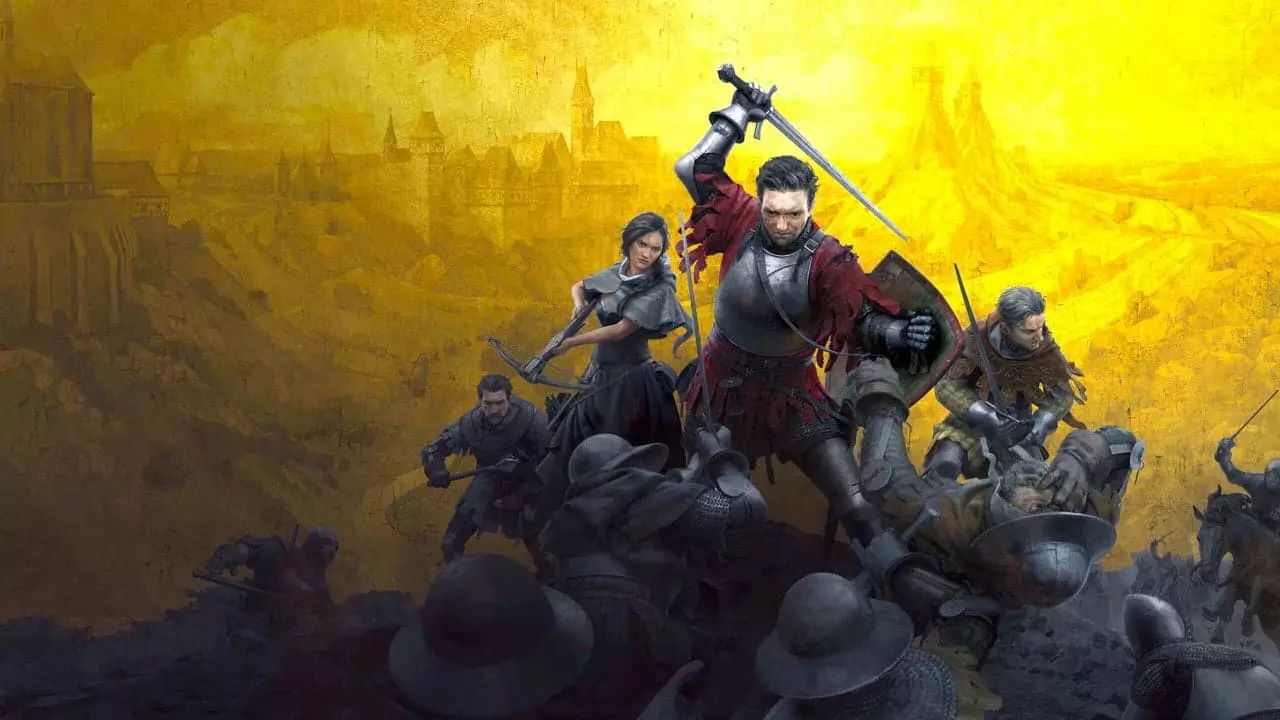
Larian’s admission regarding artificial intelligence sparked a major debate on the internet, which Daniel Vávra weighed in on.
Larian admitted that they use generative AI for certain tasks – concept art, placeholder text, and PowerPoint presentations – during the development of the new Divinity game, which triggered a huge controversy. Many fans vowed not to buy the game if the studio did not reverse its decision, while Larian denied the accusations and clarified that AI-generated content would not make it into the final game and that no one would lose their job because of it.
Daniel Vávra, founder of Warhorse and creative director of Kingdom Come: Deliverance, shared his own thoughts on the subject. Vávra is not known for mincing words, and stated that Larian merely said out loud what literally every developer is doing, adding that AI is now a reality we cannot turn back from, despite the hysteria surrounding it. He compared this reaction to people smashing steam engines during the Industrial Revolution.
“This AI hysteria is the same as when people were smashing steam engines in the 19th century. Larian said they were doing what everyone else is doing, and it caused a crazy shitstorm. I’ve seen someone even accuse us of using AI in Kingdom Come: Deliverance 2. I know nothing about that, except that I used Topaz Labs to improve some AI elements and a few old, low-resolution textures from the first game. I’m not a fan of AI-generated art, but it’s time to face reality. AI is here, and it’s here to stay. As frightening as it may be, that’s the situation.
If AI helps me create an epic game in a year with a smaller team, like in the old days, then I fully support it. The game will still have an art director, writers, programmers, and graphic designers, but they won’t have to perform tedious and boring tasks and can focus on what really matters. I have ideas for many games, but I’m fifty years old, and so far it has taken an average of seven years to make a game. If AI helps me realize these ideas faster, then I fully support it,” said Vávra.
This AI hysteria is the same as when people were smashing steam engines in the 19th century. @LarAtLarian said they were doing something that absolutely everyone else is doing and got an insanely crazy shitstorm.
I’ve even seen someone accuse us of using AI in KCD2. I don’t… https://t.co/l7pNbTxeIT
— Daniel Vávra ⚔ (@DanielVavra) December 17, 2025
The gaming industry is facing significant challenges due to rising budgets and increasingly long development cycles. The only viable solution is to intelligently apply AI-based tools wherever possible to reduce the time spent on tedious, repetitive tasks. Of course, there is another option: significantly reducing scope, quality, or both, but for obvious reasons no developer or publisher believes this to be a viable path.
In his lengthy tweet, Vávra also mentioned other possible uses of generative AI in games, such as RPGs that would allow players to ask virtually anything of certain NPCs within the context of the game world, as seen for example in the Skyrim mod powered by Inworld AI technology. He also noted that AI will soon handle game programming as well, with software developers supervising this work. Opposing this, in his view, is just as pointless as opposing the use of sewing machines in the textile industry.
Vávra concluded his remarks by stating that AI could ultimately bring about humanity’s destruction, as predicted in Terminator, but it could also mean that virtually anyone will be able to realize almost any large-scale idea at a fraction of current costs. Making a game could become as easy as writing a book.
Source: WCCFTech


![God Save Birmingham Is Getting Co-op Mode [VIDEO]](https://thegeek.games/wp-content/uploads/2025/04/theGeek-God-Save-Birmingham-302x180.jpg)

![Miyazaki Says The Duskbloods’ Story Can Stand Alongside FromSoftware’s Earlier Games [VIDEO]](https://thegeek.games/wp-content/uploads/2026/08/theGeek-The-Duskbloods-story-1280x720-q80-302x180.jpg)





![God Save Birmingham Is Getting Co-op Mode [VIDEO]](https://thegeek.games/wp-content/uploads/2025/04/theGeek-God-Save-Birmingham-300x365.jpg)

Leave a Reply