
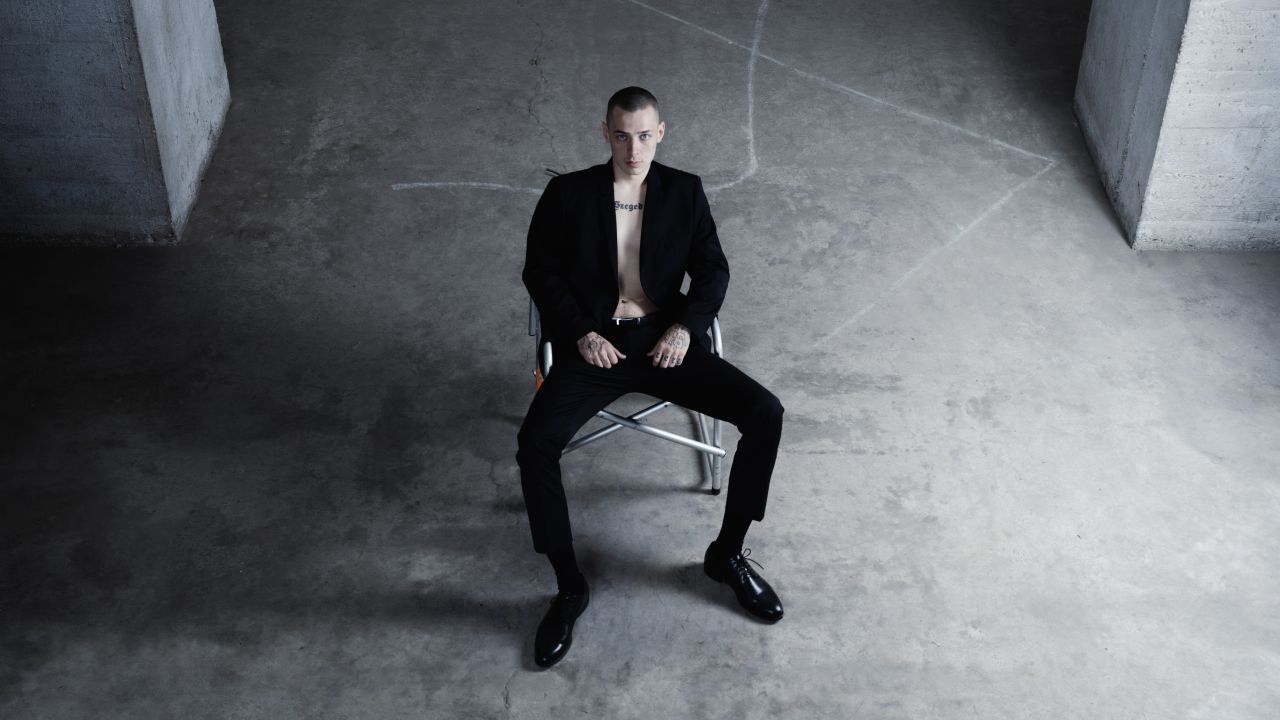
SERIES REVIEW – The documentary series Pogány Induló – What Would Mom Say does not create a myth, nor does it aim to become a parable. It follows a young artist in his early twenties during a phase of life when making music turns into a way of life, attention becomes constant pressure, and success brings not relief, but new questions.
The four-part series captures the everyday life of Marcell Szirmai, known by his stage name Pogány Induló (Pagan March), at the moment when his career takes a visible turn. Previously moving mostly within the underground scene, the artist suddenly finds himself on major stages, at sold-out concerts, and in the middle of nationwide attention. One of the series’ most important decisions is that it does not present this journey as a success story, but as a constantly shifting state, where progress does not mean closure, but an increasingly complex situation.

Personality Behind the Spotlight
Pogány Induló does not play a role in front of the camera. He comes across as restrained, often uncertain, at times distinctly withdrawn, someone who struggles to verbalize the processes unfolding inside him. The documentary does not attempt to resolve this, does not impose psychological explanations, and does not push him to deliver grand statements. Instead, it allows the personality to emerge through small reactions, gestures, and moments of silence.
The series consistently conveys that visibility does not automatically mean confidence. The larger the audience Marci faces, the more clearly the tension appears: the pressure to meet expectations, the fear of making mistakes, and the constant anxiety about when control might slip away. These internal processes do not surface in dramatic climaxes, but slowly, almost imperceptibly, build on one another.
What is important is that the series does not take sides and does not attempt to decide whether this life situation is “good” or not. It simply shows what it feels like to be inside it. This is what makes the portrait authentic: it does not comment, it does not judge, it simply records.

A Rapid Rise From the Inside
One of the strongest layers of the documentary series is the way it closely follows Pogány Induló’s everyday life amid concerts, rehearsals, and constant travel. On stage, the artist appears confident and often provocative, while behind the scenes he is frequently tired, scattered, and visibly exhausted. The camera does not only capture performances, but also those transitional moments when the spotlight fades and euphoria gives way to silence.
The pace gradually accelerates, while at the same time there is less and less time for processing. One trip follows another, one performance replaces the next, as private life is increasingly pushed into the background. In several scenes, Marci refers to how difficult it is to keep up with the rhythm of his own life, and how much fatigue and uncertainty accumulate behind what appears to be a “successful” operation.
Decision-making situations – new performances, collaborations, statements, expectations – do not appear as major dramatic conflicts, but as small, often unspoken tensions. This is precisely why the series works: it does not shout, it condenses. It shows how a career turns into a permanent state of readiness, where there is no real pause.
It also becomes clear that Pogány Induló is not a “stage animal” in the classical sense. He functions on stage, but does not draw energy from it. In front of the camera, an ambivalence repeatedly surfaces: as if he were simultaneously grateful for the attention and burdened by the entire situation. This duality forms one of the strongest tensions of the series.
The rapid rise therefore does not appear as a triumphant march, but as a process in which the artist constantly tries to adapt to a pace he does not always control.

Family, Personal Background, and Inner Tensions
The subtitle What Would Mom Say is not a stylistic ornament, but a genuine interpretive key. The family scenes reveal the foundational layers of Pogány Induló’s personality. Conversations with his parents bring out concern, anxiety, and the generational gap that creates tension in the lives of many young artists.
In these scenes, Marci shows a very different face than on stage. He is more restrained, less confident, often uncertain, and it is clearly difficult for him to articulate what everything happening around him actually means to him. The series does not dramatize this duality, does not attempt to manufacture conflict, but lets the situation speak for itself.
The family background does not function as an explanation, but as a point of reference. It shows where the artist started, and relative to which values and patterns his own life begins to feel alien. These moments give the series its emotional weight, without slipping into emotional manipulation.
The depiction of mental strain also fits into this layer. The documentary does not use big words, does not speak about burnout or diagnoses. Instead, it conveys through gestures, silences, and small reactions how pressure becomes constant and seeps into every area of life.
This restrained approach is particularly strong because it offers no resolution. It does not promise relief and does not close the story. The viewer must confront the fact that these tensions do not dissolve overnight.
Beyond a Portrait: A Generational Imprint
Formally, Pogány Induló – What Would Mom Say consciously avoids sensationalism. The visual language is functional, often raw, and the editing frequently lingers, allowing scenes to play out. This rhythm fits the depicted life situation and helps avoid excessive dramatization.
The alternation between concert footage and intimate, everyday moments constantly reminds the viewer how sharp the divide is between the public role and the private individual. The series does not attempt to bridge this gap, but rather shows that one has to live with it.
Ultimately, the documentary does not summarize the milestones of a career, but records a state of being. A phase of life in which success is already present, but its processing has not yet happened. Pogány Induló’s story thus extends beyond itself and condenses the experience of an entire generation: the tension between visibility, expectations, and identity.
It offers no closed narrative and provides no ready-made answers. It shows a young artist at a moment when everything is still in motion, and when the next step is far from obvious. This is precisely what makes the series truly strong.
-Herpai Gergely “BadSector”-
Pogány Induló – What Would Mom Say
Directorial Concept - 8.4
Authenticity - 8.8
Narrative Structure - 8
Visuals and Editing - 8.3
Social Relevance - 9
8.5
KIVÁLÓ
Pogány Induló – What Would Mom Say does not tell a heroic story, but documents a particularly dense and uncertain phase in a young artist’s life. The strength of the series lies in its refusal to explain or idealize, instead consistently revealing the tensions and inner struggles behind success. This restrained, intimate approach makes it both authentic and memorable.










Leave a Reply