
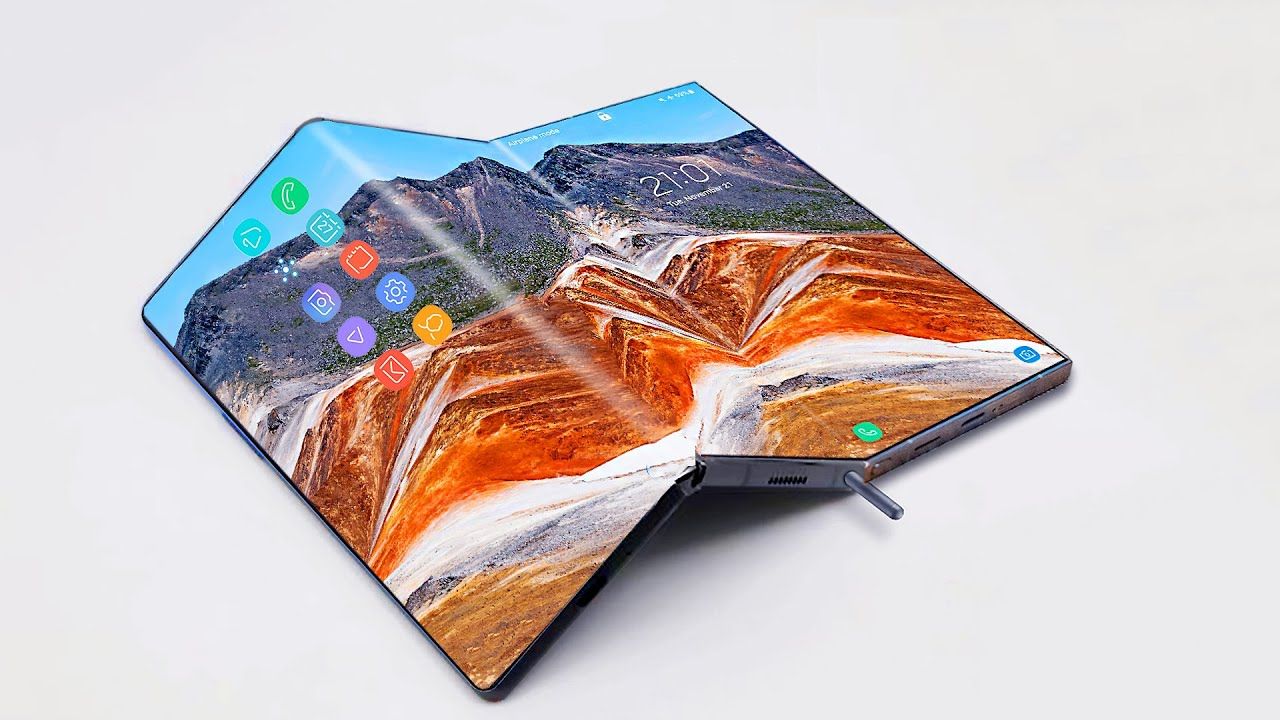
TECH NEWS — Perhaps it’s no coincidence that the South Korean tech giant decided to produce fewer double-folding smartphones than its other devices.
As we know, the Samsung Galaxy Z TriFold is fragile; the hinge starts to creak after about 60,000 folds. However, a new bend test has shown exactly how fragile the smartphone is in real life. JerryRigEverything recently uploaded an interesting video in which the Galaxy Z TriFold fails the bend test. The YouTuber notes that the TriFold’s thin plastic back panels do not provide additional structural support.
Note that Samsung claims the Galaxy Z TriFold can withstand 200,000 folding cycles, fewer than the Galaxy Z Fold 7,500 cycles. However, OMG_Electronics recently demonstrated that the TriFold’s hinge starts to creak after 61,000 folds and completely gives out after 144,000. According to industry estimates, we recently reported that Samsung has sold only 3,000–4,000 units of the Galaxy Z TriFold, and total global sales are not expected to exceed 30,000–40,000 units.
The key technical specifications of the Samsung Galaxy Z TriFold are as follows: unfolded dimensions of 159.2 x 214.1 x 3.9–4.2 mm and a folded thickness of 12.9 mm. It has a 10″ (25.4 cm) Dynamic LTPO AMOLED internal screen with a resolution of 2160 x 1584 and peak brightness of 1600 nits, as well as a 6.5″ (16.51 cm) FHD+ Dynamic LTPO AMOLED display with a resolution of 2520 x 1080 and peak brightness of 2600 nits. Both displays have a variable refresh rate ranging from 1 to 120 Hz. The device has 16 GB of RAM and a Snapdragon 8 Elite SoC (system on a chip), with 512 GB or 1 TB of storage.
It has a 5,600-mAh battery that supports 45-watt wired charging. The device is IP48 dust- and water-resistant, runs on Android 16-based One UI 8.0 software, and will receive seven Android operating system updates. The foldable smartphone has a 200 MP main camera, a 12 MP ultra-wide-angle lens, a 10 MP telephoto lens, and a 10 MP selfie camera on both the internal and external displays.
Source: WCCFTech








![Stranded Deep 2: After Two Years, We Finally Get to See More of It! [VIDEO]](https://thegeek.games/wp-content/uploads/2026/09/Stranded-Deep-2-1280x720-1-302x180.jpg)
![Sony Is Following the Same Path Xbox Took in 2013! [VIDEO]](https://thegeek.games/wp-content/uploads/2026/09/Live-TV-on-PS5-1280x720-exact-302x180.png)



Leave a Reply