
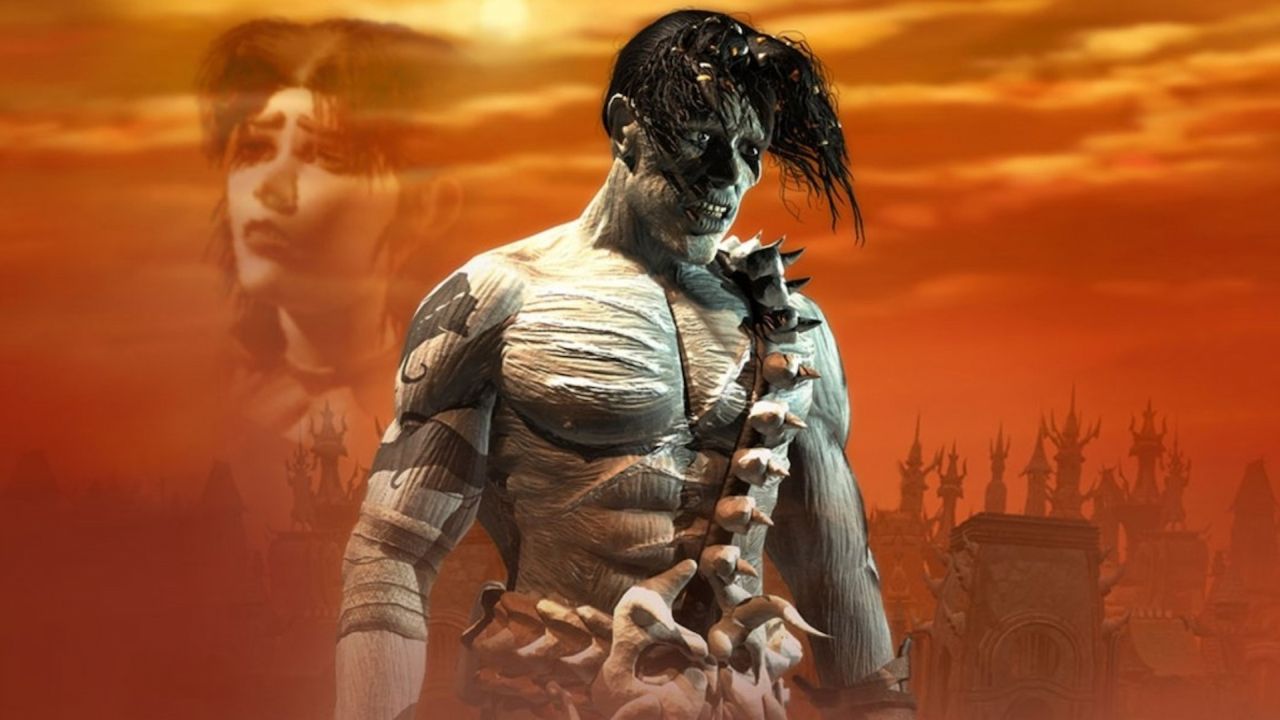
RETRO – Is immortality a curse, or a blessing? The protagonist of Planescape Torment would most certainly vote for the former. Since his soul is not accepted by the afterlife, after every death he constantly comes back to life within the walls of a mortuary and remembers nothing at all. He is forced to set out again and again to investigate who he really is and what he is looking for in the dark world of Planescape. Interplay’s latest role-playing game uses the Baldur’s Gate engine, but breaks away from the Sword Coast’s world of green forests and colorful meadows. It takes place in a universe where we must wander through catacombs filled with rotting corpses, within the walls of a cursed city, and our most loyal companion will be a floating skull.
Interplay’s career in computer role-playing games can hardly be called uninterrupted: after the famous Bard’s Tale series and Wasteland, for many years they failed to create anything truly era-defining. Their major comeback was finally brought about by the explosively successful post-apocalyptic Fallout released in 1997, which, among other things, won the Game of the Year title. One year later, Fallout 2, released in 1998, may not have contained revolutionary innovations, but it was just as good as the previous installment.

The company’s name once again came to the forefront among role-playing game enthusiasts – all the more so because enormous anticipation preceded the release of Baldur’s Gate, set in the Forgotten Realms, which achieved a breakthrough success. The creation of the BioWare team was called by many the greatest role-playing game of all time and topped the sales charts for months.
Amid the success, fortunately Interplay did not sit around resting on its laurels, but worked at full steam on its next project, Planescape Torment. The future of the game looked quite bleak: while it was being developed over the course of several years, the composition of the development team kept changing constantly – which is usually a sure sign that a game will be a major flop, or that it will not be released at all. Fortunately, this “curse” did not come true this time: Torment is a worthy “sibling” to Baldur’s Gate in almost every respect.

Dark Fantasy, No Sugar
I assume many are curious: what exactly is Planescape? If we call the worlds of Fallout and Baldur’s Gate universes, then the world of Planescape (using the creators’ own term) is a “multiverse.” This means it is divided into “planes of existence” (different dimensions) that revolve around the central city – Sigil.
The city of Sigil plays a special role: we can reach these planes of existence through mystical gates hidden throughout the city. These gates appear in the form of portals – but only if we have the proper key. To make things even more complicated, these keys are anything but ordinary – they can even take the form of a feeling or a thought.

The city itself could hardly be called a dream for SimCity fans: among miserable shacks, dark, foul-smelling taverns, filthy catacombs, bloody mortuaries, and various futuristic buildings, the streets are populated mostly by rotting zombies, prostitutes, bandits, and the hooded members of a strange cult, the Dustmen. The city of Sigil is ruled by the mysterious “Lady of Pain”: she is the master of everything and everyone, so it is not advisable to defy her laws or insult her openly in the streets…
From this, it is probably already clear that the Planescape “multiverse” paints a much more pessimistic worldview than other AD&D worlds. In addition, it is far more complex: in Planescape, belief, feelings, superstitions, and other abstract concepts can even manifest in physical form, and in the literal sense we can tear down or raise walls with them, kill or even resurrect various beings, and so on.

Our Name: Nobody
Those whom I have not yet scared away from the game will need a bit more “mental strength,” because the protagonist is not a well-groomed, Avatar-like fantasy figure either. Our hero is an undead being covered in terrible scars, who most resembles a large, relatively well-preserved zombie.
Moreover, those who have already been thinking about what clever name they would give their custom-built character (Ubul the Great, Killer Zotyó, Dreaded Béla, etc.) must be thoroughly disappointed: not only can they not change their character’s attributes or appearance, they cannot even give him a name. This might still be tolerable, but our hero’s “name” is simply – “The Nameless One.” I do not know how those who have already played the game feel about it, but at first I had the feeling that I had simply forgotten to give my character a name.

This feeling is not unfamiliar to our hero either, as he remembers not only his name, but nothing else at all: when he awakens on a cold stone slab in a mortuary during the game’s intro, only vague flashes of memory haunt him, and he has no idea how he got there or who he really is. (This motif may be familiar to adventure game fans: most recently, the bandaged-headed hero of the horror-adventure Sanitarium struggled with a similar trauma…)
“The Nameless One” is also immortal: unlike in Baldur’s Gate, where upon the death of our generated character we could immediately reload the previous save, here every time we receive a fatal wound, our hero faints, then awakens in the Mortuary, steps down from his stone bed, dusts himself off, and we can continue adventuring…
This is positive in some respects, but it can also become quite annoying when we are already very far away somewhere – most people will probably reload the previous save anyway. Our hero, by the way, only truly dies a “death of deaths” if his body is reduced to atoms, burned to ash, or otherwise completely destroyed.
The appearance of “The Nameless One” will unfortunately affect dialogue at first as well: in a rather frustrating way, most passersby look at us as if we were some kind of leper. Alongside remarks like “Get the hell out of here!” or “You stink!”, the friendliest comment is, “So what kind of grave did you crawl out of?” Sadly, we are better off (at first) if we endure this and do not give way to murderous urges…

The Good Dead Keep Learning Until Death…
Immortality also distinguishes “The Nameless One” from traditional RPG characters in another respect. Our hero does not learn and develop new abilities in the usual way; instead, they “come back to him” during our adventures. Despite being amnesiac, under the influence of certain events he can recall old abilities from his “previous” life. During the game, it turns out that in his earlier “lives,” over the many years that have passed, “The Nameless One” has practiced almost every kind of profession.
Translated into the language of gameplay, this trait makes Torment much more enjoyable compared to traditional role-playing games, because in terms of learned abilities it is far more flexible than heroes of other worlds: he can learn from mages, warriors, or thieves at the same time, and does not have to get stuck in a single class. At the beginning of the game we start as a low-level warrior, but if we want, we can soon “transform” into a thief or a mage. If later we want to return to our warrior past, we can do so almost at any time. Of course, if we want to remain truly proficient in a profession, it is worth sticking with it.

Similar to the two Fallout games, this title was fortunately also designed so that characters can behave in different ways in difficult situations: intelligent ones can “talk their way out,” those with a magical inclination can use spells, characters with stronger charisma can appeal to the sympathy of their conversation partners, while those with strong “charisma” can simply… well, beat things to a pulp. This trait of Planescape not only makes the entire game more realistic, but also truly worth replaying: if we have already finished it once with a warrior-type character, it will be worth starting again with a mage-oriented approach.
There is also a major difference in level progression compared to traditional RPG characters. At the beginning of the game, we are not a complete beginner, but a level-three warrior, a level-one mage, and a level-one thief. Since our experience points are divided among these three categories, leveling up takes quite a long time. Our HP (“hit points,” the “vulnerability value”) only increases when we raise the highest-level class by one: so if we are already a level-three warrior, then even if we advance from level one to level two as a mage, our HP will not change.
The developers also complicated magical abilities: even if we already have enough experience to know a spell, we can only cast it if we remember it. Learning weapon usage works similarly: we can only improve it if an instructor teaches us – no matter how high-level a warrior we are. (This detail, by the way, somewhat resembles another undead RPG, Revenant.) Fortunately, we also possess excellent special abilities: our hero can resurrect any member of his small party (assuming we are talking about “living” ones at all…), thus effectively extending his immortality to the entire group. I think it is already apparent from this: alongside his zombie-barbarian appearance, our hero has a rather complicated inner world…

Combat to the Death… or Even Beyond?
Fans of Diablo, and those who loved the large-scale battles in Baldur’s Gate, will be quite disappointed by the combat in Planescape. Their biggest problem will be that there is simply very little of it: this game is primarily built on character development and dialogue. Because of this, many would simply label it an adventure game: the truth is that the game mixes adventure and RPG elements in roughly a fifty-fifty ratio. If we want, we can fight during the game, but we gain most experience points by skillfully navigating the many branching dialogues.
This will be enjoyable for those who love lengthy conversations with non-player characters or uncovering terrible secrets behind hidden items. At the same time, Planescape Torment lacks the well-coordinated, gigantic battles of Baldur’s Gate: despite appearances, they did not simply “drop” a new universe and story onto the Baldur engine.

The strategic nature of combat has also disappeared from the game: it will generally be unnecessary to pause fights frequently – here we do not need to think about which warrior to place up front and what weapon to use. Only when using magic or performing a special ability do we need to freeze the game. Unfortunately, changes were also made to the interface: compared to Baldur’s Gate, it is much more cluttered and less transparent. Because of this, finding a spell during pauses is much more cumbersome – unfortunately.
Ultimately, combat most closely resembles old action-adventure games (Heimdall, Darkmere) – the role of ranged combat is essentially negligible. There will be no archer wars like in Baldur’s Gate – I do not know how others feel about it, but I missed this element a lot… If we want to kill with “our Nameless One,” most of the time we simply have to walk up and take down the problematic delinquent. The dominance of melee combat also affects magic use: we will not have much time to mutter spells, because before we can finish, we will get hit over the head and the muttering will turn into swearing.

Companions We Would Not Want Even in Our Nightmares?
However, the somewhat simplified combat is counterbalanced by the excellently crafted non-player characters, and especially our companions. Each of them has their own individual character and traits, and this comes through much more strongly during the game than, for example, in Baldur’s Gate. One such example is Morte, the floating skull, who joins us right at the beginning of the game and, having no other body parts, is most useful for his never-ending mouth (his teeth). We constantly have to argue with him so that he does not harass seductively rotting zombie girls or pick fights with strangers while we are talking to them.
During clashes, however, he is a very useful companion: his bites can cause damage comparable to a small scratch, and during the game we can also “upgrade” his teeth (harder dentures, etc.). Like other characters, he also has special abilities: he can anger an enemy so much that they immediately attack him, trying to beat him senseless (or rather, just senseless), while we can comfortably take down the other characters from behind.
During our journeys we encounter many other non-player characters as well, and they too are almost as carefully crafted – so much so that we will spend a large part of the game talking to them. The sheer number of dialogues (many even compared to Baldur’s Gate) will certainly appeal to fans of adventure games, but hardcore role-playing fans or Diablo enthusiasts will probably find it boring.

An Autopsy Hall With Frescoes?
Although the graphics engine of Planescape is essentially the same as Baldur’s Gate’s, with small innovations it was still made more spectacular. Thanks to the camera zooming in much closer, the characters are far more visible and drawn in greater detail.
The various buildings and locations are also drawn with enormous care – sometimes we truly feel as if we ourselves are wandering through the world of Planescape. Because of the graphics, we may even become too immersed in the game’s atmosphere: at the very beginning, when I was wandering through the mortuary among the many dissected corpses, I was sometimes seriously overcome with nausea and urgently wanted to get out of there. I would also like to highlight the graphical effects during spells: sometimes we see such astonishing, screen-filling animations that we find ourselves no longer paying attention to the combat at all!

“Dead Boring” or “Deadly” Good?
If we compare Planescape to Baldur’s Gate, we get a rather mixed picture. The game’s story, the protagonist, and the other characters are all much more detailed and interesting personalities than those in Baldur’s Gate. At the same time, many people (especially hardcore role-playing fans) may be bothered by the fact that they cannot fully shape the main character to their own taste, and may not be eager to step into the skin of a hulking, corpse-colored undead – perhaps it would have been good to have the option to generate a different kind of character in the usual way (although this could have come at the expense of the story). The dark, morbid world of Planescape may be off-putting at first glance – especially after Baldur’s Gate.
-Herpai Gergely BadSector-(2000)
Pro:
+ Atmospheric story
+ Beautiful graphics
+ Innovative approach
Con:
– Weak, simplified combat system
– Annoying side characters
– Occasionally dumbed-down companions
Publisher: Interplay
Developer: Black Isle Studios
Genre: Fantasy
Release: 12.12.1999.
Planescape Torment
Gameplay - 8.3
Graphics (1999) - 8
Story - 8.6
Music/Audio - 7.5
Ambiance - 9
8.3
EXCELLENT
A kalandjáték jelleg (sok párbeszéd, gyenge harc) idegesítő lehet azoknak, akik egy újabb Baldur's Gate-re vágynak. Akik viszont hozzám hasonlóan ezeken a kisebb negatívumokon túltették magukat, azok heteken keresztül ott ragadnak a Planescape világában!







Leave a Reply