
REVIEW – Operation Serpens looks like a no-nonsense VR shooter built to let you switch your brain off and start firing, and to its credit, it often delivers exactly that kind of cheap, loud fun. The problem is that the added free locomotion does not always make the game better – in several stages it feels like a later patch fighting against a rail-shooter skeleton that was never meant to carry it. We tested Operation Serpens on PSVR2.
Operation Serpens has been around for a while, and you can still feel its original form under the hood: this started life as a stationary, on-rails shooter, then later updates bolted on locomotion and turned it into a hybrid of arcade light-gun chaos and more traditional VR gunplay. On paper, that sounds like a straight upgrade. In practice, it is more of a mixed blessing. You play as a member of an elite task force tasked with dismantling the terrorist group called the Snakes by taking down their leadership and the soldiers guarding them. The opening tutorial runs you through the basics – shooting, movement, grenades – then sends you into the first mission. After each completed stage, you return to base, where you can pick the next campaign level or jump into extra modes.

Built on Rails, Then Taught to Walk
It becomes obvious fairly quickly that many stages were designed before free movement was ever part of the plan. The spaces where you can actually move are often tight and oddly constrained. One early mission keeps you inside a single room in an apartment building, another plants you in the back of a parked truck, and a third traps you in an elevator while enemies appear floor after floor. In these smaller scenarios, thumbstick movement mostly helps with bullet dodging so you do not have to physically sway around like you are doing aerobics in your living room.
In the larger stages, where the game expects you to walk or climb, the cracks show much more clearly. Invisible walls pop up where you do not expect them, geometry clipping can force awkward corrections, and the whole thing starts feeling less like tactical movement and more like negotiating with a stubborn level boundary. That tension between old structure and new locomotion is one of the game’s defining problems: when it works, you get a bit more freedom; when it doesn’t, you spend time wrestling the map instead of the enemies.
Outside the 7-stage campaign, which you can play on three difficulty settings, there are extra modes meant to add replay value. Zombie mode throws waves of armed and unarmed undead at you on a single map while you defend your position. It is serviceable, but it becomes repetitive fast. Another mode gives you three attempts to shoot as many animated dolls as possible in a bar, then locks you out until the next day. If you do not care about chasing leaderboard scores, neither mode has much long-term pull.
There is also multiplayer, where you and up to three friends fight through waves of soldiers in a mall map. Clearing waves opens additional routes and spawn points, which is a decent escalation hook. Unlike the other modes, ammo is limited here, so you actually need to pay attention to your surroundings because weapons can be scarce and seem to spawn in inconsistent spots. Crossplay is enabled – I played with a Quest user – but we could not hear each other, so voice chat support is either missing, unreliable, or simply not obvious. It is an okay mode, and you can play solo if you want, but with only one map and a visibly thin online population, it feels more like a bonus than a real pillar of the package.

Pistols Save the Day, Other Guns Mostly Spray Noise
The gunplay itself is where Operation Serpens becomes both fun and infuriating at the same time. Pistols feel good. They are reliable, readable, and responsive enough that you can actually play with intent. Most other weapons, unfortunately, feel like variations of spray-and-pray. Machine guns and shotguns rarely gave me the confidence that my shots were going where I wanted, whether I held them one-handed or two-handed. A lot of the time it felt like the bullets were actively negotiating with everything except the target I aimed at.
Because of that, I defaulted to pistols whenever the game let me. Sniper rifles are a pleasant surprise and can be fun, but the zoom feels too tight, which makes target acquisition harder than it should be. Ironically, in the stage that asks for sniping, you can also control an armed drone, and that ended up being more enjoyable than the actual sniping – aside from the fact that the drone moves at a glacial pace. It is one of several moments where the game stumbles into a better idea, then immediately trips over its own execution.
Reloading is simplified to keep the pace high: lower your weapon to your waist or press a face button. Some VR purists will not love that, but honestly, with the number of enemies and bullets on screen in many encounters, manual reloads would probably push the game from chaotic fun into pure frustration. The action is already hectic enough that you are often trying to shoot and dodge at the same time, let alone perform clean tactile reload animations under pressure.
Your left wrist shows health, your right wrist tracks stage progress, and missions usually hand you the starting weapons you need. Beyond guns, you get health pickups, riot shields, explosive grenades, and flashbangs. Grenades and flashbangs can be armed either by pulling the pin with your off hand or by pressing a button. No, you cannot pull the pin with your teeth – but yes, you can store smaller weapons in your mouth, which is ridiculous in exactly the kind of way this game occasionally benefits from. Flashbangs are especially useful because they trigger roughly ten seconds of slowed time, letting you pull off mini Matrix moments and rebalance fights that would otherwise spiral into nonsense.
Mission failure restarts the whole stage, which is mostly fair, but one mission is built around not killing allies, and the game has already trained you to shoot first and never ask questions. The result is a lot of accidental friendly kills until you memorize where and when everyone appears. The final stage leans heavily on climbing while enemies are still shooting at you, and that is where the locomotion issues hit hardest: I fell through the environment, got shot through geometry, and even got stuck once in a way that forced a restart because I could not reach the last enemy. So yes, it can be fun. It can also be maddening in a very avoidable way.

Budget Looks, Arcade Charm
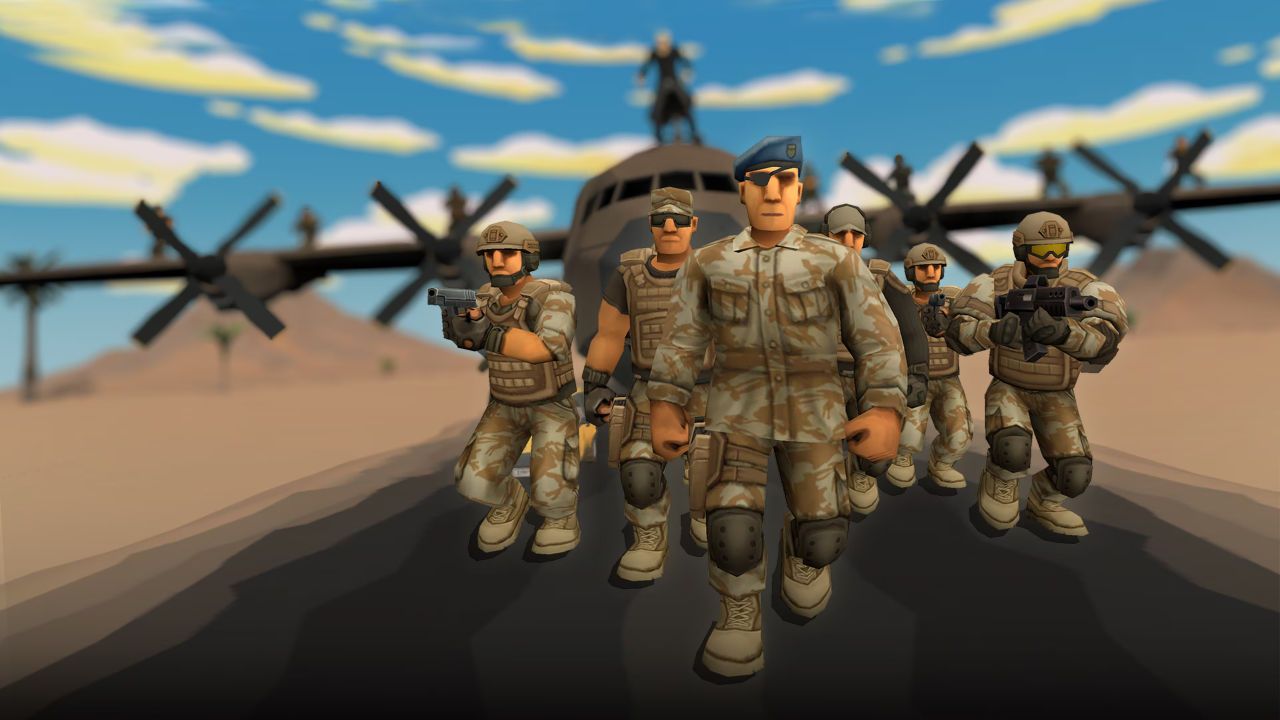
Operation Serpens is not going to impress anyone chasing realism. The visuals are stripped down, the NPCs move stiffly, and character models have a chunky, toy-like look that makes them resemble cheap action figures more than trained soldiers. Lighting is minimal to the point of near-absence, and the overall presentation strongly recalls the first Crisis VRigade, both in how it looks and in how it throws waves of enemies at you from windows, corners, and occasionally places that feel suspiciously convenient for the game rather than convincing for the scene.
And yet, despite all of that, the game has a scrappy charm. It feels like a small project trying to punch above its weight and occasionally landing a hit. One mission set in the back of a moving truck, with enemies driving and flying toward you, delivers exactly the kind of late-80s arcade absurdity that this game is actually very good at. I cannot call it a good-looking game, but I also cannot deny that the over-the-top action helps smooth over some of the rougher edges.
Performance, at least in my experience, was stable. As far as I could tell, the game was not using reprojection and held a steady frame rate, likely targeting 120Hz on PSVR2. That technical stability matters here because the game already asks you to deal with enough chaos without frame pacing adding to the problem.
3D audio is present, but in practice the sheer amount of on-screen chaos makes it easier to just look around than rely on sound cues for enemy direction. The soundtrack is sparse, with only a couple of tracks doing most of the work – one for briefings, one for combat – and the gunfire tends to overpower everything else anyway. It is not a strength, but it is not a deal-breaker either. Weapon sounds do the job. Haptics are similarly basic: most guns feel broadly the same, with light controller rumble on shots and reload actions. There are no adaptive triggers here.
Better When It Stops Pretending to Be Something Bigger
The funny part is that I often enjoyed Operation Serpens more when I treated it like an old-school arcade shooter and ignored the promise of modern locomotion depth. When I focused on shooting, dodging, and surviving the chaos, the game could be a genuinely entertaining, brain-off blast. The moment I had to fight the movement system, climbing logic, or collision problems, that momentum collapsed.
The extra modes do add some replay value, and multiplayer is a welcome inclusion on paper, but none of it feels substantial enough to carry the package once the campaign is done – especially with only one multiplayer map and a low chance of finding active players unless you organize a session yourself. What remains is a rough, sometimes charming shooter that can absolutely kill an evening if you are in the mood for disposable VR action and can tolerate its mechanical quirks.
That is also why the price stings. At around 20 dollars, this feels expensive for what it is – not because there is no fun here, but because too much of that fun is buried under locomotion problems and uneven execution. Cut the price roughly in half, and I would be far more forgiving. At full price, it is harder to recommend unless you specifically want a janky, arcade-style VR shooter and know exactly what you are getting into.
-Gergely Herpai “BadSector”-
Pros:
+ Pistols feel satisfying, and the core shooting can be genuinely fun in short bursts
+ Flashbang slow-motion moments and some set pieces deliver great arcade-style chaos
+ Extra modes and crossplay multiplayer add some replay value, even if limited
Cons:
– Added locomotion frequently clashes with stage design, causing invisible walls, clipping, and frustration
– Most non-pistol weapons feel unreliable, making combat variety weaker than it should be
– Thin presentation and uneven execution make the 20-dollar price feel too high
Publisher: VRKiwi
Developer: GINRA TECH
Genre: VR Arcade/FPS Shooter
Release Date: February 23, 2024 (PSVR2)
Operation Serpens
Gameplay - 7.9
Graphics - 6.3
VR Experience - 7.5
Music/audio - 6.8
Ambience - 8
7.3
GOOD
Operation Serpens is at its best when it embraces its old-school VR arcade shooter roots and lets you focus on fast shooting, dodging, and chaotic set pieces. The patched-in locomotion and climbing systems add freedom on paper, but too often create frustration through collision issues, invisible walls, and awkward level interactions. There is fun here, but it comes wrapped in rough execution and a price point that asks for more polish than the game consistently delivers.




![An ex-Bethesda Dev Says Including More than 1,000 Planets in Starfield Was a Bad Decision! [VIDEO]](https://thegeek.games/wp-content/uploads/2025/09/thegeek-starfield-nagy-1-302x180.png)










Leave a Reply