
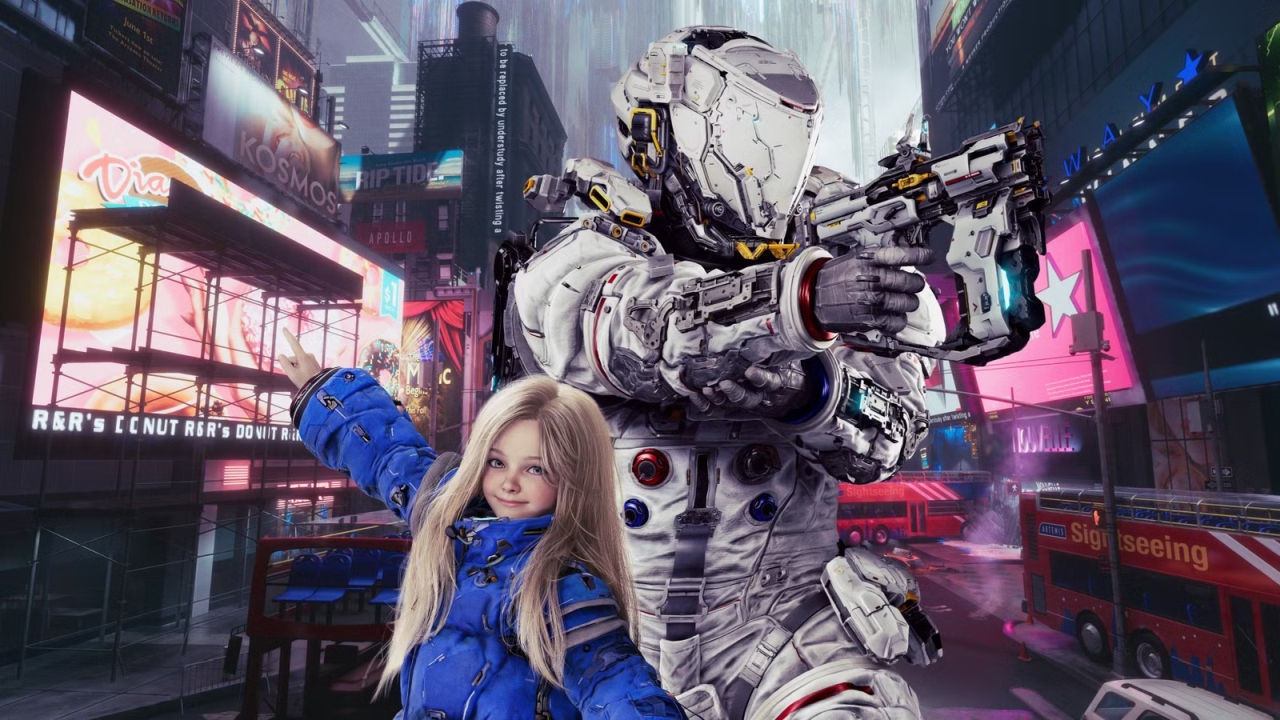
REVIEW – Six years passed between the announcement and release of Pragmata, which is an unusually long time by Capcom standards. The Japanese publisher usually works with tightly structured, highly precise marketing campaigns: a strong first reveal, clearly trackable milestones, a few months of buildup, and then the game is already in players’ hands before anticipation can turn into frustration.
In the case of Pragmata, however, that machine visibly stalled. The game was first shown during the initial hype around the PlayStation 5, at the time it was still promised for the following year, then it practically disappeared from the radar and kept collecting delays one after another. Because of this, many people had already started to think this would become yet another lost project, one that gets strung along for years before quietly being swallowed by nothingness. Now that it has finally been released, one of the biggest surprises is just how little of that troubled development history actually shows on it.
Many feared that Pragmata would meet the same fate as Deep Down, becoming another example of that bizarre vapourware category publishers refuse to talk about in any meaningful way for years, yet never officially cancel either. Instead, after nearly five years of almost complete silence, the game returned, then after a few months of a restarted campaign it actually made it to stores. And what is truly strange is that at first glance it does not look at all like a project that was torn apart and rebuilt a thousand times along the way. After such a long development cycle, you would normally expect the final result to be full of compromises, an identity crisis, and ideas awkwardly stitched together. Pragmata, however, feels surprisingly cohesive, and it has also preserved several characters, locations, and motifs we had already seen in its first trailer six years ago.
After finishing the campaign and checking out part of the endgame as well, the whole thing feels even stranger. If Capcom had not shown the game so early back then, nobody would probably be able to tell that it went through such a troubled development cycle. You simply cannot see it. Pragmata is an extremely polished, technically stable game with a clear gameplay rhythm and very confident ambitions.
Several people have pointed out that, in some ways, it feels like it came from another era, more specifically from the period two generations ago when the market was full of third-person shooters born in the wake of Resident Evil 4 and Gears of War. That is partly true, because Pragmata really does draw from that tradition, but at the same time it adds its own twist, which immediately gives it a distinct identity.

The rhythm of two opposing gameplay systems is what gives the game its soul
One of Pragmata‘s most important ideas is that Hugh and Diana are both in your hands at the same time, and combat is built accordingly around two systems that seem contradictory at first. The enemies are armored robots that Diana has to hack in order for Hugh’s weapons to actually damage them. The hacking itself is a very simple grid-based minigame where you have to connect certain nodes as efficiently as possible. On its own, this minigame is not especially exciting, and the shooting is not as if some never-before-seen genre revolution were unfolding before your eyes either. Looked at separately, neither element screams genius. Together, though, the situation becomes very different.
If there is one thing the developers clearly spent a great deal of time on, it is the very specific rhythm with which they mix puzzle-like thinking and raw, immediate action. As players, we are forced to switch back and forth between two types of tasks that video games have spent decades carefully keeping apart. Here, however, there is no comfortable separation. You have to pay attention to space, threats, timing, and the systems that need to be broken into all at once. The result is a kind of multitasking tension that can at times feel genuinely unpleasant, even unfair, but that is exactly where the game’s personality comes from.
From this perspective, Pragmata is a distinctly risky game. For decades, the medium has taught us that combat and puzzles belong in two separate boxes. If you are fighting, you are not solving this kind of logic task, and if you are solving a logic task, an aggressive swarm of robots is not crashing down on you at the same time. Because of this, it is a completely natural first reaction for the whole thing to feel wrong, alien, and uncomfortable. My first impression from the demo was not positive either, and I was worried the game would wear me out too quickly before it had a chance to fully make its case. Even with the final version, it took some time before it really clicked for me. There is a more serious encounter on the New York stage where enemies pour onto you mercilessly, exploit the narrow choke point, and very quickly push you to your limit. That was the point where the frustration already felt too intense. Then something suddenly clicked, and from there on everything started to work.

Once your brain adjusts, you start seeing a very different game
As soon as a player internalizes the rhythm of how Pragmata works, the pieces suddenly slide into place. This is not an especially difficult game, far from it. It simply structures situations differently from what we have been used to for the past twenty years. It is not creating a completely new paradigm, but it does shake up familiar formulas enough to be called genuine innovation. The immediate consequence of that, however, is that it creates friction between the player and the system. And that is exactly the kind of risk fewer and fewer studios are willing to take today, when there is brutal competition for people’s time and money.
A lot of people like to say that today’s audience has a higher tolerance for frustration because of soulslike games, but I think that is misleading. By now, soulslikes are themselves a fully known and solidified set of conventions. Players know exactly what to expect, how the genre works, and what kind of mindset they need to approach it with. Innovation, by contrast, always comes with the unfamiliar. And this is where Pragmata is clever: it is not interesting because nobody has ever done anything like it before, but because it reaches back to an older action-game tradition while disrupting its familiar rhythm in a fairly forceful way.
The industry is also prone to jumping from one trend to the next. A surprise hit arrives, publishers see the money in it, and suddenly everyone starts trying to reproduce that same genre or formula in some variation. That is how, for a while, everything became open world, MMO, extraction shooter, battle royale, or survival. The same thing happened with third-person action games back in the day as well. The process usually looks the same: something explodes in popularity, everyone rushes toward it, the market temporarily swells, then quickly saturates, enthusiasm cools off, projects die out, and everyone starts scrambling toward the next big wave. Pragmata is especially interesting in that environment because it is not desperately trying to hit the next trend. Instead, it reaches back to something we thought had already worn itself out, and dusts it off in a way that gives it life again.

It does not create a revolution, it gives a new perspective to something we had already written off
From this perspective, Pragmata represents a kind of more mature moment for the industry. It does not suggest that we must invent entirely new genres at all costs, but rather that it is still possible to turn meaningfully toward the past. Old ideas can be lifted up, rethought, and presented again in a way that lets them function as more than mere nostalgia, giving them genuine new life instead. If you add Capcom‘s experience to that, along with a budget tailored to the task, the visible patience spent on polishing, and the fact that audiences were open to it this time, then what you really have in front of you is a fairly logical recipe for success.
A few weeks ago, Mark Cerny said in Simon Parkin’s podcast My Perfect Console that in Atari’s early 1980s period, they essentially could not even make a game that belonged to an already existing genre – every single time they had to create a new genre. That may have made sense back then, because we are talking about a pioneering era. Today, however, the foundations of design have long since been laid, and there is no new genre continent waiting to be discovered on every corner. Even so, there is still plenty of room for innovation. What is needed is not necessarily revolution, but a new point of view. And that is exactly what Pragmata offers: it shows that what once became scorched earth because of an oversaturated industry can, decades later, start growing again.
-Gergely Herpai “BadSector”-
Pros:
+ The combination of hacking and third-person action creates a rhythm that gives the game a truly distinct identity
+ Stable, polished execution with a cohesive identity – no sign of the six years of trouble behind it
+ It dares to return to an older formula, but disrupts it in a way that creates a fresh experience
Cons:
– The grid-based hacking minigame is not very exciting on its own, and can feel alien at first
– In some larger encounters, the multitasking tension can slip into frustration
– Anyone instinctively put off by the idea of “thinking during combat” may need time before their brain adjusts to it
Developer: Capcom
Publisher: Capcom
Release date: April 17, 2026
Genre: Third-person sci-fi action with hacking-centered combat
Platforms: PlayStation 5, Xbox Series X|S, PC
Pragmata
Gameplay - 8.2
Graphics - 8.4
Story - 8.6
Music/Audio - 7.6
Ambiance - 8.2
8.2
EXCELLENT
Pragmata's greatest strength is not that it reinvents everything, but that it rethinks a familiar action framework through a system that feels unusually fresh. At first, the combination of combat and hacking deliberately throws the player off balance, but later that very quality becomes the source of the game’s distinctive rhythm and character. Not every idea works equally well, yet the end result is still a confident, polished, and surprisingly unique action game that, despite its long development, arrived not as a compromised mess but as a deliberately crafted experience.








![The Alighieri Circle: Dante’s Bloodline: A Divine Drama Amid September’s Flood of Games [VIDEO]](https://thegeek.games/wp-content/uploads/2026/08/theGeek-Alighieri-Circle-1280x720-1-302x180.jpg)
![Clive Barker’s Hellraiser: Revival Is Already in the Works for the Nintendo Switch 2! [VIDEO]](https://thegeek.games/wp-content/uploads/2026/08/theGeek-Hellraiser-Revival-1280x720-1-302x180.jpg)
![Head to the Pondverse in The James Pond Legacy: The Pond Is Not Enough [VIDEO]](https://thegeek.games/wp-content/uploads/2026/08/theGeek-James-Pond-Legacy-1280x720-1-302x180.jpg)




Leave a Reply