
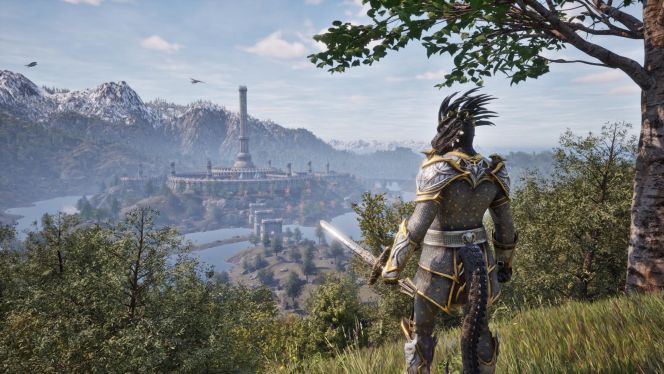
When The Elder Scrolls IV: Oblivion Remastered launched in April 2025, many players were willing to overlook its technical flaws because excitement around the release was so intense. Nearly a full year later, that goodwill has largely evaporated, and it is now increasingly clear that the PC version has seen very little meaningful optimization while Bethesda appears to be doing almost nothing about it.
When Bethesda surprise-launched the remaster in April 2025, expectations were so high that a lot of players gave it the benefit of the doubt. Since it was a Virtuos and Bethesda production, it was easy enough to assume the RPG would suffer from some performance issues, especially with an Unreal Engine 5 layer involved. What is far harder to excuse is the fact that, almost one year later, the situation seems barely improved.
Digital Foundry had already warned at launch that Oblivion Remastered had serious technical problems to solve. These included frame rate drops while exploring the open world, unstable performance in general, and, most worrying of all, a gradual degradation that pointed to an unresolved memory leak. After revisiting the game now, the team has arrived at essentially the same conclusion it did back then: very little has changed, and Bethesda seems content to ignore the issue.
Oblivion Remastered Is Still Almost as Broken on PC
According to Digital Foundry, the last PC patch was update 1.2, which arrived in July last year, and the game has received no further fixes since then. The team argues that this is an unusually short post-launch support window for a title that was only a few months old when support effectively dried up. In their view, the current state of the remaster ranges from merely frustrating to effectively unplayable, depending on how much tolerance a player has for constant stuttering, crashes, and deeper systemic technical issues.
The analysis points directly at the game’s underlying design decisions as the source of the problem. The original 2006 game architecture was overlaid with an Unreal Engine 5 presentation layer, and the combination of those two technologies appears to create frame rate instability that worsens the longer you play. Steam users have been asking for additional optimization patches for months, and it is no coincidence that the RPG’s recent user reviews have slipped into mixed territory.
The player numbers do not paint a flattering picture either. The remaster once reached more than 216,000 concurrent users, but that peak now feels very distant. The comparison becomes even more awkward when you remember that Skyrim, which turns 18 in December, still pulls in far stronger activity, while even the original Oblivion is not as far behind its remaster as Bethesda would probably like.
Digital Foundry’s only real hope is the Nintendo Switch 2 version, which is expected sometime in 2026. If that edition does arrive, Bethesda could use the opportunity to push a broader update across all platforms. However, the analysis suggests that the lack of substantial fixes so far points either to a belief inside Bethesda that major improvements were not possible, or to a simple unwillingness to put in the work. Neither explanation reflects well on the company.
What makes the whole thing especially frustrating is that Oblivion Remastered has been a major commercial success, selling millions of copies in only a few months. That is why a growing part of the community now feels the game has been effectively abandoned despite having generated more than enough momentum and money to justify proper long-term support. For a remaster of a title this important, it is a very poor look.
Source: 3DJuegos












Leave a Reply