
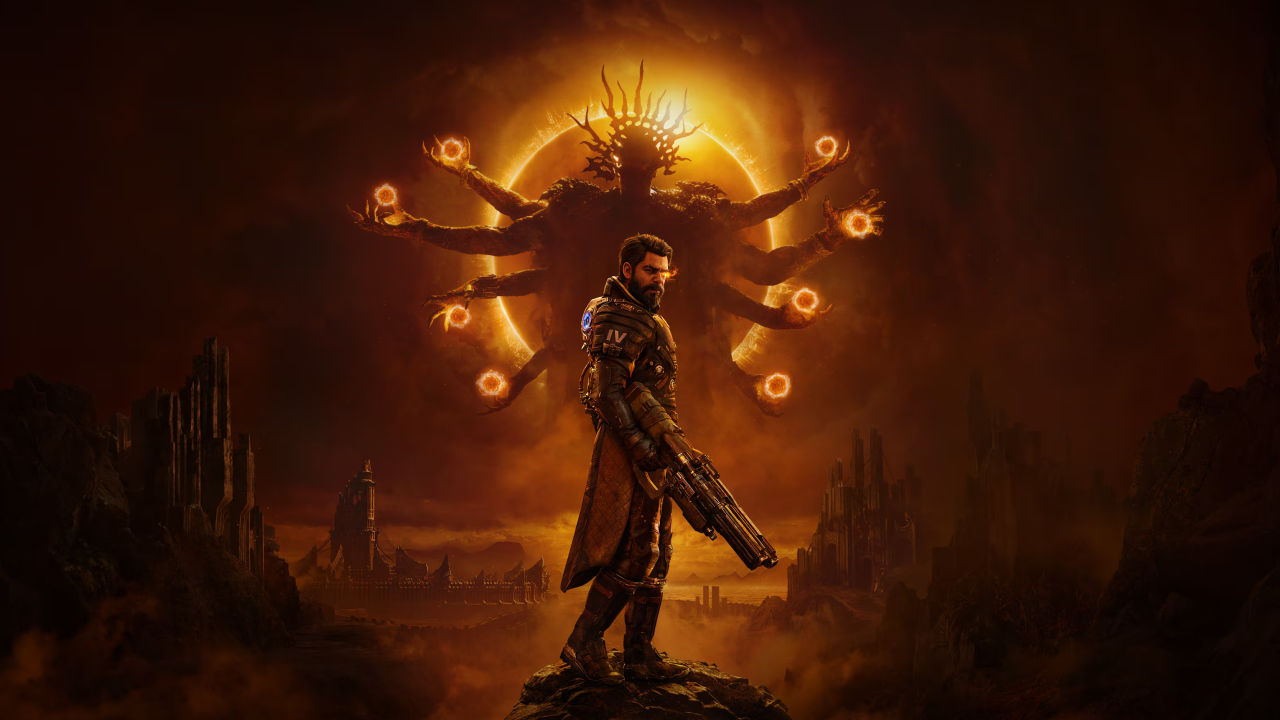
REVIEW – Saros is the kind of game that tells you within the first half-hour that you’re not here on a sightseeing tour. Housemarque has unleashed another neon-soaked cosmic nervous breakdown, only this time the punishment is smarter, meaner, and structured with far more confidence. Returnal hangs over the whole thing like a familiar ghost, but Saros is not a copy. It is a sharper, heavier, and occasionally nastier descendant from the same bloodline.
Before we get to Carcosa’s crimson flowers and blackened trees, though, there is a domestic side note that cannot be ignored. Hungarian PlayStation put us on a blacklist using a reason that was never properly explained to us and, from where we stand, looked like a fake excuse with zero transparency attached. As a result, we received no official support whatsoever for this review, and I was only able to properly test Saros thanks to a friend with whom we share an account.
And to be clear, this did not begin with the blacklist. Even before that, Hungarian PlayStation had a long-standing habit of getting codes to the bigger outlets first, which meant they could publish right as the embargo dropped, while smaller sites like ours were left to come in later and fight over the scraps. In games media, that is not some minor scheduling issue. It is a sporting head start dressed up as normal practice. Readers almost always click the first review they see, while late reviews inevitably reach fewer people. Anyone working in this field knows exactly how much that matters. Why certain outlets keep ending up with that kind of edge is something I will leave to the reader’s imagination. What matters here is that Saros is so good it muscles its way through even this bitter prelude.
Because if there is one thing Housemarque still understands better than most of the industry, it is how to turn on-screen chaos into a kind of violent, hypnotic rhythm. At first, Saros feels a little more forgiving than Returnal. A little more human. A little less eager to stomp on your throat for sport. Its permanent progression system makes the whole structure seem less punishing, as though the game has finally learned that respecting the player’s time is not the same as going soft. Then the bosses arrive, and the mask comes off. Suddenly you are back in that familiar Housemarque territory where one mistake becomes three, three becomes death, and death becomes a lesson delivered with a steel-toed boot. The first real boss in particular is where the game stops being polite, and getting thrown all the way back to the starting point after dying there is exactly the kind of frustration that can make you bark at the screen even while admitting the game is brilliant.

Even the scenery looks like it wants you dead
You play as Arjun Devraj, brought to life by Rahul Kohli, and that casting choice matters. Arjun is not some blank sci-fi mannequin in a suit. He carries history, trauma, obsession, and enough emotional wreckage to make Carcosa feel less like a mission objective and more like a psychological trap designed specifically for him. He arrives as part of a security operation looking for missing colonists, but the setup quickly mutates into something darker, stranger, and far less tidy than a rescue job gone wrong.
Carcosa itself is one of the game’s greatest weapons. Blackened forests, red flora, impossible ruins, metallic tunnels under the earth, cable-laced chasms the size of nightmares – the whole place looks like an ancient alien machine having a spiritual breakdown. The environments are not merely pretty. They are diseased, hostile, and memorable. This is not photorealism for its own sake. This is stylised dread with purpose. Saros works best when it lets the world do the talking, because Carcosa constantly suggests that something has gone wrong on a scale larger than plot exposition can comfortably explain.
The story is good without being airtight. There are strong moments, and the cast does a lot with the material. Jane Perry is excellent in command, Kohli gets several scenes that show he can do far more than just grimly bark through a helmet, and Housemarque clearly wants the narrative to carry some thematic weight about obsession, fear, and the cost of chasing answers on a world that keeps reshaping itself around you. The problem is that not every story beat lands with the same force as the combat. Some conversations feel oddly static, almost underdirected, and there are stretches where the plot seems less urgent than the firefights surrounding it. The story never sinks the game, but it does spend a little too much time trying to catch up to the action.

You feel invincible right up until you don’t
Combat is where Saros really bares its teeth. Housemarque’s action has always looked like panic rendered beautifully, and that remains true here. You dash, strafe, grapple, jump, shield, parry, and try not to disgrace yourself while the screen fills with hostile light. These encounters are not elegant in the balletic sense. They are desperate, filthy, instinctive things, the kind of fights where you win by staying half a second ahead of catastrophe and pretending that was your plan all along.
What makes Saros so addictive is how quickly it drags you into a flow state. At first the projectile patterns look like nonsense. A few hours later your eyes stop reading them as individual threats and start processing them as moving architecture. You are no longer reacting to separate bullets, lasers, and enemy lunges. You are reading the whole field at once, drifting through it on reflex and nerve. Your thumbs really do start to ache from all the strafing, but that physical pressure is part of the thrill. Very few studios are this good at making sensory overload feel readable.
Then there are the guns. They are spectacular. Not just visually, but mechanically. This is not a stack of interchangeable sci-fi peashooters with different damage numbers. Every weapon changes the feel of a fight. Some shots ricochet, some spread like a furnace blast, others carve through crowds with vicious spin and force. Switching between primary and alternate fire matters constantly, because the game keeps asking for adaptation rather than routine. You are not sitting behind cover waiting for permission to engage. You are being dragged into the centre of the storm and told to survive through movement, precision, and nerve.
The smartest evolution over Returnal is the progression model. Death still matters, but it is no longer the total reset button it once felt like. Saros gives you permanent resources and meaningful upgrades, so every failed run leaves something behind other than irritation. That design decision changes the emotional temperature of the whole game. It feels less punitive without ever becoming soft. The bosses will still flatten you if you lose concentration, and they are every bit as filthy and demanding as the toughest fights in Returnal. But the game now respects the idea that challenge does not need to erase your time investment in order to feel sharp.

The guns earn their keep here
Technically and artistically, Saros is the kind of first-party showcase Sony desperately wants in its portfolio. Thankfully, it earns that status the hard way. The art direction is superb. Carcosa is constantly moving, constantly mutating, constantly threatening to swallow you in a wash of red, black, steel, and cosmic rot. Housemarque is not chasing sterile realism here, and the game is much better for it. It aims for atmosphere, texture, motion, and impact, and in those areas it delivers with real authority.
The audio side is just as strong. Weapons crack with satisfying force, enemy attacks scream across the soundscape, and the score helps push the whole experience into that slightly feverish headspace where every run starts to feel half tactical and half primal. DualSense support is not some box-ticking extra either. It genuinely adds to the physicality of the shooting and defensive timing, making well-timed blocks, shots, and evasions feel like more than simple button presses.
Still, Saros is not untouchable. The story can drift. The dialogue scenes sometimes lack energy. Some of the visual excess borders on self-indulgence, and the repetition between runs can occasionally show through the spectacle. That first boss checkpoint sting is also real, and the game absolutely knows how to make you feel the distance between confidence and humiliation. But these blemishes never collapse the experience. They merely scratch at something that remains, overall, deeply accomplished.
Not flawless – just seriously good
Saros succeeds because it knows exactly where not to copy Returnal. It feels more welcoming at first, more considerate of your time, more willing to let progress accumulate rather than snatch it away for the sake of cruelty. But it never betrays the essential Housemarque philosophy. You still need speed. You still need precision. You still need to accept that one lapse in concentration can turn you into debris in under two minutes. The difference is that now the game throws you back into the ring a little stronger, rather than just laughing at your corpse.
There is a certain dark poetry in the fact that despite all the petty, opaque, and deeply unsporting nonsense surrounding access on the Hungarian side of PlayStation, what ultimately emerged here is a game worth talking about anyway. Not because it is flawless, but because it is forceful, distinctive, and intense in a way so few big-budget action games manage anymore. Housemarque has built another title that does not simply entertain. It alters your pulse. After a while, you are no longer just playing Saros. You are enduring it, adapting to it, and eventually moving inside its rhythm.
If the narrative had been a little tighter, if the talk-heavy scenes had been given more life, and if that early boss reset had been handled with a touch less sadistic satisfaction, the score might have climbed even higher. Even so, this is still one of the best PlayStation releases of the year, and exactly the kind of exclusive that gives a platform a face. Saros is not gentle, cheap, or accommodating. But when it hits its stride, it lands like a sanctified sci-fi slap across the nervous system.
-Gergely Herpai “BadSector”-
Pros
+ Superb flow-state bullet hell combat
+ A gorgeously diseased world and an outstanding arsenal
+ More humane progression than Returnal, with bosses just as vicious
Cons
– The story and dialogue scenes do not always match the gameplay’s strength
– The reset after the first major boss can be especially frustrating
– The visual overload and run-to-run repetition occasionally show through
Details:
Developer: Housemarque
Publisher: Sony Interactive Entertainment
Genre: action, sci-fi, third-person shooter, roguelite
Release Date: April 30, 2026
Platform: PlayStation 5
Saros
Gameplay - 8.7
Graphics - 8.8
Story - 7.5
Music/Audio - 8.4
Ambiance - 7.6
8.2
EXCELLENT
Saros is not flawless, but its combat, atmosphere, and Housemarque's viciously elegant shooting are strong enough to survive the occasional narrative wobble and the harsher reset beats. This is an excellent, abrasive, alien PS5 exclusive with real bite.









Leave a Reply