
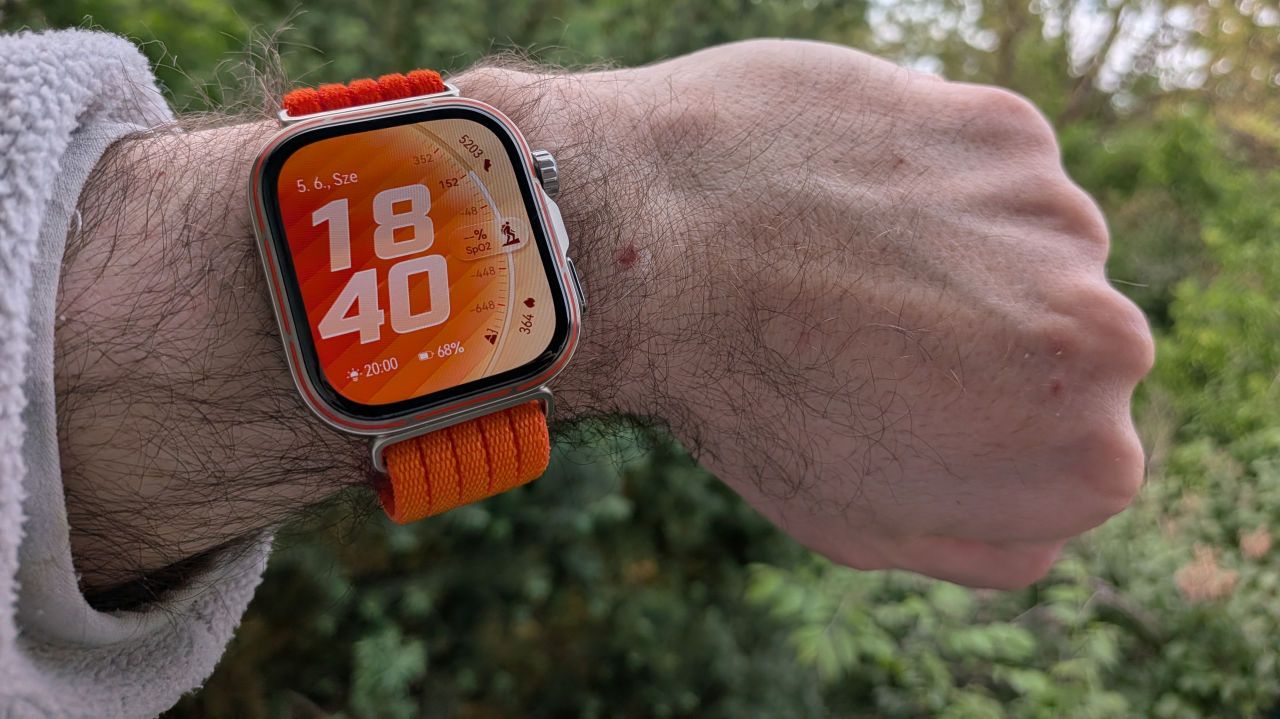
TECH REVIEW – The Huawei Watch Fit 5 Pro is the next Fit-series step: a brighter AMOLED panel, an updated TruSense sensor stack, real crown control, and the classic Huawei calling card, multi-day battery life. Demos suggest the quick cards and day-to-day navigation are more practical, while the workout and health sections feel less like checkbox features. In Hungary, the question is simple: at a recommended retail price of HUF 99,990, is this a sensible buy, or do the software compromises still drag the whole thing down?
The Fit line has always been about a specific promise: a lightweight, rectangular wrist device with a big display and solid tracking, without trying to become a full-on app-first smartwatch. The Huawei Watch Fit 5 Pro does not rewrite that formula, it tightens it up with a brighter screen, a refreshed sensor platform, multi-system, dual-band GNSS, sapphire glass, a titanium alloy bezel, and a crown that actually changes how you use the interface. For a lot of people, that is the sweet spot: notifications that behave, workouts that log properly, sleep insights that do not feel random, and battery life that does not turn every evening into a charger ritual. The trade-off is still software ecosystem depth, but the Fit audience typically cares more about friction-free basics than an endless app catalog. The Fit 5 Pro is trying to make those basics feel faster and more “watch-like” on the wrist.
Quick Look
| Category | Spec |
| Display | 1.92″ AMOLED, 480 × 408 px, 328 PPI, up to 3000 nits, 2.5D sapphire glass |
| Build | 44.5 × 40.8 × 9.5 mm, aluminum alloy middle frame, titanium alloy bezel, approx. 30.4 g without strap |
| Durability | 5 ATM water resistance, IP6X dust resistance, freediving support up to 40 meters |
| Sensors | TruSense platform, accelerometer, gyroscope, magnetometer, optical heart-rate sensor, barometer, temperature sensor, ambient light sensor, ECG sensor and depth sensor |
| Connectivity | 2.4 GHz Bluetooth 6.0 (BR + BLE), GPS (L1 + L5), GLONASS, BeiDou (B1I + B1C + B2a), Galileo (E1 + E5a), QZSS (L1 + L5), NavIC |
| Battery | 471 mAh, up to 10 days (light), about 7 days (typical), about 4 days with AOD, wireless charging |
| Compatibility | Android 9.0 or later and iOS 13.0 or later via the Huawei Health app |
| Price | Recommended retail price in Hungary: HUF 99,990 |
Where the Fit 5 Pro looks most improved is the stuff you touch dozens of times a day. Watch face changes, quick cards, the control center, and shortcut settings appear set up to reduce menu digging. The crown is not just cosmetic either: it is positioned as a real input method for scrolling and quick adjustments, including brightness. That matters when you are outside, moving, or wearing gloves, where tapping small UI targets becomes a chore. There is also a practical focus on “one-step” tools: screen lock and keep-awake timers, quick brightness, alarms, focus modes, and device finding. This is the kind of polish that makes a wearable feel like a tool instead of a tiny phone screen on your wrist.

Display and Controls – Crown Input Changes Everything
According to the spec sheet, the Fit 5 Pro’s major display upgrade is its 1.92″ AMOLED panel with up to 3000 nits of peak brightness, which can be decisive outdoors in direct sunlight. The demos show watch faces that are not just replaceable but meaningfully customizable, so the first glance can be tuned to the stats you actually care about. Swipe patterns are straightforward: quick cards, schedule-style views, notifications, and the control center each have a predictable direction. The crown improves two things immediately: navigation feels more precise, and settings like brightness become less of a “dig through menus” scenario. That is a real quality-of-life upgrade, not marketing filler. It is also paired with “keep screen on” options, which makes a difference if you are filming, following a workout, or checking a route without re-waking the display every minute.
A small but useful addition is the water-drain function, designed to push water out after swimming or washing hands. It is not glamorous, but it is the kind of detail that helps the speaker and mic area stay usable over time. The basics are here too: DND and sleep modes, quick alarms, flashlight, and fast settings access without bouncing through submenus. Put together, it reads like a Fit device that is trying harder to be pleasant all day, not only during workouts. If the Fit 5 Pro wins people over, it will be through these “I stopped thinking about it” touches. That is exactly where wearables earn their keep.

Workouts and Training – Variety, Data, and Real Post-Run Context
The demo walk-through leans hard into volume: a huge menu of workout modes and a full set of post-session stats that sync back to the phone. For running, the core staples are present: pace, heart rate, distance, route, splits, and summaries that can actually inform the next session. There is also a metronome-style rhythm aid, which is more useful than it sounds if you are working on cadence instead of just “going out and surviving.” Controls are positioned as workout-friendly too, with physical inputs helping you pause or stop without fighting the touchscreen mid-run. Warm-up and stretch guidance shows up as well, which is an underrated feature for beginners who need structure more than another chart. The Fit 5 Pro’s value is in turning “I went for a run” into “I can adjust my plan” without feeling like homework.
There is also a playful “route drawing” angle, where you can intentionally run a path that forms a shape and save it as a track. That is not performance science, but motivation tools matter, and badges and goals can keep people consistent. Daily activity tracking supports that with rings, targets, weekly progress, and reward-style nudges. A recovery-time style indicator is also shown, offering guidance on when to push again after a session. It is best treated as a directional signal rather than a strict rule, but it is still useful for avoiding dumb overtraining choices. Overall, the Fit 5 Pro looks set up to be a dependable training companion, not a pretend coach.

Health and Sleep – TruSense, HRV, SpO2, and Trends That Make Sense
Huawei positions TruSense as the core health stack on the Fit 5 Pro, while the official sensor list includes an accelerometer, gyroscope, magnetometer, optical heart-rate sensor, barometer, temperature sensor, ambient light sensor, ECG sensor and depth sensor. In the demos you get continuous heart rate, daily HRV, blood oxygen, ECG analysis, pulse wave arrhythmia monitoring, and alert thresholds for values that drift outside your chosen range. HRV is best understood as a recovery and stress signal: when it trends lower for days, it often aligns with fatigue, poor sleep, or higher stress. SpO2 and sleep breathing monitoring are presented as risk indicators and pattern tracking, not clinical diagnosis tools. The Fit 5 Pro’s goal seems to be turning raw numbers into something you can actually act on without staring at graphs all night. For most users, consistency and trend visibility are more valuable than chasing perfect “medical” accuracy claims.
Sleep tracking is described as upgraded with a newer algorithm, with more accurate segmentation and clearer summaries. The strength of good sleep tracking is not just charts, it is repeatable measurement and helpful explanations. Emotional well-being style features also show up, with mood indicators and guided breathing exercises meant to reduce stress spikes. A daily goals system is part of the package too, covering basics like movement, hydration, and sleep targets. None of this is magic, but it is effective when it nudges you into better habits without nagging. The Fit 5 Pro health suite looks designed to keep you honest about routines, not to play doctor.

Smart Features – Notifications, Replies, Calls, and the Regional Reality
The Fit 5 Pro is shown handling the day-to-day smartwatch stuff in a practical way: notifications, message previews, and replies via quick responses, voice, or typing with keyboard layout options. Calls are supported over Bluetooth, with contact syncing and on-watch dialing as long as your phone is nearby. There are the expected utility tools too: camera remote, music control, weather, calculator, compass, altimeter, barometer, and a voice recorder. Bluetooth headphone pairing and offline listening are also referenced, which implies internal storage for audio, but capacity and behavior can vary by region and firmware. The same is true for third-party apps highlighted in some demos, especially services tied to specific markets. In Europe, you should expect a solid core feature set and a lighter app ecosystem, which is consistent with Huawei wearables in general.
The interface is still the real story here: quick cards, predictable swipes, and fast access to the things you use daily. A task-switching style element is also demonstrated, helping you jump between active features without re-opening menus. If this is stable in real use, it is worth more than having ten apps you never open. The Fit 5 Pro does not need to out-app a Wear OS watch to succeed, it needs to be friction-free and reliable. That is the lane the Fit series has always owned. The Fit 5 Pro just looks more confident about it.

Battery, Durability, and Daily Usability
Battery life remains the Fit series’ strongest argument. With a 471 mAh battery, Huawei talks about up to 10 days with lighter use, around 7 days typically, and around 4 days with always-on display enabled. That is long enough to break the “charge every night” habit for most people. 5 ATM water resistance, IP6X dust resistance, and freediving support up to 40 meters keep it practical for sweat, rain, swimming, and messy real life. The water-drain feature adds another small layer of confidence after wet sessions. These devices are best when you stop babying them, and the Fit 5 Pro seems designed for exactly that.
Band swapping is also framed as quick and simple, with compatibility mentioned for older Fit straps in demos and product roundups. It is a small thing until you actually wear the watch daily and want a sport band for workouts and something cleaner for work. Comfort and low weight matter too, because a wearable that annoys your wrist ends up in a drawer. The Fit 5 Pro’s thin, light profile is part of why this series stays popular. If the software keeps up, this is a solid “wear it and forget it” device in the best way. That is what the Fit lineup is supposed to be.

Price and Availability
According to Hungarian communication, the Huawei Watch Fit 5 Pro has a recommended retail price of HUF 99,990. The €199 price bracket belongs to the standard Watch Fit 5, not this Pro model, which steps up with sapphire glass, a titanium alloy bezel, an ECG sensor, and a depth sensor. For the Fit 5 Pro, the key question is whether the Fit series’ basic promise – strong display, lots of sports modes, and long battery life – can be pushed into a smarter direction without being held back by region-dependent features. For region-dependent features, it remains important to know exactly what the local user gets from the full package. If some functions remain tied mainly to far-eastern ecosystems, the Fit 5 Pro can still become a “good hardware, slightly compromised smart side” story.
Based on what is known so far, the Fit 5 Pro looks like a well-aimed refresh: stronger display, better controls, an updated sensor package, and solid battery life. If you run, train, and do not want to hunt for a charger every day, this line already made sense. The Fit 5 Pro improves exactly the parts where the Fit world could still be annoying. If local pricing and the actual feature list are clear, this model can easily move into the “put it on and go” category.
-Herpai Gergely „BadSector”-
Pros:
+ Bright, highly readable 1.92″, 3000-nit AMOLED with sapphire glass, crown control, and quick settings
+ Strong sport and health package with TruSense, ECG, depth sensor, detailed workout and sleep data
+ Fit-level battery life: 7-10 days is realistic, and AOD use remains viable
Cons:
– Some “smart” extras are region-dependent and will not translate 1:1 to every local market
– Third-party app ecosystem remains limited compared with Wear OS
– Internal storage and the exact local availability of some extra features are not fully clear in every respect
Huawei Watch Fit 5
Design - 7.2
Display - 8.2
Software - 7.8
Fitness/Training - 8
Price/value - 7.3
7.7
GOOD
The Huawei Watch Fit 5 doesn’t try to be an app-first smartwatch, it tries to be a fast, bright, comfortable Fit device that you can actually live with all day. The crown, refined UI flow, and TruSense tracking stack address the biggest Fit-series annoyances without sacrificing battery life. If local pricing is sensible and Curve Pay support is confirmed in Hungary, this is a strong “put it on and go” pick for everyday training and health tracking.



![DLSS 5’s Neural Rendering Barely Works on a GeForce RTX 3080! [VIDEO]](https://thegeek.games/wp-content/uploads/2026/08/vnews-02-rtx3080-1280x720-1-302x180.png)









Leave a Reply