
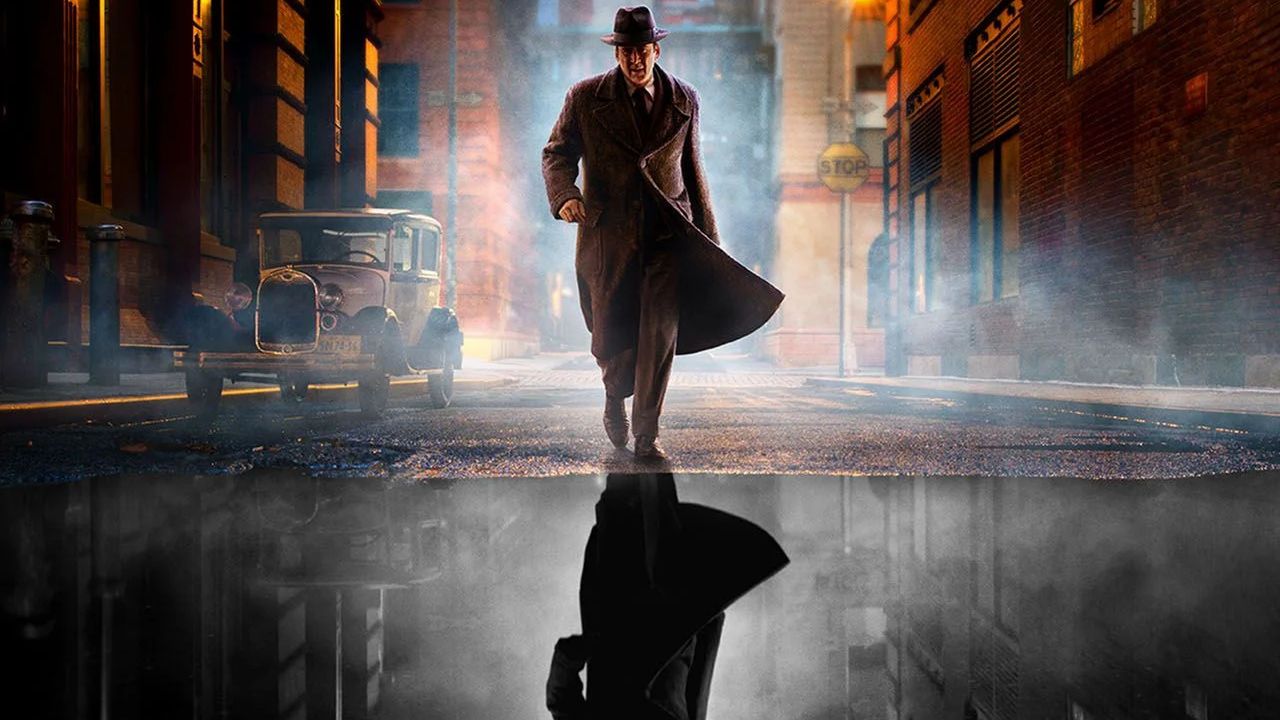
SERIES REVIEW – Spider-Noir does not behave like another superhero streaming side product, but like a smoky, guilty, 1930s detective nightmare into which someone accidentally dropped a web-shooter and Nicolas Cage. Ben Reilly is not Peter Parker in a different coat, but a burned-out private eye long past the cheerful hero-in-training stage, though the world still refuses to leave him alone. The series also offers a black-and-white option, but I watched it in the color, “Technicolor”-style version, and that saturated, painterly, smoke-filled visual approach does not weaken the noir mood so much as illuminate it from a stranger angle.
It took far too long for Nicolas Cage to finally get a superhero role that is not a footnote, a misfire, an internet legend, or a brief animated turn that leaves viewers wanting far more. After Spider-Man: Into the Spider-Verse, his short appearance as Spider-Man Noir was enough to make it obvious that this version of the character should not be locked back in the display case. Spider-Noir finally keeps him out. It puts a trench coat on him, drops him into Great Depression-era New York, and lets Cage be Humphrey Bogart, insect, self-parody, and exhausted moral wreck at the same time.
The series runs for eight episodes, and its best decision is visible almost immediately: it does not pretend this is the same Spider-Man story with darker lighting. Ben Reilly is not a teenager, he does not bring the good-hearted working-class momentum of Queens, he does not arrive from Aunt May’s kitchen, and he is not a figure whose heroic path is still forming in front of us. He has already passed the breaking point. He had a mask, he had a past, he had the moment when the world shoved his face into the pavement, and he has been trying to look up from there ever since. That is why building the show around Ben rather than Peter works so well. The hero is not born here; he crawls back.
Ben Reilly works as a private investigator, hired for what initially seem like straightforward cases, until gangsters, monsters, femmes fatales, and buried sins spin a web around him that forces him to confront his former life as New York’s only superhero: the Spider. The official premise is clear enough, but the show’s mood is far more interesting than the synopsis. Here, the investigation is not an excuse for fights; it is the spine of the story. Superpowers are secondary, while crime, corruption, the past, and moral exhaustion are what truly matter.
Spider-Noir, then, does not merely dress a Marvel concept in noir décor. It actually thinks like a hard-boiled detective story. The hero does not solve the case; he slowly discovers that the case has already solved him. That is where the series breaks away from the usual comic-book rhythm. The question is not when the next big action scene will arrive, but how many layers of lies Ben Reilly can peel off the city before realizing that beneath the final layer there is no clean truth, only more dirt.

This Is Not Marvel Constantly Trying To Prove It Is A Universe
The freshest thing about the series is precisely that it does not keep waving at a larger franchise. It does not assign the viewer multiverse homework, does not run on cameo lottery logic, and does not feel as if it grew out of a studio presentation. The 1933 New York of Spider-Noir is its own world: wet streets, tall hats, dark offices, bad decisions, carved shadows, cheap cigars, dangerous women, and men who speak as if someone turns the lights off after every sentence.
In that world, the Spider-Man myth works surprisingly well. The Spider is not a friendly neighborhood hero, but an urban legend, a worn-out figure who seems closer to a lost cousin of The Shadow or The Spirit than to the modern, colorful, quipping web-slinger. That choice frees the show. It does not have to meet every expectation attached to a classic Spider-Man story, yet the moral core remains intact: when someone is in trouble, Ben Reilly moves, however reluctantly. Not because he believes the world is fair, but because he has seen too often what happens when nobody moves.
The visual presentation is naturally crucial. Prime Video offers two versions: a black-and-white option and the color “True-Hue Full Color” version. I watched the latter all the way through, and it makes for a fascinating experience. The color version is not simply noir with color added, but a saturated, old-Hollywood “Technicolor”-inflected crime-comic dream. The reds are deeper, the greens more poisonous, the yellowish lamplight spills across the sets as if the city itself were a cheap, beautiful, rotten poster.
This color approach gives the series a different rhythm. The black-and-white version is surely the stricter, more classic, more severe noir experience, but in its “Technicolor” form, Spider-Noir leans closer to pulp comics, old crime-paperback covers, and the more flamboyant criminal world of something like Dick Tracy. The costumes, Li Jun Li’s feline Felicia Hardy, Brendan Gleeson’s Silvermane, the smoke-filled clubs, and the rain-washed streets all gain a slightly otherworldly, painted quality. It is not realistic. It is theatrical. Not a faithful historical reconstruction, but a guilty city dreaming about itself.

Ben Reilly Is Not Peter Parker, And That Is The Point
The series works best when it does not try to force Ben Reilly into a familiar Spider-Man shape. This Ben is older, more tired, more cynical, and much more wounded. He is not driven by optimism, but by a stubborn sense of duty that has survived worse days. The writers wisely understand that they do not need to make him younger or over-explain him. The character is interesting because the tragic disillusionment most heroes reach later has already happened to him.
Cage delivers exactly what makes every good idea involving him twice as risky and three times as exciting. His Ben Reilly is not merely a tired detective, but a spider trapped in human form, occasionally seeming not to understand why he still has to talk to people. His head movements, sudden pauses, hoarse inner monologues, and unmistakably Cage-like facial jolts all suggest a man simultaneously performing a role and trying not to come apart completely.
When Cage is given room, the series glows. An entrance, a half-smile, a dry line delivered at the wrong moment, a Bogart-like voiceover, or a completely unexpected stare is enough to make an ordinary scene snap into life. When the script restrains him too much and uses him simply as a serious, brooding detective, the show still holds together, but it loses some of its spark. Spider-Noir runs chiefly on Cage, and fortunately the creators usually know it.
Li Jun Li’s Felicia Hardy is one of the strongest supporting figures in the show. She does not merely occupy the required femme fatale slot, but becomes a character whose every glance seems to hide another locked door. She works especially well in the color version: the costumes, lighting, skin tones, and saturated club scenes make Felicia not just a noir archetype, but a genuinely dangerous splash of color in this smoky world. Brendan Gleeson, as Silvermane, is also enjoyably solid, bringing exactly the kind of gangster energy that can feel both comic-book heightened and grounded.

The Superpowers Are Not The Attraction, But The Dirty Side Effect
The smartest move in Spider-Noir is that it keeps its priorities straight. The superhero elements do not overwhelm the crime story; they seep into it. There is action, web-slinging, bodies moving above the streets, and powered villains, with Electro and Sandman getting their place, but the show is not built around the idea that a fight must arrive between every two conversations. Here, a fight matters when it grows out of the investigation, the threat, or Ben’s personal past.
That does the pacing a lot of good, even when the show sometimes feels slower than a traditional comic-book series. Viewers looking for the quick, flashy superhero formula with a big cliffhanger at the end of every episode may get impatient during the early stretch. Those who love the world of The Maltese Falcon, The Big Sleep, or old hard-boiled crime fiction will understand exactly why cigarette smoke, bad streets, and half-sentences need space.
The color “Technicolor” version is interesting in this regard too: it does not erase the noir bitterness, but gives it a sticky comic-book surface. Red neons, greenish shadows, yellow-lit offices, and a painted-looking night sky sometimes make the series feel like an old detective-pulp cover come alive. It is not necessarily realistic, but it fits this world. Ben Reilly is not crawling walls in historical New York, but in a city held together by crime, nostalgia, and the smell of old comic-book paper.
The strongest episodes are the ones in which these three layers – classic noir, pulp comics, and Cage’s grotesque heroism – work at once. When that happens, Spider-Noir really does feel unlike anything else in the current Marvel lineup. It is not perfect, but it takes risks. It is not the same safe franchise noise, terrified of leaving the viewer alone with a real mood for five minutes.
There Is Still Some Webbing To Clear Before Season Two
Not everything works perfectly. Across eight episodes, this world occasionally gets tangled in itself. Some subplots run longer than the pacing can comfortably support, a few supporting characters do not get strong enough material, and at times the show explains again, very carefully, things the viewer understood long before. That is especially frustrating because when Spider-Noir trusts its atmosphere, its actors, and its visual language, it is much stronger than when it clings to safe exposition.
The third acts of some episodes do not always sustain the tension built by their stronger openings. A few installments begin with excellent images, sharp dialogue, and a compelling criminal mood, only to lose some air by the end. This does not break the season, but it is noticeable. A tighter six- or seven-episode run might have hit even harder.
Still, it is hard to be too severe with a show whose strengths feel this distinctive. Nicolas Cage finally has a Marvel role that does not try to sand him down into normality. The series, meanwhile, adapts comic-book material by building a new genre body around it rather than merely translating it. The result is detective drama, comic-book pulp, character study, and strange smoky love letter to old Hollywood all at once.
Spider-Noir proves that a Marvel series does not have to look, speak, and move like every other Marvel series. It can be dirtier, slower, stranger, more theatrical, and braver. Watched in the color, “Technicolor”-like version, it becomes especially interesting because it emphasizes not the strict austerity of classic noir, but the pulp fever dream: an old detective movie, a vintage comic book, and Nicolas Cage’s inner monologue colliding on a rainy night. Not every minute is flawless, but because of its character, images, and mood, it is one of Marvel’s most exciting experiments in years.
-Gergely Herpai “BadSector”-
Spider-Noir
Direction - 8.7
Actors - 9.2
Story - 7.8
Visuals/Music/Sounds/ - 8.8
Ambience - 8.7
8.6
EXCELLENT
Spider-Noir is finally a Marvel series that did not tumble off the usual superhero assembly line, but has its own dirty, smoky, pulpy personality. Nicolas Cage revels in the role of Ben Reilly, while the color “Technicolor”-style version gives 1930s New York a strange painted comic-book pulse. Not every subplot is tight enough, but the atmosphere, Cage’s performance, and the detective-noir comic-book world make this one of Marvel’s boldest recent experiments.







![Dexter Returns in the First Look at Dexter: Resurrection Season 2 [VIDEO]](https://thegeek.games/wp-content/uploads/2026/07/theGeek-Dexter-Season-2-302x180.jpg)






Leave a Reply