
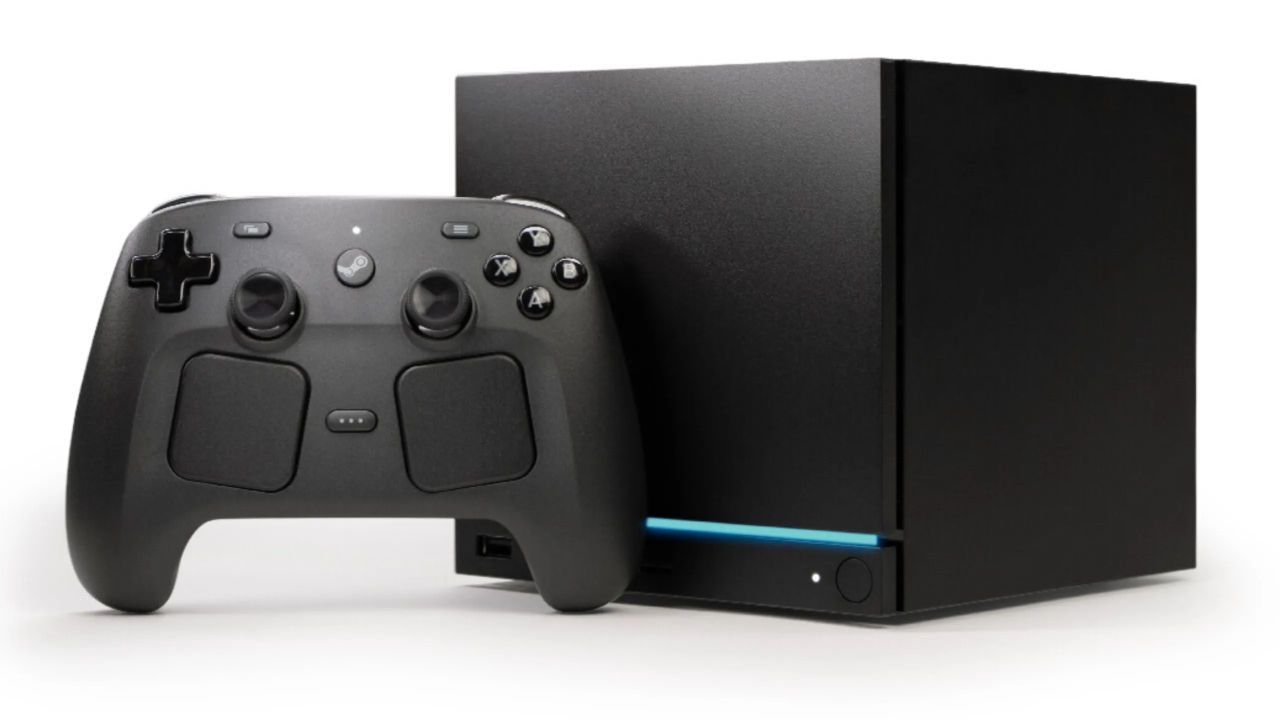
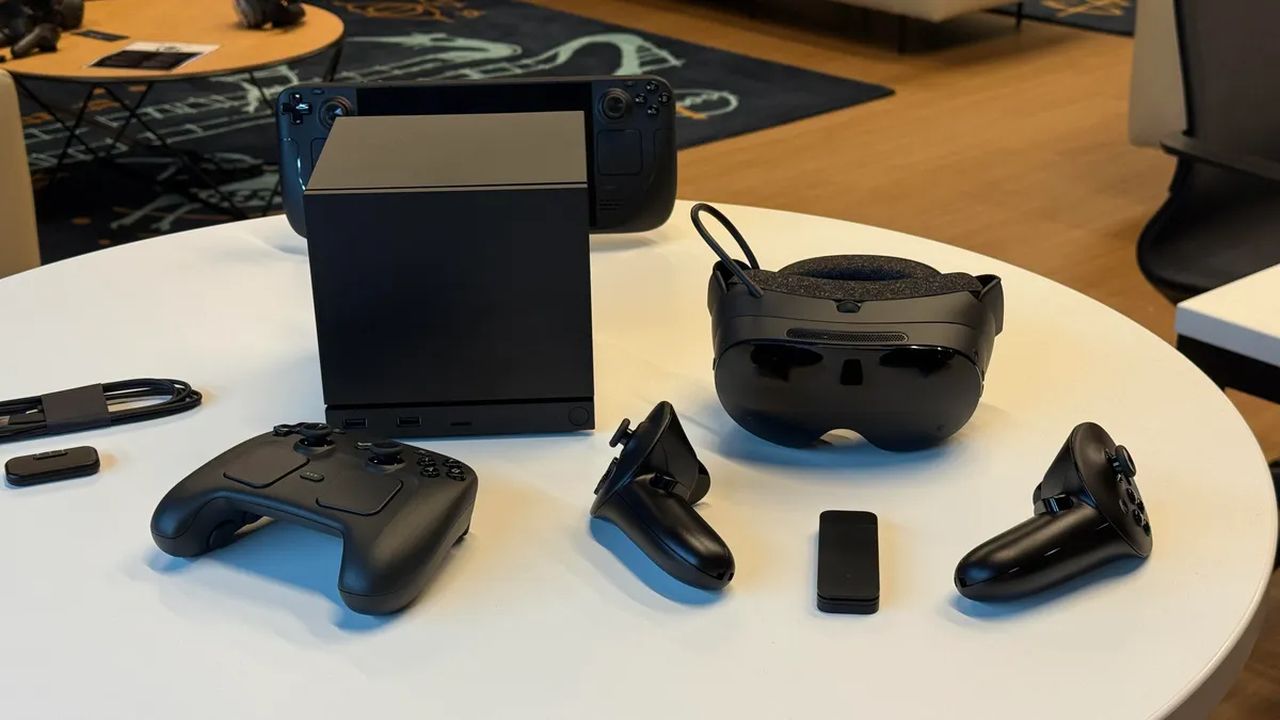
OPINION – At first glance, the Steam Machine looks like exactly the hardware PC players have been waiting for: a small, quiet black box built for the living room, putting a Steam library beneath the TV with console-like simplicity. Valve has not created a new category, though. It has created an extremely expensive halfway house that cannot match the consistency of consoles or the performance of proper gaming PCs.
The basic idea behind the Steam Machine is genuinely excellent. No Windows updates, no pop-up windows, no driver problems, no awkward desktop-mode gymnastics with a mouse and keyboard in the living room. You turn it on, open Steam, see your library, sit on the couch, and play. Valve has taken the best ideas from the Steam Deck and tried to place them under a television: SteamOS, quick suspend and resume, controller-first navigation, cloud saves, compact hardware, useful ports, and quiet operation. At first glance, this should be the console for PC players.
In reality, it is an expensive question mark. The 512 GB Steam Machine costs €1,039, while the 2 TB version costs €1,359, and a controller is not included by default. This is no longer the kind of price where people can shrug and say that the machine is imperfect but cheap enough to be charming. Valve is charging premium money for a device that does not deliver premium performance. It delivers premium compromises.
You Cannot Compete With Consoles While Making the Player Manage the Settings
The Steam Machine is not bad hardware in the traditional sense. It is a modern AMD-based mini PC built around a small, living-room-friendly form factor, and Valve clearly has not simply repackaged a pile of cheap laptop parts with a Steam logo stuck on the front. Its shape, its SteamOS experience, and its quieter operation are more appealing than another anonymous RGB gaming PC that looks as though an energy drink can and a cooling fan started fighting in a shop window.
But the Steam Machine is not competing with old laptops or office mini PCs. It wants to sit beside a PlayStation 5, an Xbox Series X, and a PlayStation 5 Pro. Once it enters that space, being compact, clever, quiet, and full of good intentions is no longer enough. One of the biggest advantages of consoles is not necessarily that every game looks better than it does on PC. It is that players know what they are getting. Every machine has the same hardware, developers optimise for that hardware, publishers build graphics profiles around it, and buyers do not start wondering which option will need to be sacrificed first before the next major release.
On a console, you choose quality or performance mode and move on with your life. The Steam Machine, on the other hand, inherits both the freedom and the burdens of PC gaming: Steam libraries, mods, mice, keyboards, external storage, different displays, open software, and endless options to tweak. All of that is excellent when the hardware can keep up. When a machine costing more than €1,000 already relies on aggressive upscaling, reduced settings, and frame-generation tricks to keep demanding games under control, it does not sit above consoles. It falls very visibly between two chairs.

4K at 60 FPS With FSR Is Not a Triumph, It Is the Fine Print
Valve’s official promise sounds impressive: 4K gaming at 60 FPS with FSR. You can say that sentence confidently without technically lying. The trouble is that the most important part is not 4K, and it is not 60 FPS. It is “with FSR.”
FSR is not a miracle weapon. It is upscaling. It is useful, sometimes necessary, and occasionally remarkably effective, but it does not add raw graphics performance, increase available VRAM, or turn a mid-range GPU into a future-proof powerhouse. Modern blockbuster games are not simply asking for more polygons anymore. They pile on larger textures, heavier lighting effects, ray tracing, denser geometry, and constant data streaming. Upscaling means the machine renders at a lower internal resolution and then tries to assemble something convincing for a large television.
Sometimes that works. Sometimes distant detail turns soft, fine textures dissolve, and motion becomes a digital smear that should not be acceptable from a device costing more than a thousand euros. If the Steam Machine cost €500-600, the conversation would be very different. Then people could say that it is not the most powerful device, but it is an affordable, quiet, Steam-based living-room PC. At €1,039, the story reverses. At that price, the customer should not be grateful that a modern game can be forced into working with enough technical trickery. The hardware should be grateful that anyone is still willing to give it the benefit of the doubt.

When the Nintendo Switch 2 Exposes How Badly This Machine Is Positioned
The most embarrassing example is Cyberpunk 2077. The Steam Machine falls to an average of 28 FPS at 1440p with medium settings and ray tracing enabled. That is not the kind of result that makes a player lean back proudly and think that a living-room PC has finally proven what it can do. It is the kind that makes them count how many graphics settings still need to be thrown out the window before Night City stops looking as though rendering itself has been hit by austerity measures.
Then along comes the Nintendo Switch 2, priced at €469.99. The entry-level Steam Machine is therefore €569.01 more expensive, costing more than 2.2 times as much. Cyberpunk 2077 on Nintendo’s machine targets up to 40 FPS at 1080p output in TV mode, on hardware that can then be removed from the dock and taken with you.
And no, the Switch 2 version of Cyberpunk 2077 does not abandon ray tracing. The port uses a limited but real RT implementation: selected reflections, ray-traced sunlight shadows, and ray-traced local-light shadows remain part of the presentation. CD Projekt RED has obviously cut back the most expensive elements. There is no full PC-style RT suite, no ray-traced ambient occlusion, and the reflections do not reach the standard of substantially more powerful hardware. But ray tracing is there, used intelligently rather than worn as a technical badge pinned to the corpse of value for money.
The Switch 2 has its own Quality and Performance profiles, dynamic resolution, and DLSS. It is not running the same PC graphics menu as the Steam Machine, so the two setups cannot be placed on top of each other with a ruler. But that does not excuse Valve. It is the indictment. The far cheaper Nintendo system manages a 40 FPS target and a far more coherent, cleaner, more visually convincing image in motion while retaining an important part of Cyberpunk 2077’s visual identity: ray-traced lighting and shadows.
The Switch 2 is not magic hardware, of course. Its 40 FPS target is not unbreakable, and the denser parts of Phantom Liberty, especially Dogtown, can push it hard. But that is still a clearer and more honest situation than a Steam box costing more than a thousand euros arriving at launch already needing so many technical safety nets that it starts to feel less like a premium product and more like an elegant support ticket.

The Steam Deck Became Lovable Because It Never Pretended to Be the Future of Desktop Gaming
The Steam Deck worked because it was honest. It was a portable, relatively affordable PC that never seriously promised to run every new AAA release at astonishing quality. A roughly 800p resolution, 30-40 FPS targets, medium or low settings, and occasional stutters felt different in that context. The system fit into a bag, opened Steam, launched a huge number of games, and had a wonderfully cheeky charm: here is a PC you can take onto a train and continue playing on later that evening.
The OLED revision improved many things, but it did not create a new performance generation. The Steam Deck remains excellent for indie games, older blockbusters, role-playing games, emulation, and titles that do not demand a complete lighting technology showcase around every second corner. In the latest visually obsessed AAA releases, though, its age has been obvious for a while. That is not shameful. It is simply the natural fate of portable hardware.
The Steam Machine brings the same fast-ageing problem in a far more expensive form. It is not portable, it is not cheap, and it is not special enough in performance terms for its limitations to be forgiven automatically. The Steam Deck’s limits made sense because of its size and price. The Steam Machine’s limits, at a €1,039 starting price, are not lovable quirks. They are expensive warnings that the system is already too close to the point where the next few years of games will make it feel painfully old.

Valve’s Principle Does Not Replace Value for Money
Valve clearly does not want to follow the traditional console model. It does not want to sell the hardware at a loss and recover the money through subscriptions, exclusive content, locked-down software, and countless digital toll booths. That is a respectable principle. An open PC ecosystem is genuinely valuable, and it is good that Valve does not want to build another garden where players can enter freely but need special permission to leave.
But a player sitting in front of a TV is not thinking about ideological purity. They are looking at what they paid, what they received, how smoothly the games run, how clean the image looks, and how many compromises they have to accept. The Steam Machine asks them to accept PC-level pricing, give up the raw performance of a traditional gaming PC, and celebrate a console-like living-room experience. That may appeal to an extremely narrow audience: people who absolutely want a Steam-based device under their television, do not want Windows, do not want to build a PC, and are not especially bothered by the price.
This will not become a console killer, though. It will not become a mass-market device. It is too expensive to recommend easily, too weak to behave like a genuine premium PC, and too compromised to replace the simple predictability of consoles. The Steam Machine may be a fascinating object for hardware enthusiasts, but fascination is not the same thing as value.
It Is Not a Future-Proof Steam Deck for the TV, It Is an Expensive Subscription to Reduced Graphics
The Steam Machine is full of good ideas. Its form factor is excellent, SteamOS is fundamentally a strong platform, Steam libraries are enormously valuable, and the concept is far more attractive than another anonymous gaming PC covered in RGB lights. Valve understands that many PC players do not want more fans, more flashing LEDs, or more Windows inconvenience. They want something they can turn on and use.
Good ideas do not save bad positioning, though. At this price, the Steam Machine is not a safe purchase. It is an elegant risk. It is less predictable than a console, weaker than similarly priced PCs, and stripped of the Steam Deck’s charm because portability has been replaced with a much larger bill. Its greatest flaw is not that it cannot run games. Its greatest flaw is that, for this amount of money, merely running them is no longer enough. It should run them well.
The Steam Deck became lovable because it was clear about what it offered for the money. The Steam Machine, by contrast, arrives already suggesting that every major new release will require another visit to the graphics menu, another setting reduced, another upscaler enabled, and another hope that the compromises will not be too obvious on a large TV. That is not premium gaming. It is an extremely expensive way to learn that a living room does not become console-like just because someone shrinks a PC.
-Herpai Gergely „BadSector”-






![The Head of Take-Two Is Lying About the Price of Grand Theft Auto VI! [VIDEO]](https://thegeek.games/wp-content/uploads/2026/08/gta-vi-1280x720-1-300x365.jpg)

Leave a Reply