
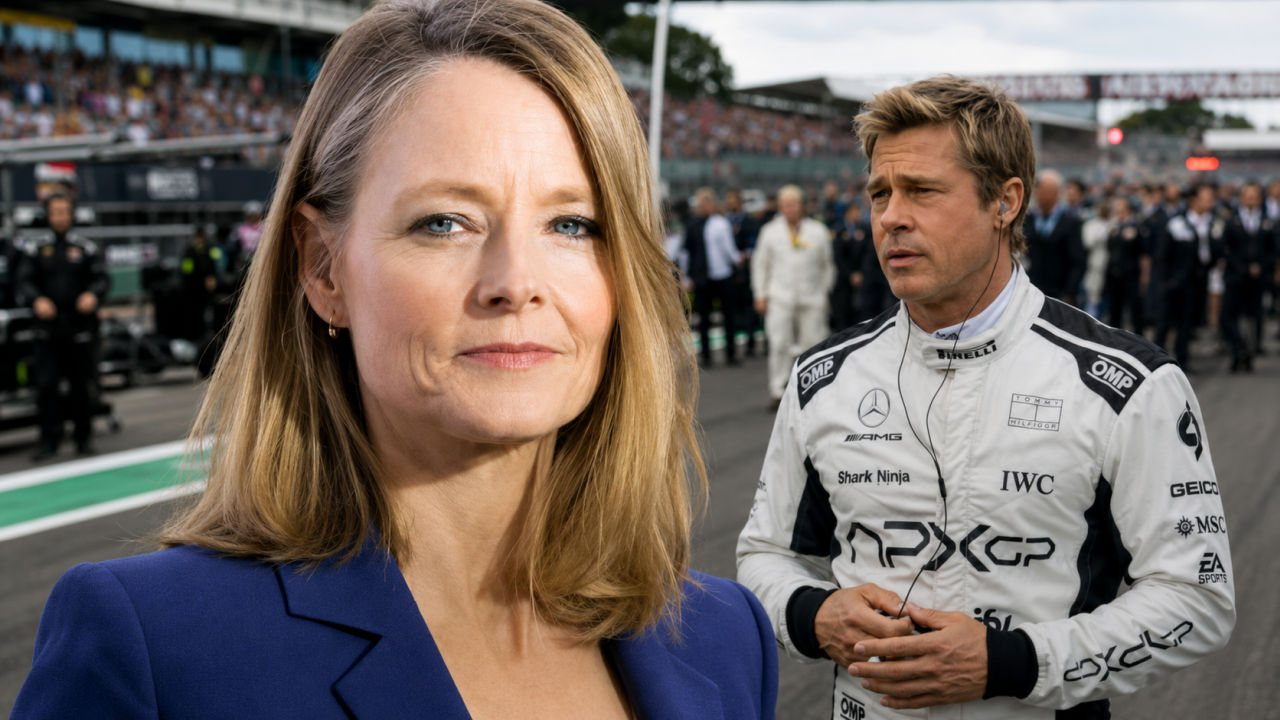
MOVIE NEWS – Jodie Foster suggested during an Aspen Ideas Festival panel that Brad Pitt’s racing drama F1 felt so precisely structured and polished that it could have been made by artificial intelligence. She did not claim that AI was actually used to make the film, but her comments have reignited the debate around the technology’s place in Hollywood.
Jodie Foster has worked in Hollywood since the 1970s, meaning she has witnessed several versions of the industry that no longer exist. She received an Academy Award nomination as a child actor for Taxi Driver, later won two Best Actress Oscars for The Accused and The Silence of the Lambs, and has since built a career as a director and producer moving between studio releases and adult dramas.
Foster has now shared her thoughts on artificial intelligence in Hollywood during an Aspen Ideas Festival panel titled Who Owns the Future of Hollywood? She pointed to Brad Pitt’s F1, directed by Joseph Kosinski and co-starring Damson Idris, as an example. The racing drama was one of Apple’s biggest theatrical bets, and Foster did not present AI use as a confirmed production fact. Instead, she said its structure and polish gave her the impression of something engineered by a machine.
“I don’t say this disparagingly, how could I? This movie went on to make millions of dollars. But I look at a movie like F1 and I’m like, F1 was made by AI. Wasn’t it?”
Foster argued that the storytelling followed a formula with unusual precision. “I mean, the structure was exactly the structure that you would learn in school. The actors say the lines exactly the way it would be written if a computer was writing exactly what would be the right thing for that time. And they were able to dominate the technology to make something big and beautiful and potentially where a lot of the information comes from other places.”
F1 became a major commercial and awards-season success, earning more than $634 million worldwide, winning the Academy Award for Best Sound and receiving further nominations for Best Picture, Best Film Editing and Best Visual Effects. Apple CEO Tim Cook has also said that a sequel has definitely been discussed. There is no public confirmation that the film was made with artificial intelligence in the way Foster suggested, but her point appears to be that a movie does not need to be written by a machine to feel as though it was assembled by one.
Foster also addressed the danger of technology being used to repeatedly reuse or replicate actors’ faces and voices. “Hopefully, things like unions will be able to come in and say, you can use my actor 20 times, but you’re going to pay him 20 times. And I think that’s fair. I think that if we can come up with a way of saying we will participate with technology as long as we still have the dignity of the craft that we make, right?”
Her position is especially interesting because Foster’s own 2025 film, Rebecca Zlotowski’s A Private Life, used AI for a dream sequence. That does not mean she believes filmmakers should hand over control to the technology. “What we all would love is that filmmakers would be able to dominate AI, and never lose sight of that. If we are able to dominate AI consistently over time, we will be able to make things that reflect us, and we can make things better.”
Resistance to AI has often come from artists who view the technology as an attack on human authorship. Hayao Miyazaki’s reaction to a computer-generated movement test has become one of the most frequently quoted moments in the modern debate around AI art. In the 2016 documentary Never-Ending Man: Hayao Miyazaki, the Studio Ghibli co-founder said: “I strongly feel this is an insult to life itself.”
Tim Burton has also criticised AI-generated imitations of his visual style, comparing the experience to “a robot taking your humanity, your soul.” Scarlett Johansson has publicly challenged unauthorised uses of both her voice and likeness. Foster’s position is not a rejection of the technology itself, but a demand that filmmakers and performers retain control over their work, their image and the creative choices that define them.
Source: MovieWeb








Leave a Reply