

TECH NEWS: Yes, even Mark Zuckerberg’s company is facing a DDR5 memory shortage, but it has created a workaround with a custom chip.
Imagine that we are Meta. We have spent millions on new servers that use only DDR5 memory modules, only to discover that even this is not enough memory.
The solution? Pull the DDR4 modules from old servers and use a custom chip to connect the two systems, allowing us to make full use of the available RAM.
Even with only a basic understanding of how CPUs and memory work together, we would probably assume this should not be possible. Yet it can be done: all that is needed is something that translates the CPU’s DDR5 language into the DDR4 language understood by older memory modules.
The gap between AMD Zen 5-based Epyc processors and previous-generation memory technology is bridged by a solution called Compute Express Link, or CXL, using Meta’s custom chip called Vistara.
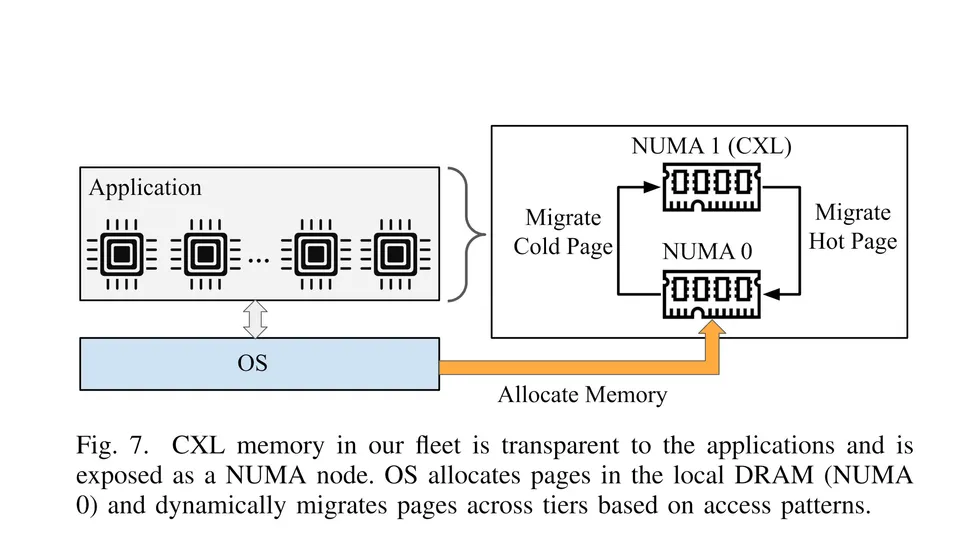
It treats a bank of DDR4 modules as a separate memory pool, although it is much slower than the main DDR5 pool. More technical details can be found in Meta’s research paper about Vistara and the so-called MemServers.
It can also be imagined as a PCIe expansion card carrying a massive amount of DRAM. Because DDR4 has different latency characteristics and lower bandwidth, the software powering Vistara tracks threads and data, using the older DRAM for cold storage.
This is essentially information we would rather keep close at hand than place on an even slower SSD or HDD, because it may be needed again soon. Data currently in use or required immediately is kept in hot storage, located in the Epyc processor’s DDR5 memory.
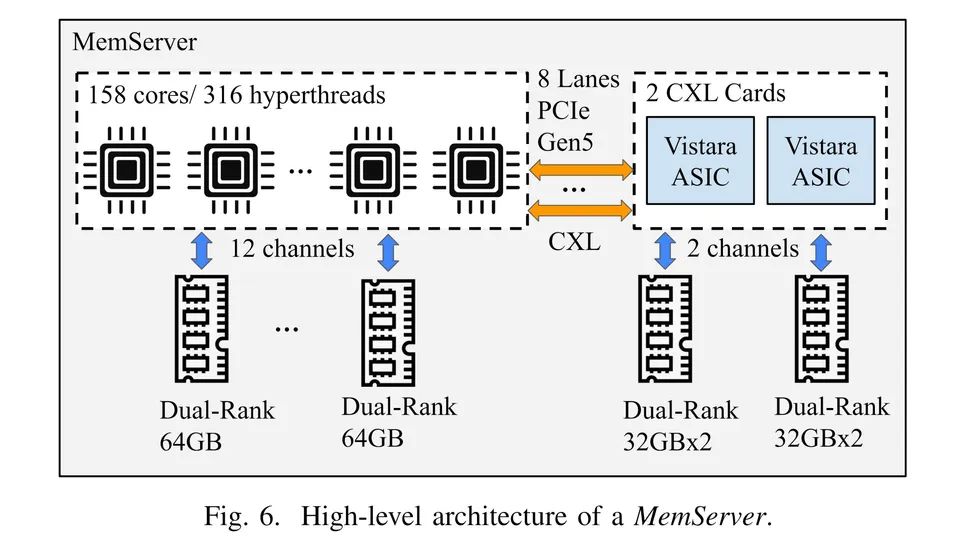
According to the paper, each MemServer node contains a custom 158-core AMD Epyc 9000-series chip. No single Epyc CPU has exactly 158 cores, so either this is a special model or one or more cores have been disabled.
The motherboard holding the processor contains 768 GB of DDR5-6400. That is not enough for Meta, so it also installed 256 GB of DDR4-2400 memory managed by two Vistara expansion cards placed in PCIe 5.0 x8 slots. In total, this amounts to 1024 GB, or 1 TB, of system memory.
Could we do the same in a desktop PC? Some motherboards offer two Gen5 PCIe slots connected to the CPU, so if Meta created Windows-based drivers for Vistara, we could technically plug in an expansion card and install cheaper DDR4 memory on it.
CXL was not designed for general consumer PCs, however, and there are no desktop CPUs that support it. If memory prices stay extremely high in the coming years and perhaps never return to pre-2026 levels, this could be one way to offset the huge cost of buying enough DRAM for a PC.
Of course, the cost of the Vistara card, the required motherboard, and a CXL-compatible CPU would probably make the whole idea pointless anyway.












Leave a Reply