
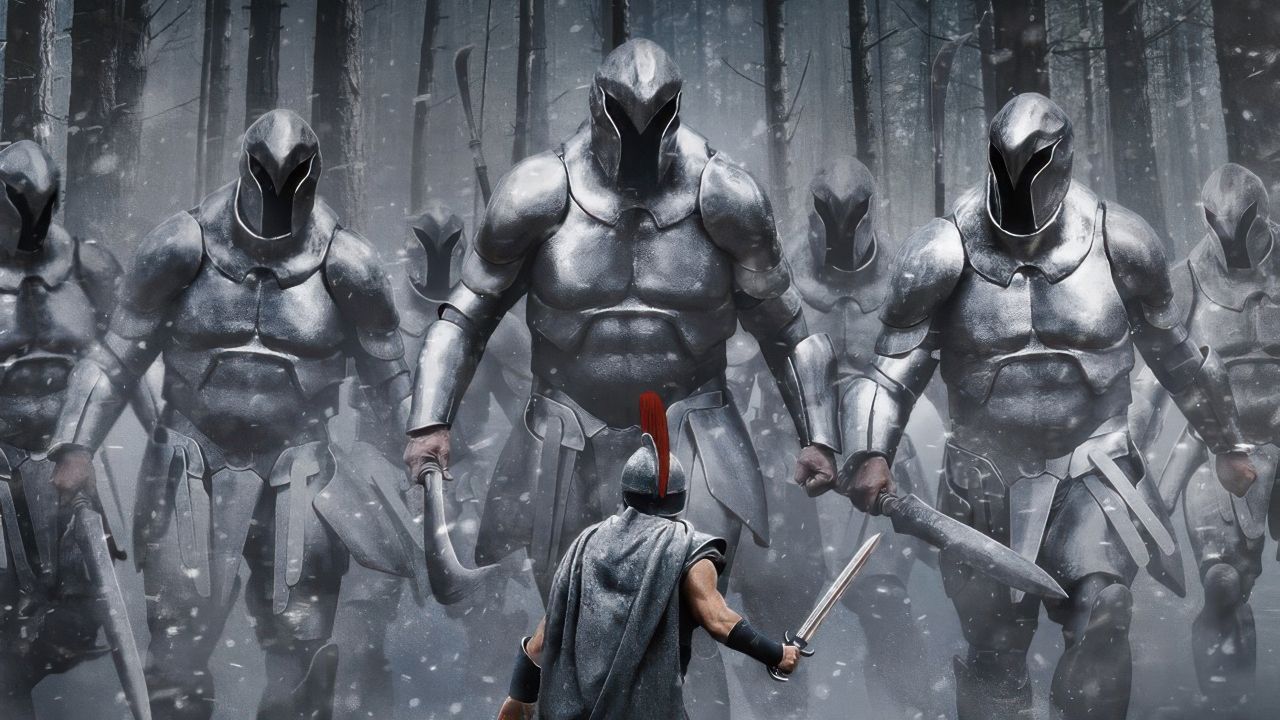
MOVIE REVIEW – After Oppenheimer, Christopher Nolan turns to Homer and transforms The Odyssey into a flesh-and-blood survival story soaked in mud, ash, blood, and seawater, where the presence of the gods weighs on humanity as heavily as the memory of war. The film is at once a monumental historical epic, a nightmarish mythological adventure, and a surprisingly intimate examination of the price a man pays when his deeds become songs, with Matt Damon delivering one of the finest performances of his career at the centre of Nolan’s largest production to date. Its scale is overwhelming, yet the emotional core remains focused on one exhausted man trying to reach the home that has spent twenty years becoming a memory.
Christopher Nolan’s career has always been built around making the impossible feel tangible. Inception turned dreams into architecture, Interstellar bound cosmic emotion to physical theory, and The Dark Knight treated comic-book mythology like a crime story that might appear in tomorrow’s newspaper. The Odyssey initially looks like a far less comfortable fit. Homer’s world is ruled by divine intervention, monstrous creatures, enchantment, prophecy, and a sea capable of becoming a road, a grave, or an act of punishment.
Nolan answers that mythological chaos with the language he knows best. The fantasy remains visible in every part of the journey, yet everything carries the physical weight that has defined his earlier work. Ships struggle against real water, soldiers move through dust and fire, darkness is illuminated by actual flames, and creatures emerge as though humanity’s oldest fears have acquired bodies. The divine is never fully explained. The characters believe in it, experience its influence, and accept its power, while every supernatural event also reflects something recognisably human: grief, trauma, desire, guilt, or madness.
Like Homer’s poem, The Odyssey finds us in the middle of a story that has already lasted for years. Odysseus left Ithaca almost two decades earlier, spending the first ten years beneath the walls of Troy. His Trojan Horse strategy has already become legend, yet the king himself has failed to return. Penelope’s palace is overrun by suitors who steadily consume the wealth of the estate, while Telemachus is provoked more openly with every passing day. Robert Pattinson’s Antinous is especially unpleasant: vain, wounded, predatory, and increasingly confident that power is already within reach.
The lost years return through Odysseus’ damaged memories. Nolan once again fractures chronology, although the structure feels more instinctive than the mathematical construction of Tenet or the interlocking timelines of Oppenheimer. Memory is wounded here. We move through the mind of a soldier who cannot find his way home and no longer knows where experience ends, legend begins, or how much remains of the man who originally sailed away.

The Weight of Twenty Years Is Felt in Every Step
The Odyssey demands patience and makes that clear during its opening hour. Troy is briefly revealed, then withheld. Time is spent establishing Ithaca’s decaying order, Penelope’s long resistance, Telemachus’ uncertainty, and finally Calypso’s island, where Odysseus struggles to recover from years spent inside a dreamlike haze. His memories return slowly, and the film allows the length of the journey to settle into every part of its nearly three-hour running time.
That deliberate pace becomes part of the experience. Odysseus spent years trying to return, and the film refuses to reduce loss to a handful of quick montages. Time at sea, the disappearance of companions, and the accumulation of detours gradually change Matt Damon’s face. By the time the story reaches its major turning points, the emotional weight has already been building for hours. Nolan allows anticipation to become uncomfortable because that discomfort belongs to Odysseus as well.
Jennifer Lame’s editing is essential to the balance. The film is long without becoming inert; large-scale sequences are separated by enough quiet to give the next event force. Some chapters fly by, while others expand with deliberate patience, and the contrast strengthens both. Each stage of the voyage can stand as its own story, yet every departure moves us closer to Ithaca, where the political and personal danger becomes more severe with each passing day.
For much of the film, it is difficult to imagine how so many characters, memories, and mythological episodes can arrive at a satisfying conclusion. Nolan does not rush when the final act arrives. The homecoming is long, tense, and precise, receiving as much attention as the adventures that came before it. Only then does the film’s central question become fully visible: can the same man return who left twenty years earlier?

IMAX Is Not a Format Here, but an Earthquake
The Odyssey was filmed entirely with IMAX cameras, and that ambition can be felt in every frame. Hoyte van Hoytema’s cinematography can hold thousands of soldiers, the helplessness of a ship trapped in a storm, and the smallest movement in Matt Damon’s face with equal force. The size of the image is never decorative. The screen expands the world, then a single close-up pulls the entire epic back into Odysseus’ private suffering.
The Trojan Horse sequence stands among the strongest set pieces of Nolan’s career. Soldiers wait inside a narrow wooden prison as the enemy drags them through the gates and begins celebrating outside. We hear the structure groan and feel the confinement before the silence erupts into violence with enough force to make the IMAX sound system feel physical. The scale is staggering, yet the direction remains fixed on human fear.
The Polyphemus episode creates a different kind of terror. Nolan does not treat the Cyclops as a simple attraction. The creature feels ancient, disturbing, and dangerous, with practical craft and digital effects blending almost invisibly. There is something of Ray Harryhausen’s handmade magic in the sequence, transformed into a darker, harsher, and far more brutal experience.
Circe’s island is even bolder. Samantha Morton’s limited screen time changes the temperature of the entire film, while the imagery moves into territory few would have expected from Nolan. Sensuality, menace, and altered consciousness overlap until beauty becomes unsettling. This section provides the clearest proof that Nolan has preserved the magic of mythology while finding a darker visual language of his own.
Ludwig Göransson’s music is as important as the photography. Bronze textures, immense percussion, and the raw sound of a giant lyre connect the ancient world to the pulse of Nolan’s modern cinema. During several scenes, the score appears to move the sea itself. In IMAX, the bass works through the chest while ships, waves, battle noise, and human voices surround the audience completely.

Matt Damon Carries the Greek World Home on His Shoulders
Matt Damon plays an Odysseus who has already seen too much. Heroic authority is shadowed by exhaustion, intelligence by guilt, and every new decision by the knowledge that a leader’s mistakes are paid for by others. Damon never turns him into a marble statue. His Odysseus is angry, clever, selfish, tender, cruel, and occasionally capable of disastrous judgment. Those contradictions make him human.
The role is physically enormous. Damon is present through almost the entire film, commanding ships, fighting, climbing, swimming, suffering, and continuing to develop the man beneath the legend. Early scenes show the celebrated architect of victory at Troy; later ones reveal a survivor broken by memory. By the final act, both versions exist in the same face.
Anne Hathaway has significantly less screen time, yet she becomes Odysseus’ true equal. Penelope has held Ithaca together for twenty years while surrounded by suitors, political pressure, and the slow erosion of hope. Hathaway can communicate patience and anger in the same look. The film understands that waiting can also become an act of heroism, and Penelope’s endurance requires a discipline equal to anything faced at sea.
Tom Holland uses the youthful uncertainty familiar from earlier performances and gradually allows Telemachus to grow beyond it. The young man lives beneath the shadow of his father’s legend while possessing almost no personal memory of him. Holland captures the difficulty of trying to live up to a myth known by everyone except the son who inherited it.
Robert Pattinson again finds pleasure in playing a deeply unpleasant man. Antinous brings wounded vanity, predatory politeness, and increasingly open aggression to every scene. Charlize Theron gives Calypso an almost otherworldly calm, Zendaya leaves a clear impression with limited material as Athena, and Lupita Nyong’o’s dual presence as Helen and Clytemnestra creates a haunting echo of war’s consequences. John Leguizamo’s Eumaeus and Himesh Patel’s Eurylochus provide emotional anchors that keep Odysseus’ journey connected to ordinary human loyalty.
The size of the cast inevitably means that several major stars appear only briefly. Zendaya, Theron, and Nyong’o function more like mythological imprints than complete character arcs. The choice serves the film, although another twenty minutes with any of them would be easy to welcome. Even so, The Odyssey is a rare ensemble in which famous faces contribute to the same world rather than competing for attention.
Nolan’s Myth Ultimately Becomes a Story About Humanity
The Odyssey can be enjoyed as pure adventure. It contains battles, monsters, shipwrecks, betrayals, divine signs, and monumental images worth seeing in a theatre. Beneath every spectacular episode, however, Nolan examines the same question: what remains of a man after the world has turned him into a hero?
Odysseus’ actions become songs, and the songs gradually separate themselves from the person who performed them. Fame removes fear, failure, and the faces of the dead from the story. Nolan places those things back behind the legend. Victory at Troy is measured in human cost, while every new loss on the journey home adds weight to the name that others continue to celebrate.
In that sense, The Odyssey becomes a compelling companion to Oppenheimer. Both stories centre on extraordinary men whose abilities transform the world and who must then live with the consequences. One stands at the beginning of the atomic age and imagines destruction; the other searches for home inside humanity’s oldest surviving myths. This time, Nolan leaves more hope on the screen.
A few contemporary lines sound strange in the ancient setting, and the American speech patterns require some adjustment. Several supporting roles disappear almost as quickly as they arrive, while the episodic nature of the source naturally produces sections of varying intensity. Those small irregularities fade when the complete film operates with this much confidence.
Christopher Nolan has created a work that is ancient and modern, monumental and intimate. The images of The Odyssey will remain long after the screening, but its greatest power lies in Matt Damon’s exhausted eyes, Penelope’s long wait, and the question of whether a man can recover himself after the world has built a legend in his place. Cinema screens rarely feel this large, and even more rarely serve a story this human.
-Gergely Herpai “BadSector”-
The Odyssey
Direction - 9.8
Actors - 9.4
Story - 9.3
Visuals/Music/Sounds/ - 10
Ambience - 9
9.5
AWESOME
The Odyssey is Christopher Nolan’s largest film to date, transforming Homer’s epic into overwhelming IMAX spectacle, brutal survival drama, and an unexpectedly intimate story. Matt Damon’s exceptional Odysseus, Hoyte van Hoytema’s monumental imagery, and Ludwig Göransson’s elemental score make the nearly three-hour journey a genuine celebration of cinema. A few uneven episodes and abbreviated star appearances remain, yet the complete experience has the kind of power audiences will remember for years.










Leave a Reply