
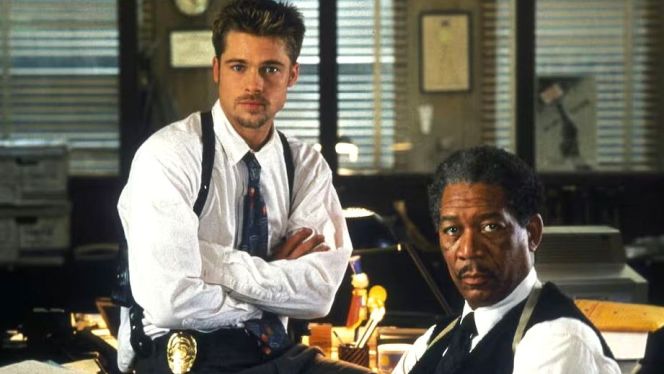
MOVIE NEWS – Brad Pitt, the Academy Award-winning actor (Once Upon a Time… in Hollywood, Meet Joe Black, Fight Club), has said that it was Seven that truly convinced him acting was a career worth fighting for. While he was already known in Hollywood by the early ’90s, it was Fincher’s iconic serial killer thriller—and the director’s passion—that snapped Pitt out of his professional stupor and made him hungry for more.
Pitt is currently promoting his latest film, F1, but on the Armchair Expert podcast with Dax Shepard, he recalled those early years: “I’d wake up, take a bong hit, have four Cokes on ice, no food. That summer, I was just watching the O.J. trial, wondering, ‘What am I even doing next?’” The answer, it turned out, was a pitch-black thriller that wasn’t uplifting but had enough punch to jolt him awake:
“My dear friend and manager, Cynthia—who’s basically my sister now—sent me the script. She said, ‘You’ve got to read this.’ I read the first seven pages, called her, and said, ‘Are you kidding? The cliché: grizzled old cop wants out, young hotshot’s staring at his high school trophies?’ She told me, ‘Just finish it.’ Then I met with Fincher, and he talked about movies like nobody I’d ever heard. It fired me up again. That feeling… it just reignited my passion for the work.”
Before Seven, Pitt had starred in Interview with the Vampire and Legends of the Fall, but it was Fincher’s film that let him flex his dramatic range. The climactic scenes showed a side of Pitt that audiences hadn’t seen before. That same year, he also starred in 12 Monkeys, earning his first Oscar nomination.
‘Seven’ at 30: Still Chilling Audiences
It’s now 30 years since Brad Pitt and Morgan Freeman’s characters faced a twisted mind obsessed with using the seven deadly sins for his own warped brand of justice. David Fincher’s masterpiece remains one of the bleakest and most disturbing thrillers ever made—a horror experience that lingers with you long after the credits roll. The ending hits like a gut punch, but the entire journey through John Doe’s warped psyche is nothing short of unsettling.
Some of the film’s murders are graphic and explicit; others are so disturbing that Fincher deliberately pulled back. It didn’t matter: the evil at the heart of John Doe was clear from even the smallest hint. In hindsight, it’s almost lucky he surrendered when he did—who knows how much worse it could have gotten if his cycle had continued?
Source: MovieWeb













Leave a Reply