
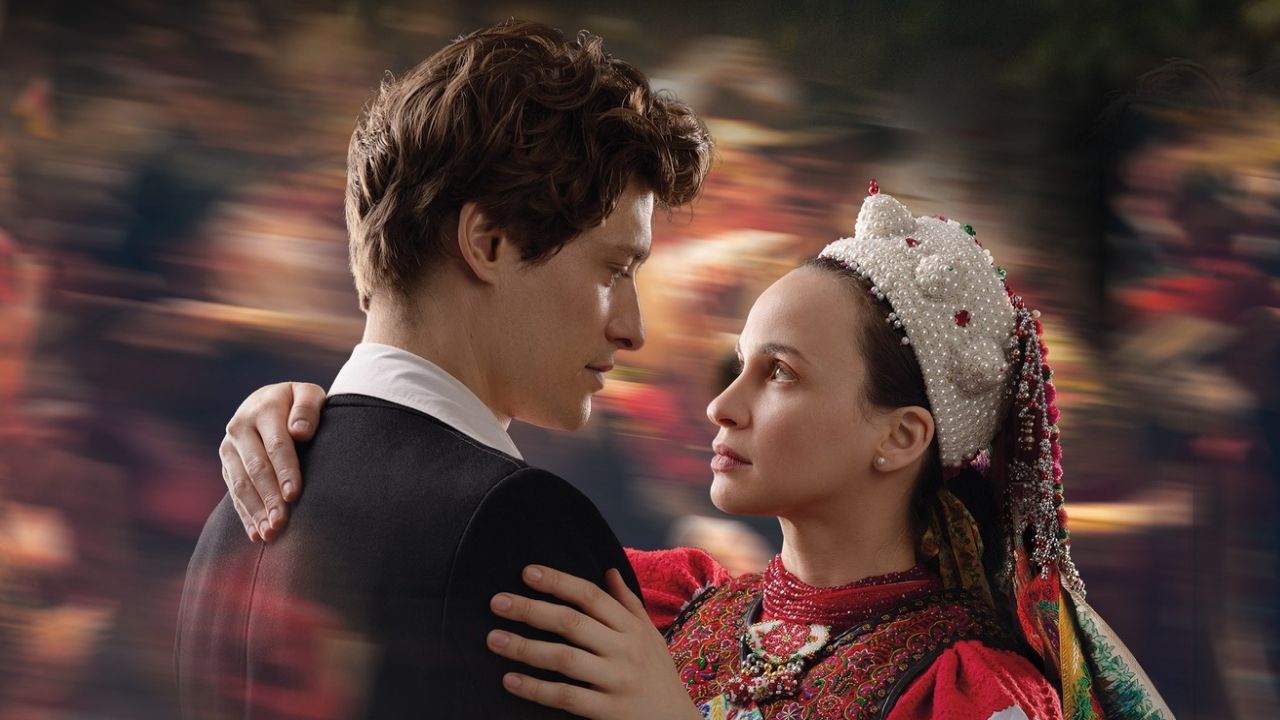
MOVIE REVIEW – Hungarian Wedding looks, at first glance, like a music-and-dance romantic comedy, but it’s really a rom-com disguised as a love letter to folk culture: the folk music and the táncház spirit routinely run laps around the plot. The film very visibly rides the wave of How Could I Live Without You?’s crowd-pleasing success, only here the spotlight swings from musical numbers to folk dance and folk songs. The rom-com framework is often paper-thin, the turns feel forced in more than a few spots, and the logic has a habit of slipping out from under the film’s feet. Still, the moment the music kicks in and the dancing catches fire, the movie suddenly snaps to life – climbing from “weak” to a more or less acceptable, solidly middling result.
Hungarian Wedding will be an emblematic work of Hungarian filmmaking in the 2020s. The film was directed by Csaba Káel, whose primary role as the Fidesz-appointed head of the National Film Institute is to carry out the government’s will in Hungary’s film industry, including funneling billions of forints to the non-industry creators of artistically terrible propaganda films while rejecting every submission from internationally recognized, multiple-award-winning Hungarian directors.
Hungarian Wedding already stands out in the local rom-com lineup by sheer premise: it drops us into late-1970s Transylvania, into the world of Kalotaszeg village weddings and táncház nights, and it treats that world not as window dressing, but as the point. Csaba Káel’s direction clearly wants the audience to get two films for the price of one: a light romance and a bright, colorful cultural getaway – as if someone pulled a rom-com over a folk-music-and-folk-dance experience film. Sometimes the two blend beautifully; other times they grind against each other as if two different movies are trying to claim the same screen.
The setup is simple: two young men from Budapest, András and Péter, travel to Transylvania in the late 1970s to attend András’ cousin’s wedding, and in a Kalotaszeg village they get swept into a current that forces decisions out of them. The screenplay is credited to Miksa Békési, the leads are Franciska Törőcsik, Tamás Kovács, and Zsombor Kövesi – and this is roughly where the part the film handles with real confidence as a straightforward “rom-com” comes to an end.

The Rom-Com Frame: Familiar Beats, Surprisingly Little Substance
If you look only at the romantic-comedy spine, Hungarian Wedding reaches for the usual handholds: instant attraction, misunderstandings, wounded pride, abrupt reversals, then the big “everything falls into place” bow at the end. The issue isn’t that it’s familiar – rom-coms come with familiar furniture – it’s that the film rarely finds genuinely lived-in, flesh-and-blood situations to justify those beats. A lot of scenes feel like they exist because “we need a funny bit”, “we need a conflict”, “we need a romantic twist”, and just when you start to sense any real stakes, the next mandatory set piece is already on its way.
Meanwhile, that unmistakable “let’s cash in on a crowd-pleaser” intention all but shouts from the screen. The How Could I Live Without You? formula – easy romance, plenty of musical moments, big emotional swings – is all here too, only the táncház replaces the musical. That, in itself, isn’t a sin; Hungarian folk music and dance are genuinely grateful material, and you can build showy, tactile “set pieces” on top of them. The problem is that the film is often at its best precisely when it stops trying so hard to be a rom-com and simply lets this world breathe on its own.

When the Story Wobbles Not for Laughs, but by Accident
Hungarian Wedding is at its most uncomfortable not during the deliberately goofy jokes – you can shrug those off – but in the stretches where the plot’s internal logic genuinely falls apart. Certain situations and reactions aren’t merely overwritten; they’re simply not believable: characters sometimes behave as if they wandered in from a different scene, or as if the film itself hasn’t decided how seriously it wants to treat a conflict. That’s why several dramatic moments don’t land as pain – they land as a shove out of the story, and once a rom-com loses credibility, the emotional investment evaporates fast.
The ending is where this hurts the most: it feels rushed, silly, and overly “wrapped up”, as if the film is sprinting through a checklist in the final stretch. On top of that, the performances don’t always rescue the material. Tamás Kovács mostly stays parked in the designated handsome, slightly empty male-lead lane – he delivers “pretty-boy mode” competently, but you rarely feel an actual person behind the smile. Franciska Törőcsik once again reaches for the same familiar “beautiful-girl” toolkit: wounded, proud, choked-up, suddenly softening – it works on a technical level, but after so many variations it’s tiringly familiar, and the character gains no more shading than what the script already provides. A bit too often, it feels like I’m watching Brankovics Mara from Rise of the Raven again, or Eszter from How Could I Live Without You?-ből – roles I could, frankly, live without in exactly this same acting register. There are a few decent moments among the supporting cast, but overall it’s rare to get a scene that sticks purely because of the acting.
There are technical bumps as well. The cinematography (Tamás Lajos) is mostly fine, but it doesn’t always serve the scene: for instance, during a fight sequence, the darkness, lighting, and editing combine into such a muddy mess that you’re more guessing what happens than seeing it. These might sound like small things, but when the story is already wobbly, every extra “this doesn’t quite come together” feeling settles on the film and further weakens the impact of the scenes.
Folk Music and Dance: Where the Film Finally Finds Its Heart
And then there’s what makes Hungarian Wedding worth talking about at all: the folk-music and folk-dance sequences. These aren’t mere decorations; they’re the engine of the movie – sonically and visually. The choreography comes from Zoltán Zsuráfszky, Zs. Zsuzsa Vincze, and Gábor Mihályi, the dancing is performed by artists from the Hungarian National Dance Ensemble and the Hungarian State Folk Ensemble, and it shows: when the dance truly gets going, the screen finally fills with air. In those moments the film stops explaining and stops straining – it simply lets the world tell its own story, with bodies, rhythm, and momentum.
The same goes for the music: the authentic tunes and the overall sound – under the musical direction of István Pál Szalonna – genuinely lift the film, because they don’t function as “rom-com sugar glaze”, but as a shared, communal experience. The movie isn’t shy about pulling recognizable figures from that scene into the frame either: legends of the táncház movement appear, and at times the whole thing feels like a big-budget táncház field report stretched over a feature film. If you care about this culture, these passages will feel like real gifts.
In the end, that’s what drags the film upward: not the rom-com skeleton, not the turns, and not the neat conclusions, but the moments when the characters listen to the music and the story believes itself for a minute. Hungarian Wedding ultimately lands as a battered, often silly love story that folk music and folk dance hold up so firmly that, by the finish, there’s still something likable left standing.
-Herpai Gergely „BadSector”-
Hungarian Wedding
Direction - 6.2
Actors - 4.7
Story - 4.2
Visuals/Music/Sounds - 8.2
Hangulat - 5.2
5.7
AVERAGE
As a rom-com, Hungarian Wedding is often underpowered, its story wobbles into illogical territory more than once, and the acting rarely elevates the scenes. The folk music and folk dance, however, are so strong, vivid, and convincing that the film still “gets away with it” - and in places it genuinely works. If the táncház world interests you, you’ll get a loud, sweeping, high-energy movie night; if you’re coming strictly for a rom-com, disappointment is a real possibility.













Leave a Reply