
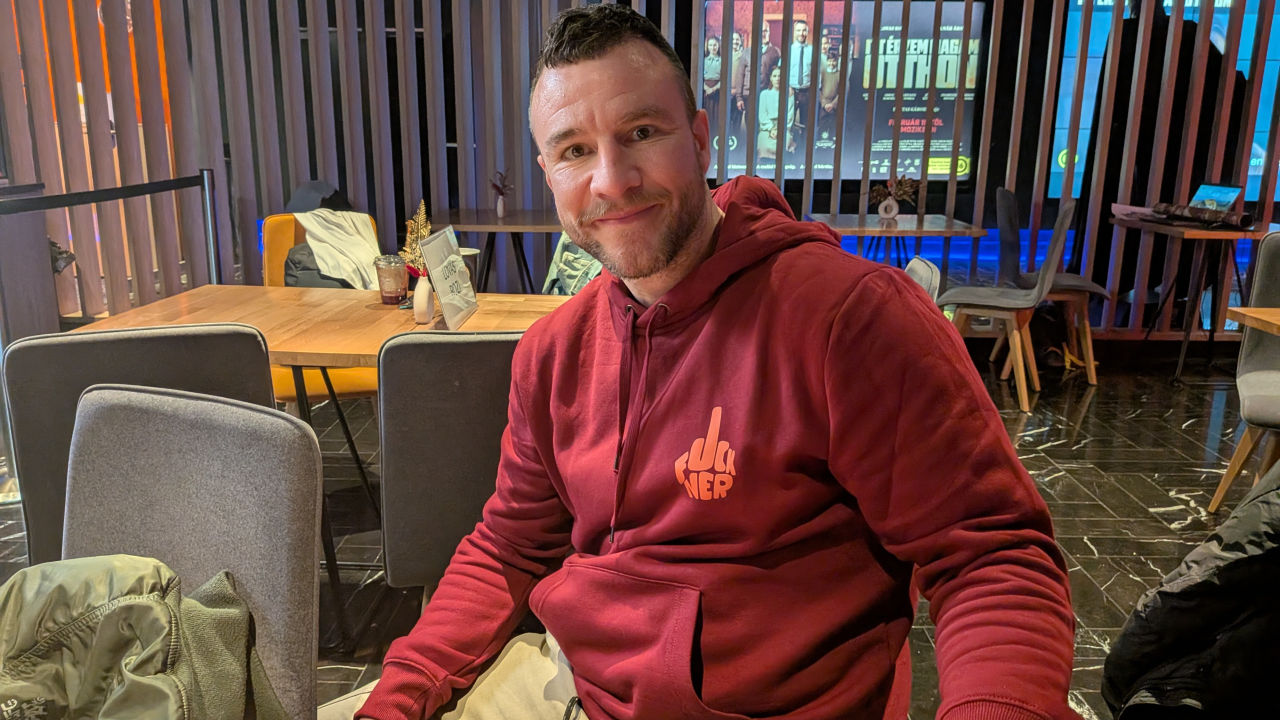
MOVIE INTERVIEW – Around Feels Like Home, we talked about the role, the film’s system critique, the toughest scenes on set, and what a film can do when it doesn’t want to preach, only to ask questions.
Feels Like Home doesn’t work “just” as a thriller – it also plays as a hard social allegory, as Áron Molnár told tG. The actor and executive producer says the film doesn’t make statements, it asks: it’s the viewer who has to decide whether they choose a lying sense of safety, or freedom. We also talked about how the story has become more relevant over time, how the brutal scenes could be shot safely, and why Hungary needs more system-critical, allegorical films like this.
In the interview, Áron Molnár goes into detail on why he sees his character as tragic, how a film can “ripen” inside social and political reality, and why he believes art has a real responsibility in processing shared trauma. The focus stays on the question the film itself asks: what happens when a society lives with lies long enough for them to start feeling normal.
theGeek: What struck me about the film is that it evokes a classic, old-school thriller, while also carrying a very strong system critique – almost a Hungarian, Orwellian allegory, with surreal, almost Ionesco-like elements. When you took the role, did you also see the story as being about these things?
Áron Molnár: When I read the script five years ago, the story didn’t feel this sharply current. Beres Attila is a fantastic screenwriter – incredibly sensitive to society, and he builds characters in a very layered way; it’s a joy to play his roles. This is my third collaboration with him. Reading the script, I felt this was a character you can really do exciting work with, because this guy is a victim of the system, someone whose mind has been washed. He was lied to for years, loudly and aggressively, and then, at some point, the lie became truth – and I think that’s the saddest tragedy of this role. And meanwhile, reality shifted in a way that the film simply “ripened” because of social and political developments. But I also think it matters that this film stands on its own beyond party politics.

tG: At the beginning, it was genuinely hard for me to watch you in this role, because people know you differently from your videos. Here, though, you’re not a simple enforcer – you’re a manipulative, intelligent figure who tortures in a very deliberate way. Was that difficult to play?
A.M.: It was a good shoot because we genuinely care about each other. Rozi and I are friends, we pay attention to one another, we can tune into each other. I’d put it this way: it wasn’t “not hard” because the material was easy – it was “not hard” because it could become a shared cause. Rozi and I are also executive producers on the film, in practice investors as well, and we shot this film for free. It was a risk we took, but it mattered to us that it reach as many people as possible, because we really put our hearts and souls into it.
tG: So you also stepped into it on the producing side because you felt the social message was worth taking that risk for?
A.M.: A truly good film is a tool. A tool to be able to talk about a problem, about a social question that’s on the table. The conversation starts when the film ends. What do you choose – a lying sense of safety, or actual freedom? That’s the viewer’s core question. The film doesn’t assert, it asks. When you walk out of the cinema, it’s up to you what you do with that question.

tG: Do you think a lot of people will recognize that it’s an allegory?
A.M.: I really trust society. I’m optimistic – not naive. If I were naive, I wouldn’t have lived through what I’ve lived through. I’m optimistic because I believe in social awakening, in taking responsibility, in activism. And I think this film can help that conversation. It can help us see what we’re living in.
tG: How hard were the physical scenes? There are parts that feel like torture – restraints, lying on the floor, total vulnerability.
A.M.: The verbal side is much harder than the physical. It’s far more terrible. We shot the tied-up scenes over four days – that’s how Rozi and I started the shoot. It’s a very vulnerable situation, but because I know her and I care about her, I was very careful with her – with her mind, too. And she’s a pro, she knows exactly what she’s doing. Gábor created a safe environment where it wasn’t even a question: the moment the scene ended, we loosened the ropes right away, we hugged, we looked after each other, we “came back” from the situation.
tG: Do you think your character goes through strong development over the course of the film?
A.M.: Yes. What’s interesting about Marci, I think, is that what he really wants is love – someone paying attention to him. He can identify with love in any form. And when he realizes he might find that in his sibling, it’s a truly frightening realization. But I don’t know if Marci can be “saved”, and I don’t know whether he will ever choose freedom.
tG: So in the end the film leaves that open?
A.M.: That’s for the viewer to decide. In a way it’s a social question, too. If I look at how deeply people’s thinking can be washed, and what a system can do to its own voters, then the big question is whether years of hatred and lies can be turned around. I say: yes. I believe it can.
tG: So you’d say your character’s path is still a question mark by the end?
A.M.: A question mark.
tG: It also occurred to me that, read as an allegory, Rozi’s figure could represent a “new leadership”. And then the question becomes what that new leader chooses – the same thing with different tools, or a real change of direction. How do you see that?
A.M.: I think the key question is what happens to the environment that stays inside that system. What it does with it. What it allows, what it maintains, what it changes. That’s the truly important question.
tG: Do you think we’ll see more system-critical, allegorical films like this in the future?
A.M.: I very much hope so. The NER’s last 16 years are literally a gold mine in terms of how many films could be made out of it. We have to talk about it, and we have to use art to process the trauma that system has caused over sixteen years. I hope real creators, real artists, real film directors – talented people – will get funding, not dilettantes.










Leave a Reply