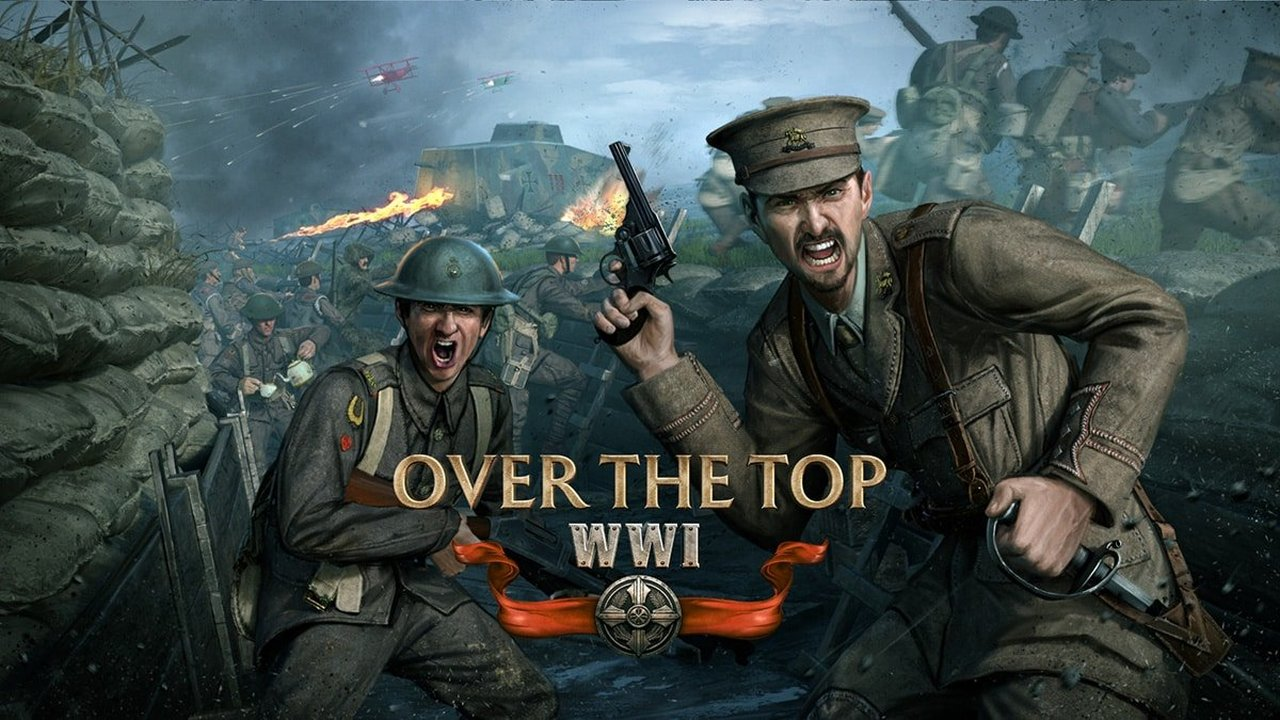
REVIEW – World War I is still strangely underused in video games. World War II has been strip-mined from just about every angle imaginable, while trench warfare, mud, charges, and collapsing front lines rarely get this much attention. Over the Top: WWI, by contrast, does not think small: it throws 200-player battles, destructible maps, and battlefields constantly reshaped by both artillery and players at you. It is not the slickest war shooter on the market, but when all of its pieces lock together, it delivers a kind of frontline chaos that very few games can match.
The basic idea behind Over the Top: WWI is both very simple and shamelessly ambitious. Flying Squirrel Entertainment took World War I, grafted onto it the legacy of large-scale multiplayer shooters, and then decided that a hundred players per side, terrain churned inside out, and total destruction still would not be excessive enough. The result genuinely feels like someone picked up the Battlefield formula and dropped it into the era of trenches, bayonet rushes, and clumsy early tanks. It is not always graceful, but there is something undeniably enjoyable about how big and unruly it lets itself become.
At its core, each match is built around large-scale, objective-driven team play, with up to 200 players – or players mixed with bots – tearing into one another across enormous maps. That immediately gives combat a very different flavor from smaller, tighter shooters. It is not two little teams trying to outsmart each other in neat lanes, but an entire battlefield that keeps moving, roaring, and falling apart. Rifle shots crack from distant trenches, artillery lands in open fields, and players come surging in from all directions trying to break toward the next objective. The whole thing carries a simmering, foul-tempered energy that is much easier to like than it probably should be.

Here the Mud Pulls Its Weight Too, Not Just the Rifle
One of the first oddities on the mechanical side is that the game lets you switch between first-person and third-person viewpoints. At first that feels a little unusual, but it quickly becomes obvious why it is there. First-person gives you more precise aiming, while third-person gives you a much better read on the chaos exploding around you. In a game where you are often killed by something you were not even looking at, that is no small advantage. The system is a little mixed, a little awkward, but in the end it adapts to the game’s own madness surprisingly well.
Movement and weapon handling are deliberately slower than in modern military shooters. Most soldiers are carrying bolt-action rifles, which means every shot has weight, every miss costs you something, and if you send a round wide, you get a couple of seconds to appreciate just how exposed you have made yourself. Because of that, the rhythm of combat feels much closer to the lurching rhythm of trench warfare: long stretches of cautious firing and repositioning, and then suddenly all hell breaks loose, artillery starts screaming in, and everybody makes a desperate run across no man’s land at once. That slower burn followed by violent detonation suits the game extremely well.
Most matches revolve around attacking and defending objectives, with teams dragging the frontline back and forth over key positions. Anyone who has sunk a few hundred hours into large-scale conquest shooters will recognize the structure immediately, and for the most part it works here too. The bigger problem is that movement can feel stiff, gunplay is not always as tight as it should be, and the whole thing carries a slightly raw, unfinished texture. None of that makes the game collapse, but it does keep reminding you that this is not a nine-figure prestige production. It is a smaller team taking a much bigger swing than most studios in its position would dare.

Class Roles, Tanks, Flamethrowers, and Everything Else That Can Go Wrong
The class system is one of the game’s load-bearing pillars. You can pick from several battlefield roles, including rifleman, engineer, officer, sniper, and other support-focused specialties. Engineers are especially useful because they can dig trenches, build cover, and reshape the terrain as if the whole map were made of putty. Officers, meanwhile, help from a higher level, calling in support like artillery strikes. That gives team play real weight instead of leaving it as decoration, because what role people choose actually matters.
The weapon roster does a good job leaning into the era’s technology. Bolt-action rifles dominate the field, but there are also revolvers, machine guns, flamethrowers, grenades, and various close-quarters weapons in the mix. The game features more than fifty weapons in total, which is a surprisingly healthy amount of variety for a setting like this. Vehicles matter too: early tanks, armored transports, artillery pieces, and aircraft all show up, and a well-used tank can absolutely stomp straight through a badly organized defense. At the same time, the era’s clumsiness is still baked into the machinery, and that works in the game’s favor. Tanks are lumbering, aircraft are fragile, and artillery tears the map apart like it has a personal issue with the original terrain layout.
Balance, however, is not always airtight. Certain weapons and roles, especially long-range snipers, can feel overly effective depending on the map and the situation. That does not make the game unplayable, but it can throw off the rhythm of a match, especially when one team figures out how to exploit a specific setup in a particularly irritating way.

The Battlefield Is Not Background Scenery Here, It Is the Victim
One of Over the Top: WWI’s best ideas is that the environment does not just sit there looking the part. It keeps changing. Nearly everything can be reshaped or destroyed. Buildings collapse under sustained fire, shells rip craters into the ground, and players dig trenches and fortifications wherever they happen to need them. That turns the map from a backdrop into an active participant in the match. A quiet village can become a heap of rubble in minutes, and a peaceful stretch of field can end up looking like the surface of the moon.
Better still, these changes are not just there for spectacle. Sightlines, cover, routes, and attack options all keep shifting because of them. A newly blasted crater can suddenly become life-saving protection, while a collapsed building can expose defenders who had been safely tucked away seconds earlier. By the end of a round, maps often barely resemble how they looked at the start, and that gives the game a destructive identity that makes it feel like more than a shooter wearing a historical costume.

A Hundred Men Yelling, Twenty Tanks Grinding Forward, and Somehow It Still Works
Obviously, multiplayer is the heart of the game. The atmosphere in 100-versus-100 battles can feel less like a traditional shooter and more like a panicked war simulation that has lost all interest in pretending to be orderly. Frontlines keep shifting, vehicles shove their way across the map, artillery rips up the ground, and infantry brawls wherever something happens to be on fire. At this scale, full coordination is rare, so matches frequently fall apart into improvised charges and panicked retreats. Strangely enough, that is not a weakness. It is one of the game’s strongest qualities. The fact that everything is not cleanly organized makes the battles feel more alive and less predictable.
When players do cooperate – building cover, repairing equipment, calling in artillery, or simply resisting the urge to sprint one by one into the grinder – the game produces the kind of moments that make the whole mess worth tolerating. Explosions flash over distant hills, tanks force their way through ruined villages, infantry collides in tight trenches, and suddenly the whole thing looks like you have stumbled into a much more expensive production. Those are the moments that make it very easy to forgive the roughness around the edges.

Not Cutting-Edge Graphics, Just Convincing Ruin
Visually, Over the Top: WWI sits somewhere between independent production and mid-tier release. It is not going to melt your face off the way the most expensive shooters can, and up close you will absolutely notice the simpler models, textures, and animations. On the other hand, it uses what it has very well. The trenches, wrecked villages, mud-soaked fields, sandbags, barbed wire, and half-collapsed buildings all sell the worn-down, pulverized frontline feeling the setting needs. The game is not trying to stylize the war. It is trying to make you believe everything here is wet, broken, and caked in gunpowder.
Dynamic weather, seasonal changes, and shifting lighting conditions go a long way toward making the maps feel like more than slightly different versions of the same mud pit. A snow-covered battlefield, a rain-soaked stretch of front, and a village burning at sunset all leave distinct impressions. The real visual centerpiece, though, is still destruction. Watching a house collapse, a shell blast tear open the earth, or an entire section of village gradually come apart can be genuinely impressive. And because the battlefield really does look different by the end of a match, the damage is not just noise. It becomes part of the experience.
Sound does a lot of heavy lifting too. The crack of bolt-action rifles, the hammering of machine guns, the thunder of artillery, and the echo of distant shots constantly remind you that what is happening around you is not some small skirmish, but whole sections of a front line breaking apart at once. Tanks grind forward with ugly mechanical strain, and aircraft have an almost irritating knack for showing up precisely when everything was already getting out of hand. Proximity voice chat adds another layer on top, because hearing players scream for cover, for a push, or simply in panic makes the whole battlefield feel that much more alive.
It Wants a Lot, and Sometimes It Almost Carries All of It
On the technical side, Over the Top: WWI shows both its ambition and its limits. The hardware requirements are not insane, which is good news for anyone not playing on a nuclear reactor, and a midrange PC can get solid performance if you are not trying to max out every last setting. But when the screen is packed with fifty soldiers, three tanks, two aircraft, one collapsing village, and half the map on fire, performance dips are going to happen. There are also smaller visual hiccups, clumsy animations, and occasional bugs that pop up now and then. None of that buries the game, but it does keep reminding you that a small team tried to grab far more than most studios of its size would dare.
Even so, the underlying idea is strong enough to keep you around. Over the Top: WWI is not the most polished war game on PC, but it is easily one of the most ambitious. And when the scale, the destruction, the trench-line chaos, and the sheer frontline hysteria all click at once, there are very few multiplayer shooters that can deliver the same picture. It is not perfect, but there is something here that reaches beyond its flaws. Sometimes that something is simply the fact that this is not a polished military product. It is a screaming, blown-apart, mud-stomped war wreck with more character than plenty of games that cost a lot more.
-Gergely Herpai “BadSector”-
Pros:
+ Huge, memorable battles where the 200-player frontline chaos genuinely works
+ Destructible, reshapeable environments that matter to the gameplay instead of just dressing it up
+ Strong atmosphere, excellent battlefield audio, and plenty of spontaneous war stories waiting to happen
Cons:
– Movement and gunfeel can be rough, stiff, and less precise than they should be
– Balance is not always great, and certain roles or weapons can feel overly strong
– Large battles can also shake the technical side loose, bringing smaller and larger issues to the surface
Developer: Flying Squirrel Entertainment
Publisher: GG Publishing
Genre: multiplayer World War I action shooter
Release: March 6, 2026
Over the Top: WWI
Gameplay - 7.6
Graphics - 7.2
Story - 6.1
Music/audio - 7.5
Ambience - 8.1
7.3
GOOD
Over the Top: WWI is not the smoothest, prettiest, or most disciplined war shooter around, but when it finds its rhythm, it delivers a tremendous frontline experience. The destructible maps, 200-player battles, and ever-changing terrain create the kind of moments that are easily worth putting up with the rougher edges. If you can live with some clunky bits, this is the kind of game that occasionally hits you in the face like a loose artillery battery.