
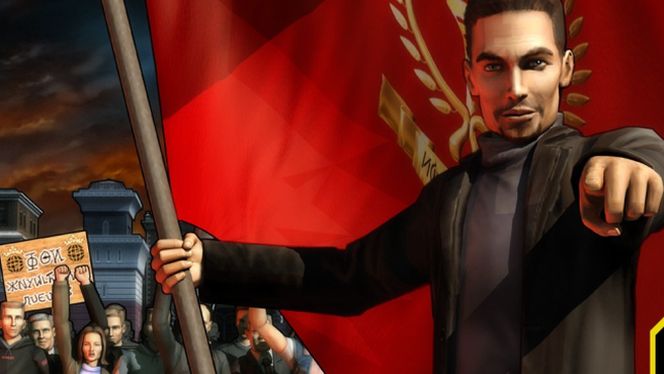
RETRO – Just as bloodlust lurks in FPS fans, true strategy games tend to hide a more or less suppressed streak of megalomania. And what better way to indulge it than by stepping into the shoes of a would-be Russian dictator who, on the bumpy road to power, must often bribe, intimidate, deceive politicians or innocent citizens, and – when all else fails – send that certain big black car after them…
Before parents who lived through the previous system start bombarding us with outraged letters, let us quickly make one thing clear: in Republic: The Revolution, the goals of our young, power-hungry political upstart are – at least at first – noble, since he must overthrow an ex-communist head of state who, after the collapse of the Soviet Union, has once again risen to the top in a small, fictional former Soviet republic.
It was also this man, back when he was still working as a political officer, who had our hero’s parents taken away when he was just a child. As an adult, he swore he would depose the dictator and gift Yekaterina a new form of government. For idealists, there is only one flaw in this worthy ambition: as the introduction makes clear, the road to power is, to put it mildly, a rough one, because the revolutionaries under our control are often forced to resort to dirty methods…
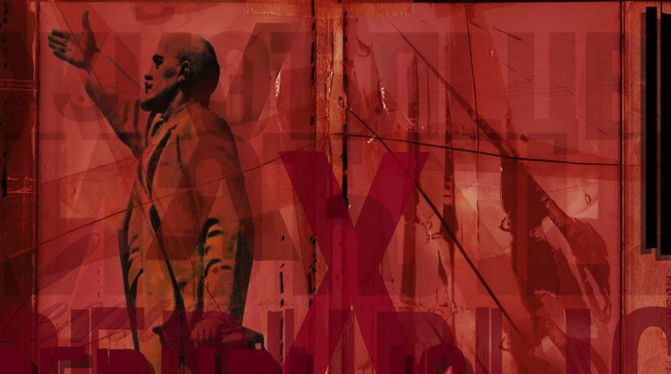
“Have No Voice? Use Mine!” (Vote for Me! – URH)
People had heard so much about this unusual-looking program, yet it was never entirely clear what exactly we were supposed to do in it. Well, at its roots, Republic is a board-style strategy game in which the most important “resource” is the trust and faith people place in us, something we can measure through the percentage pie chart displayed on the main map of the starting city, Yekaterina.
The more people love us and believe in us – or fear us… – the more power we gain. In the language of the game, this means the combined total of strength, influence, and money. Since our hero and his comrades need a certain amount of these for every action, suffering a serious shortage in any one of them will hurt our effectiveness, and in the long run we will be pushed off the political stage – in other words, we lose.
So we must ration our political “mana” carefully, and by using it we will hold rallies and speeches in the city’s various districts, distribute leaflets, or “inspire” (blind) the people with other politically motivated actions that only appear to serve the common good. That, in broad terms, is what Republic is all about – but however simple that may sound at first, make no mistake: this is one of the most intricate and complicated strategy games of all time…
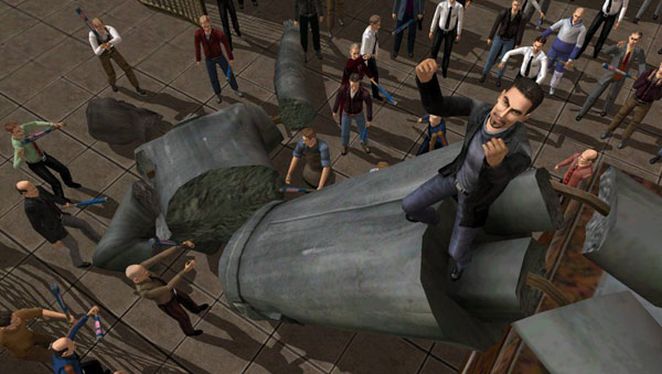
Our Beautiful, Industrious Little Working City…
Before I dive into the depths of Republic: The Revolution, I absolutely have to emphasize first… there we go, the game is already making me sound like a politician!… the game’s greatest appeal, the one thing that makes it stand head and shoulders above similar rivals like Tropico, Gangsters 2, and Pizza Syndicate.
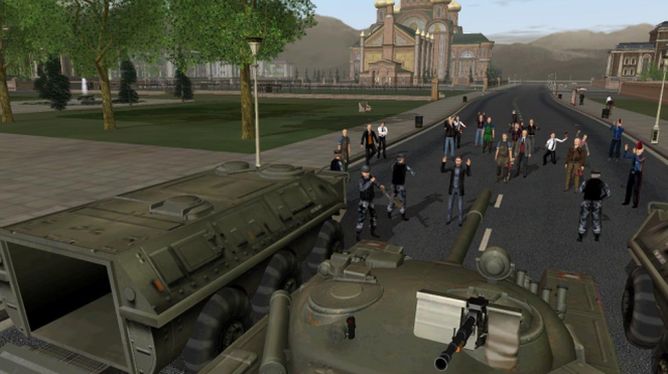
The cities in the game – there are three of them in total – are depicted with astonishing detail and realism. What I wrote in a preview back in 2001 was not fully delivered on by the developers, but the end result is still fantastic! Switching from the main map to the street-level view reveals a living, breathing environment: people hurry home from work, waiters serve in cafés, fans line up for tickets outside the football stadium, prisoners exercise in the local jail, and I could go on listing all the little moments borrowed from real life.
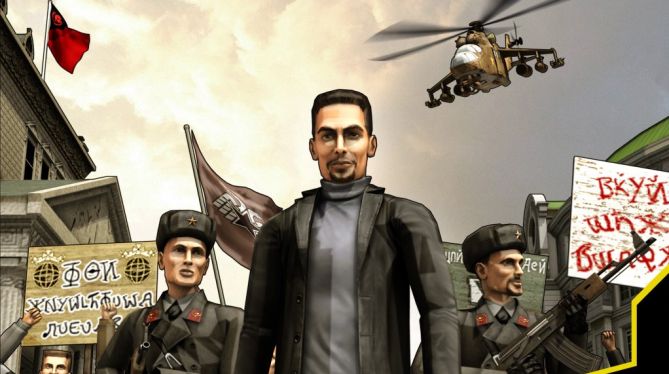
We had seen something vaguely similar before in GTA 3 or Vice City, but those games only had 7 or 8 models to represent the good citizens, whereas here, among the several thousand inhabitants, almost everyone looks completely different! (At most, you occasionally run into some very strong similarities…) Everything happens in real time, whether it is a simple passerby walking home or an important event triggered by us.
Whereas in other similar strategy and management games those events are usually shown through cutscenes, here, if we step out of the whirl of events – such as a major rally or a meeting – we can still follow what is happening from an overhead view. Accompanying the beautiful graphics is a wonderfully atmospheric soundtrack performed by real musicians, flutists, and even a choir. The city noises could have been a little more varied – beyond vehicle sounds, there is not much to hear – but I laughed quite a bit at the gibberish sprinkled with real Russian words, and at last I could make use of the patchy Russian I had picked up in high school.
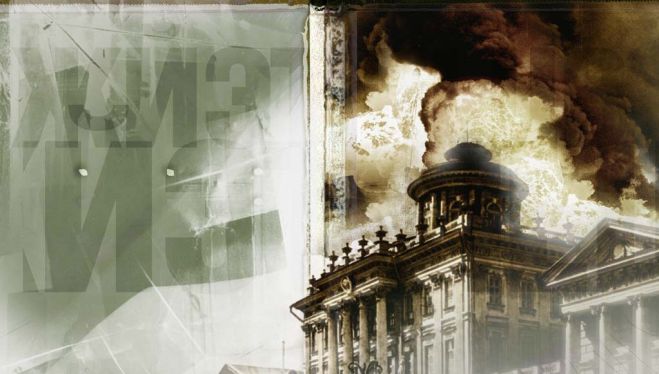
Barrel Orator
The icing on the cake is that we can also influence some of our actions. During rallies, for example, at the right moment in our pathos-fueled speech, a slider that can be dragged left or right lets us decide whether we want to appeal more to people’s “minds” or their “hearts” – hmm… how familiar that sounds… – and when distributing leaflets meant to discredit the enemy, we can also choose whether to represent communist, nationalist, or anti-government ideas.
The most developed form of this kind of “personal influence” is a separate little card game through which, during “persuasion machine”-style meetings, we can personally try to win our conversation partner over to our side or convince them by other means. (For the principle behind it, see the box!)
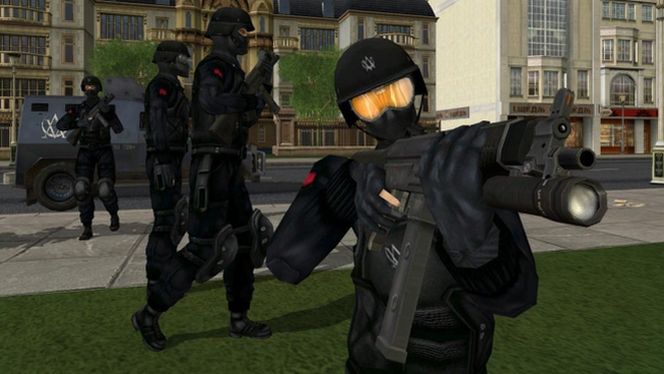
Our personal actions, by the way, are not only very important, but also tremendously entertaining, and they provide the game’s real spice. The developers included every method ever used in history by communist, anarchist, nationalist, or even more moderate parties. Among the more refined maneuvers are, besides the already mentioned rallies, charity events where we can hand out free food to the homeless, or go door to door asking “innocent” questions while gently “guiding” “confused” citizens in the right direction.
Unfortunately, these gullible fools do not always listen to our wise words and are perfectly capable of falling for the vile propaganda of enemy parties. That is when we must – with a heavy heart, of course… – deploy ahmm… less delicate solutions against our enemies…
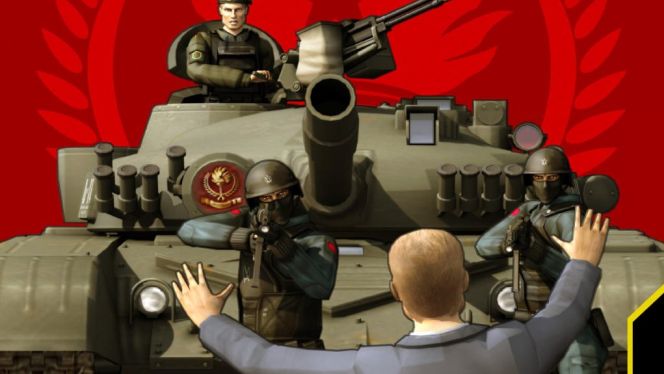
The Highest Value Is the (Obedient) Human Being
The most basic hostile action is the aforementioned leaflet campaign, but later on we can also learn other dirty little tricks. During the game, for example, we can recruit a journalist into our ranks, and with his “hostile press” action, his colleagues in the media will get angry, ranting good citizens to speak out against the targeted party in the columns of their newspapers. The effect is guaranteed: in Yekaterina, for example, I cleaned out district after district using this method. Of course, the representatives of hostile factions do not sit idly by while we make their lives miserable – they use similar schemes to make ours miserable too.
So if a movement operative from an enemy party gets far too cheeky, more direct measures must be used against that specific person: we can spread slander about our chosen victim, make life difficult by having them banned from their favorite hangouts, and later on we can simply have them beaten up – and if even that does not get through to them, we can silence them forever with a hitman…
Through our actions, the “determination” level of opposition party members drops by twenty points, and if we are lucky, their charisma and other secondary attributes will also decline. (Provided we do not kill them, of course…)
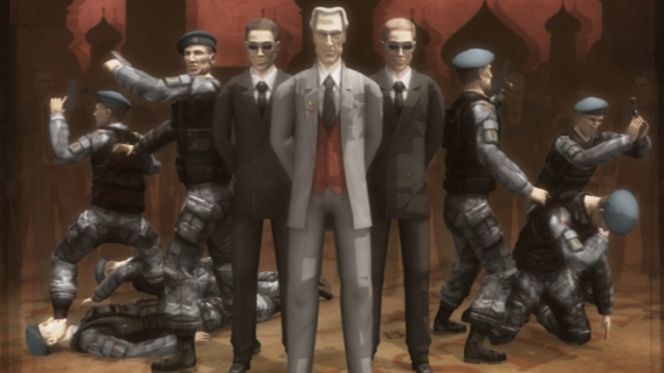
“Someday We’ll Ask a Big Favor of You Again, Comrade Pelikán…” (The Witness)
At certain stages of the game, we also get the opportunity to bribe various neutral yet very important officials, such as a mayor. That is when the usual little “convincing” card game comes into play, in which we generally have a better chance of winning than when giving gifts to improve the mood of our own people… Oh yes, I have not even talked about our comrades’ mood swings yet…
As strange as it sounds, this is the hardest part of the game. Because even though they share the good and the bad with us, the emotional state of our tovarishes constantly deteriorates no matter how things are going. I think that is already pretty stupid in itself – a somewhat better AI tied more closely to events would not have hurt – and it is even worse that, at least on the first map, it is almost impossible to cheer these good people up.
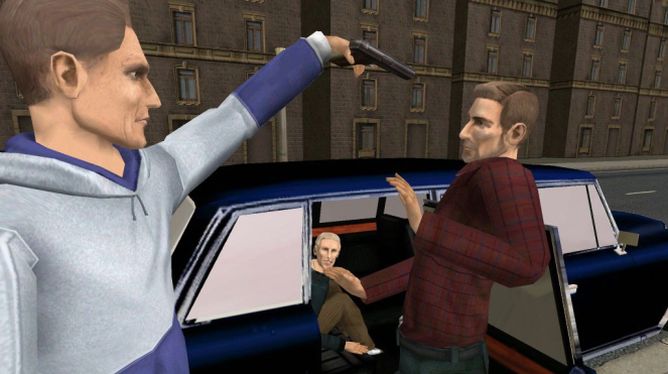
No matter how many “uplifting” initiatives we learn – such as the “easy life” our hero gets at the start of the game, which means gifting a Russian-made car – and which could, in theory, put joyful smiles on everyone’s faces, our people usually stop appreciating gifts or favors the second time around. In one such failed action, not only does their determination level fail to rise, but the determination of the generous, helpful comrade doing the gifting also drops by twenty points!
That is just dirty…
And naturally, where else would I encounter this mission objective than at the very end of the Yekaterina level, where I had to raise the determination of all my people to 70%! In the most literal sense, it was a mission impossible! (But for the solution, see Tips and Tricks!)
Human Destiny
Speaking of missions! I have not even mentioned the other most important element of the game, the one that, alongside the original core concept and the incredibly elaborate city design, lifts this title out of the crowd of strategy and management games. Republic has a fairly well-developed, linear story and mission structure, which in gameplay terms means that we only truly move forward if we complete the tasks tied to it.
As our avatar advances on the road to power, we must take part in various more or less shady or outright illegal dealings. Unlike other strategy games, it does not matter that the whole city lies at our feet – if for some reason we cannot complete the designated objectives, then we simply cannot win. This approach is somewhat similar to Black and White, which is no surprise, since lead designer Demis Hassabis once worked with Peter Molyneux on the first installment of the famous god game. Compared to B&W, however, the main story is one notch more polished, and the missions are more coherent as well – fortunately, Hassabis learned from the old mistakes.
“Study, Study, Study!” (V. I. Lenin)
What Molyneux somehow still failed to drum properly into young Hassabis’s head, though, was the importance of a tutorial… In addition to being insanely complex, Republic offers unusual solutions and a somewhat chaotic menu system, yet the tutorial section that should be mandatory in games like this is almost entirely missing. We have to puzzle out what is what and who belongs to whom from static screens explaining things in a fixed, slapdash style, and the program offers not the faintest help with the first steps! Because of this, my first two days with Republic were pure agony. By the time I finally understood what had to be done and how things should or could be used, I was already restarting the game from scratch.
Later on, I got into it and the whole picture finally came together, but that damned tutorial really was sorely missing this time. I was also a bit disappointed that although the city representation discussed above truly is astonishing in both graphical quality and detail, after a while most of the game is spent on the 2D main map anyway.
I had run into this strange flaw before: back in 1998, Gangsters stumbled into the very same trap, so I named it the “Gangsters paradox.” Luckily, Republic’s main map is not nearly as chaotic or ugly as the failed Eidos strategy title, but I think the Elixir team will soon realize that they would be better off putting every function into the living 3D world in a sequel.
“…And the Eeeeeaarth Will Be Shaken from Its Coooore…” (The Internationale)
So did it “break out”? Unfortunately, no. Republic is that typical “very good game” that could have become a genuine classic, the kind of title we would still cite as a benchmark years later, if the flaws and shortcomings discussed above – along with a few other small annoyances – did not drag down the overall picture.
For example, I was also a bit bothered by the fact that, unlike in Black&White, the developers did not allow us to rotate the camera freely or zoom in and out as we pleased. Instead, each movement only gave us fixed, somewhat stiff spins and instant close-ups. But I will stop piling on now, because I definitely do not want to put you off this game, which is built on a remarkably original idea and is fundamentally interesting, exciting, and witty, even if at times it is brutally difficult.
-Gergely Herpai BadSector-(2003)
Pros:
+ at last, a truly original and at the same time well-developed core idea
+ fantastically detailed city depiction
+ amusing political maneuvers and initiatives
Cons:
– very hard to learn at first – there is no tutorial
– you spend relatively little time looking at the city and much more on the 2D map
– a few annoying rules…
Publisher: Eidos Interactive
Developer: Elixir Studios
Genre: Strategy
Release: 2003
Republic : The Revolution
Gameplay - 8.8
Graphics (2003) - 8.7
Campaign - 8.9
Music/Audio - 8.2
Ambiance - 8.6
8.6
EXCELLENT
To what has just been said, I should still add this much: blablablablablablabla… sorry, but I absolutely have to give a speech to my little people in Pugachev!





Leave a Reply