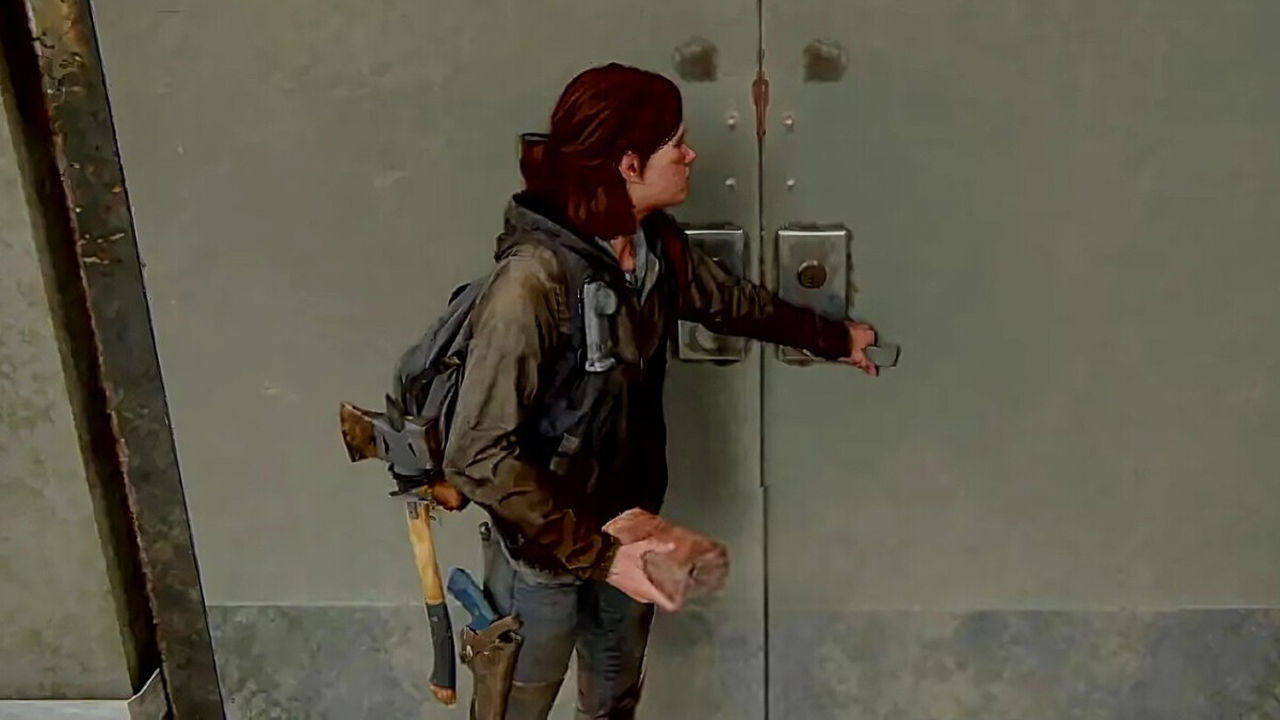
Doors are everywhere in real life, yet they are strangely rare in major video games. That does not mean they are completely missing – more than a few Final Fantasy VII Remake players probably still remember one very specific door – but most of the time they exist as static decoration instead of something truly interactive.
There is a reason for that, and it is a brutal one: doors are incredibly difficult to implement properly, especially when AI is involved, and especially if a studio wants to avoid breaking immersion with awkward animations and behavior.
“Doors are complicated to implement in games and cause all sorts of bugs.”
“AAA developers hate them,” wrote Stephan Hövelbrinks, the creator of Death Trash, in a Twitter thread later shared by PC Gamer. This week, the developer decided to explain to players why doors are such a deceptively complex feature to build into games despite seeming so simple at first glance: “Doors are tricky to put in games and cause all sorts of bugs. Mainly because they’re a dynamic funnel and an obstacle to pathfinding; they can be blocked, they can be indestructible, but above all they potentially get in the way of any playable interaction or situation between characters.”
A Problem of Both AI and Interaction
Liz England, a designer on Watch Dogs: Legion, coined the concept of “The Door Problem” to illustrate the hidden complexity of something that most people would consider mundane. In her theory, a door is not just a decorative object, but a point where every department in a studio collides: the designer decides whether it needs a key, the artist wants it to fit the architecture, the programmer has to make sure it does not clip through walls, and the sound designer has to calculate how the acoustics of a room change when the door is slightly open.
The real challenge lies in the dynamic nature of a door, which is the part that drives AI insane. The moment a door closes, it changes the “navigation map” enemies use to chase you, and it changes it in milliseconds. The AI has to instantly decide whether to open it – and in order to do that it must actually “know how” – whether to go around the building, or whether to remain stuck against the obstacle. Multiply that calculation across dozens of characters on screen and it starts consuming a serious amount of resources, resources that many studios would rather invest in visuals or combat responsiveness. As Hövelbrinks points out, that is one reason some entries in series like Assassin’s Creed spent years avoiding interactive doors almost entirely.
The thread prompted other developers to chime in with their own perspective. “I don’t know exactly how many months of work went into the door system in Control, but definitely more than for most abilities and weapons,” added Sergey Mohov, lead gameplay designer at Remedy, specifically underscoring how complicated the system was.
Kurt Margenau, co-director of The Last of Us Part II, said doors were an outright nightmare for the Naughty Dog team: “It was the thing that took us the longest to implement the way we envisioned.” The creative lead from the California studio explained that they tested every kind of prototype and idea to let players manually shut doors behind them after walking through. “None of them were very good.” In the end, they settled on doors that slowly close on their own during combat to block enemy routes, while remaining open during exploration so players can still see rooms they have already visited.
That solution was not easy either. “We had to create a new physics object that the player could push, but that could also push the player, completely unique to our engine,” Margenau added. Another major AAA game that reportedly struggled with doors was The Witcher 3, according to its former QA director Marcin Pieprzowski. Apparently, the prologue included a door that was supposed to remain locked during a boss fight and unlock only after the boss was defeated. “We found 12 cases where it wouldn’t unlock,” said the developer, explaining that the eventual solution was simply to make it unlockable all the time.
Fortnite Takes a Different Approach, and It Does It with Style
And yet there is one game that, even in a multiplayer environment where everything is at the mercy of players, has found a way around this problem: Fortnite. In Epic Games’ battle royale, doors are dynamic and editable. A player can create a door in the middle of a solid wall in a matter of seconds, forcing Unreal Engine 5 – though version four already handled this – to instantly recalculate collisions and line of sight for a hundred other players.
The achievement is not only visual, but also about synchronization. The server has to make sure that if you shut a door for cover from incoming fire, that collision is real for the opponent too, instead of bullets magically passing through because of latency. In practice, that is why Fortnite and other modern games often reduce the pain through destruction systems. If a door or a structure blocks bot navigation too heavily or creates too many physics conflicts, the system prefers to let it be destroyed. Once the door becomes a breakable object, the need to program extremely complex AI behavior for interacting with it is reduced: if the bot cannot find a path, it can simply smash through the obstacle.
So, to sum it up, if you have ever wondered why there are so few truly interactive doors in games, even in the biggest AAA productions, it is because they are a development nightmare. And if you ever needed proof that the most ordinary object can become one of the nastiest design problems in a game, the humble door is right there waiting to ruin everyone’s week.