
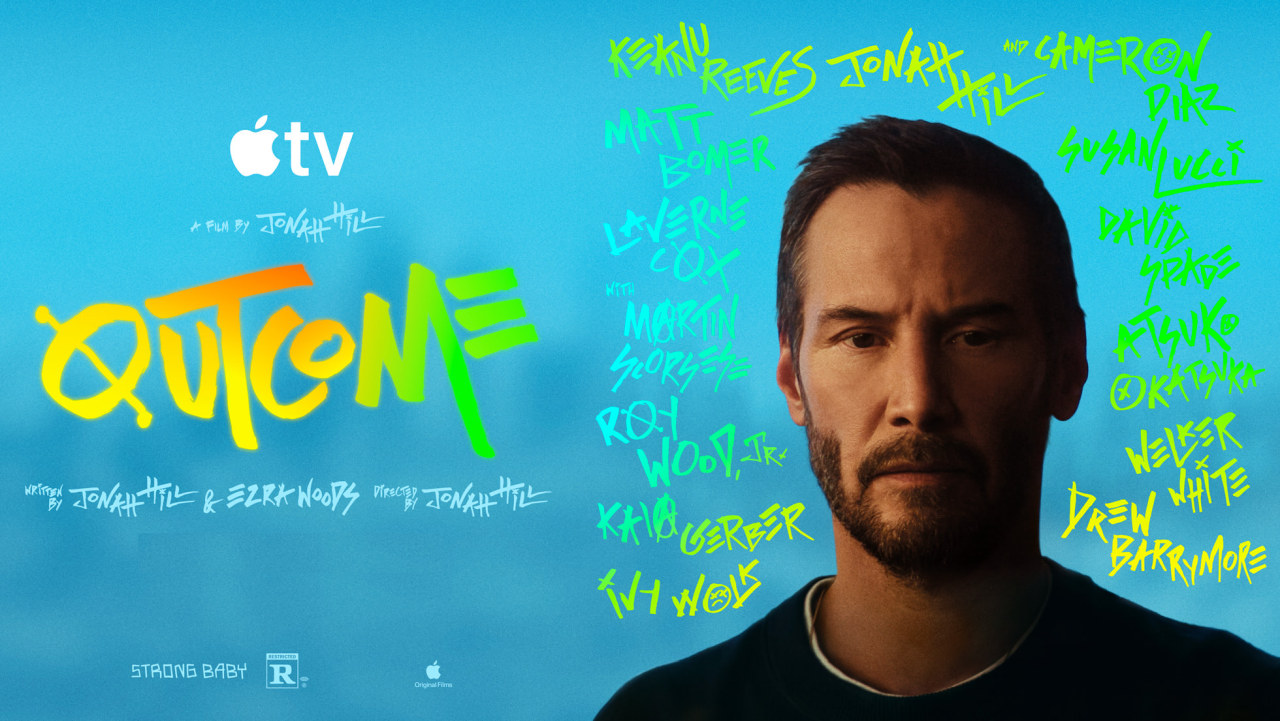
MOVIE REVIEW – Jonah Hill’s second feature as a director wants to be a nasty, insider Hollywood comedy about a star coming apart at the seams. Instead, Outcome mostly plays like a smug, overcooked industry meltdown that never becomes as sharp, funny, or revealing as it thinks it is. Keanu Reeves does what he can to give it some actual feeling, and there are moments when he almost makes the whole thing work through sheer sincerity alone. But the movie around him keeps collapsing into hollow satire, forced weirdness, and a kind of self-satisfied showbiz noise that quickly wears thin.
If Jonah Hill’s second film behind the camera has any accidental upside, it is that it makes other recent Hollywood self-destruction stories look deeper in retrospect. Outcome also centers on a rich, unraveling movie star, this time played by Keanu Reeves as Reef Hawk, a beloved actor returning after five years out of the public eye just as a blackmail scandal erupts around an old compromising video. Reeves plays him with a quiet decency that occasionally brings the character close to something genuinely moving. The problem is that nearly everyone else seems to be acting in a completely different movie. Reeves is trying to play a bruised human being. The rest of the cast often feels stuck in a loud, smug Hollywood in-joke.
It is hard not to be annoyed by how much talent has been gathered for material this thin. The movie has the stretched-out feel of a weak subplot from a much better industry satire, only expanded past the point where it can support itself. Even the easy pleasures of glossy streaming entertainment are in short supply. The visuals are full of lurid colors and uncomfortably tight close-ups, to the point where you sometimes stop focusing on the scene itself and start wondering what exactly is going on with someone’s face, mouth, or general styling. For a film with this many recognizable names, it often feels strangely cheap in ways that have nothing to do with budget and everything to do with taste.
Outcome is only 84 minutes long, but it still manages to feel slack. The Apple TV+ release, directed by Jonah Hill from a script he co-wrote with Ezra Woods, features Keanu Reeves, Hill, Cameron Diaz, Matt Bomer, Susan Lucci, Laverne Cox, David Spade, Martin Scorsese, Atsuko Okatsuka, Roy Wood Jr., Welker White, Kaia Gerber, Ivy Wolk, and Drew Barrymore. That cast list suggests something much livelier, stranger, or at least more substantial than what the film actually delivers. Instead, it feels like a thin idea padded out by attitude.

An Apology Tour Built on Bad Jokes
Reeves plays Reef Hawk, a name that sounds ridiculous enough on its own before the movie even gets started. Reef was discovered as a child on a TV song-and-dance competition, became one of Hollywood’s biggest stars, won two Oscars, and then disappeared from public view. His closest protectors are his childhood friends Kyle and Xander, played by Cameron Diaz and Matt Bomer, along with his fast-talking crisis lawyer Ira Slitz, played by Hill himself. Together, they have managed to keep Reef’s old heroin addiction out of the public story.
That changes when Ira learns that a damaging video has resurfaced and someone is demanding serious money to make it disappear. His solution is to send Reef on a strange apology tour: track down everyone who might hate him, ask for forgiveness, and figure out who is behind the blackmail. Reef initially insists he cannot think of anyone who would still have it out for him, only for his assistant Sammy to remind him, very quickly, that this is nonsense.
The movie introduces this whole plan in a long bathroom scene with Ira on the toilet, stretching a joke that was not especially funny to begin with until it becomes actively irritating. Then come the semen jokes, which lower the bar even further. A few nods to Weekend at Bernie’s tell you a lot about what Hill and Woods think counts as comedy here. The film keeps reaching for chaos and eccentricity, but the jokes land with a thud. Even when characters talk as if the humor is supposed to be wild and daring, it mostly just feels tired.

Everyone Says Reef Was Awful, But the Movie Never Proves It
One stop on Reef’s forced path to redemption is his mother Dinah, played by Susan Lucci, who agrees to listen to him only if their conversation can be filmed for an episode of The Real Housewives of Beverly Hills. Dinah comes off as a far more believable narcissistic monster than Reef ever does. That is partly because Reeves, for all his effort, is simply a hard actor to buy as some monstrous, casually cruel diva. His ex-girlfriend Savannah tells him plainly that he is not a good person and that everything has always been about him, but the film never gives that accusation enough shape to really bite.
Even Kyle and Xander eventually admit, during a sunset conversation on the deck of Reef’s Malibu beach house, that he hurt them too. The problem is that the script never digs deeply enough into any of this. It keeps hinting at serious damage in Reef’s past without ever making it vivid or specific. So much of the movie depends on the idea that Reef used to be terrible, but it never shows enough for that version of him to feel real. The result is that all the moral reckoning in the film feels strangely weightless.
The best scenes belong to Martin Scorsese, who plays Reef’s former childhood talent manager Richie “Red” Rodriguez. He is still running his business out of a bowling alley attached to an arcade, and Scorsese gives him a weary sadness that feels more real than almost anything else in the movie. He talks about the children he once represented, who moved on to bigger agencies and forgot all about him, with the kind of lived-in regret the rest of the film never finds. A late scene in which Reef reconnects with him is one of the few moments where Outcome finally stops showing off and stumbles into something honest.

A Big Cast, Lots of Noise, Very Little Forward Motion
As the blackmail threat grows, Ira gathers what is supposed to be a high-level team of experts to help contain the fallout, even though the movie never makes a convincing case for why these people would be central to this particular crisis. Laverne Cox plays Virginia Allen-Green, a prominent lawyer for abused women. Roy Wood Jr. appears as Reverend Londrus Carter, a social justice figure. Atsuko Okatsuka plays Unis Kim, an activist focused on anti-Asian misrepresentation. In theory, these characters should give the film more satirical range. In practice, they mostly feel like extra surfaces for Jonah Hill’s abrasive performance to bounce off.
There are a few visual jokes that almost work, including Kevin Spacey and Kanye West portraits hanging in Ira’s office building, and a bumper sticker on his van that says, “Honk if you can separate the art from the artist.” Some of Ira’s fashion choices are also ridiculous enough to be funny in another movie. But Hill plays the character so broadly and so insistently that even decent jokes die before they can land. The movie is full of people who are meant to feel like heightened Hollywood types, but Hill never gives them enough recognizable humanity to make them funny, sad, or memorable. They are just caricatures floating in expensive air.
That emptiness hurts both sides of the movie. It drains the comedy, and it also undercuts the film’s attempts at real feeling. Reef eventually learns something about accountability and sincere remorse, with John Prine’s How Lucky doing a lot of the emotional heavy lifting, but the payoff feels hollow because the movie never earns it. You can see what it wants to say. You just never believe it has done the work required to say it well.
What is most disappointing is how little of the warmth and curiosity that made Hill’s Mid90s feel alive survives here. Instead of that openness, Outcome gives us a sealed-off little world of Hollywood vanity mistaking itself for satire. Reeves keeps trying to find something human inside it. The movie keeps refusing to meet him halfway.
-Gergely Herpai “BadSector”-
Outcome
Direction - 6.1
Actors - 4.8
Story - 3.8
Visuals/Music/Sounds - 5.2
Ambiance - 4.4
4.9
WEAK
Outcome has a stacked cast, plenty of insider-Hollywood attitude, and no shortage of self-awareness, but it never turns any of that into a movie that feels sharp, funny, or emotionally convincing. Keanu Reeves gives it more honesty than it deserves, yet Jonah Hill’s grating performance and the script’s hollow smugness keep dragging everything back down. This is not a cutting Hollywood satire. It is a thin, uncomfortable industry joke stretched far too long.





Leave a Reply