
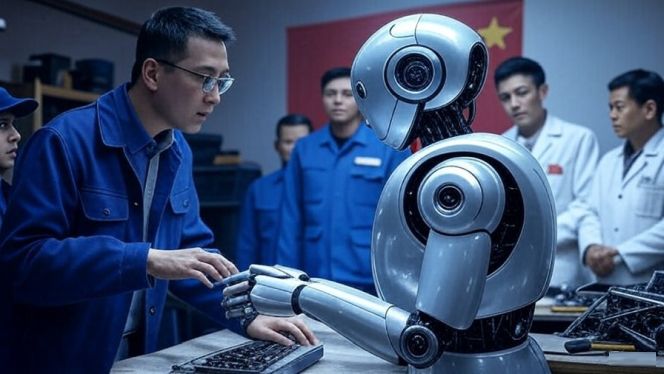
TECH NEWS – China is banking on humanoid robots to drive the next wave of technological evolution, but 123 million citizens are already fearful: “We think of space or the bottom of the ocean.”
Most tech headlines about China focus on trade wars and tariffs. For example, China’s recent deal with the United States marked a step back from aggressive tariff hikes. But beyond diplomacy, China is accelerating progress in one crucial area with the power to define the future of tech: robotics.
Following the lead of Amazon and Elon Musk
While Apple’s sales in China continue to slide, the U.S. has warned the company: “We are not interested in having you manufacture in India.” Despite breakthroughs in fiber optic speeds that stunned experts and citizens alike, China’s long-term vision now zeroes in on robotics. From public robot races to automation trials in factories, the country is following Amazon’s path toward large-scale robotic integration.
Reuters reports that AgiBot, a Chinese robotics firm, operates humanoid robots up to 17 hours a day to gather training data for its AI systems. Their mission: transform labor in factories—just like Tesla and Amazon aspire to do. The Chinese government supports this move, which has invested €18.4 billion in humanoid robotics and an additional €126 billion in AI and related technologies.
Chinese firms like Unitree and UBTech are preparing to begin mass production of humanoid robots in 2025. This momentum is expected to drive costs down dramatically, from today’s €32,000 per unit to as low as €15,700 by 2030. The reason? Around 90% of components are produced domestically — a stark contrast to Tesla’s robots, which cost €46,000–€55,000 per unit when built outside China.
China is already leading the market, offering humanoid robots for as little as €11,200 — far below global competitors. Companies like MagicLab are outfitting robots with autonomous “brains” from DeepSeek, Gwen (Alibaba), and Duobao (ByteDance). This has led to the creation of state-backed data hubs in Shanghai, Beijing, and Shenzhen, where infrastructure and subsidies foster AI innovation.
Technological revolutions always come with societal anxieties. In robotics, the fear is job displacement: the original article estimates that up to 70% of industrial positions — approximately 123 million jobs — could be affected. Policymakers are already discussing AI unemployment insurance for periods of 6 to 12 months. Still, Chinese officials are urging citizens to stay calm.
Robots won’t take jobs — they’ll change them
In a separate Reuters report, Beijing official Liang Liang emphasized that humanoid robots will not replace humans, but enhance their productivity. His perspective mirrors Amazon’s, which frames robotics as a way to improve work conditions for staff. Liang revealed the real aim of the mass deployment: shifting humans away from risky or undesirable labor.
“We hope to see robots working in dangerous or inaccessible places like space or the ocean floor, as well as doing tasks no one wants to do.” Robots could soon populate underwater data centers, orbital facilities, and other isolated environments. Since they can operate 24/7, companies expect lower costs and more efficient, continuous output.
Interest in robotics is soaring, especially as it intersects with AI. From robot-versus-human marathons to government-led optimism, China is positioning robots as allies, not enemies. Countries like South Korea are already modeling peaceful human-machine coexistence — a vision that may spread worldwide.
Source: 3djuegos















Leave a Reply