
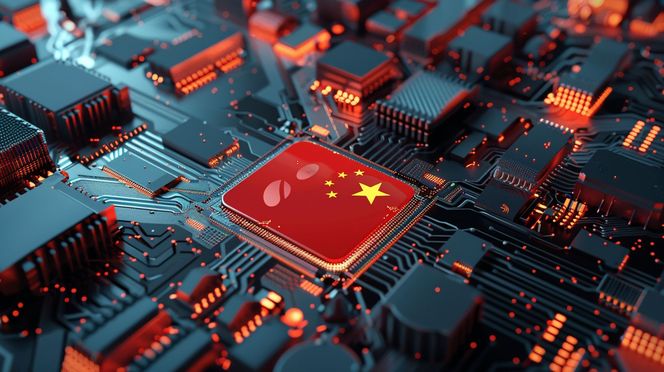
TECH NEWS – The two companies are taking different approaches to the Chinese market. One company wants to expand, while the other wants to stay, if America will allow it.
Currently, the Chinese AI market is surrounded by huge uncertainty due to growing concerns about U.S. regulations and the emergence of domestic firms with capable alternatives. AMD is developing an AI chip for the Chinese market that will likely increase the company’s influence in the region. According to DigiTimes, AMD plans to offer its RDNA4-based Radeon AI Pro R9700 workstation GPU to Chinese customers, anticipating that Nvidia’s upcoming “Blackwell” MI chip will also provide a GDDR7 solution. As a result, the two companies’ offerings will be on par in terms of performance, since both will launch MI variants with similar specifications, though Nvidia will still have the advantage thanks to its robust software ecosystem.
AMD could generate interest in its workstation-level GPUs in China through better pricing, availability, and perhaps a consistent supply. However, compared to Nvidia, AMD has much less influence in the Chinese market. It is safe to say, however, that Western AI chip options in China are already nearing the point where they are seriously lagging behind domestic alternatives like Huawei, making it increasingly difficult for AMD and Nvidia to sell to Chinese tech giants.
*NVIDIA: WOULD HAVE TO FORECLOSE FROM COMPETING IN CHINA MARKET
— *Walter Bloomberg (@DeItaone) May 28, 2025
Nvidia Pulls Back
After reporting its quarterly results, Nvidia announced that it would no longer compete in the Chinese AI market. This either means no new solutions for the region will be developed, or that ongoing profit losses from the region have forced Nvidia to rethink its business strategy. Alongside Trump’s AI policy, Nvidia’s decision to withdraw from China is likely driven by Huawei. U.S. restrictions have forced Nvidia to pull back, creating a huge opportunity for Huawei.
Huawei has capitalized on this, offering its high-end Ascend MI chips that deliver performance on par with Nvidia’s H100 MI accelerators, some of the most advanced chips on the market. “We may be unable to create a competitive product for China’s data center market that receives approval from the US government. In that event, we would effectively be foreclosed from competing in China’s data center computing market, which would have a material and adverse impact on our business,” said Nvidia.
Looking at Nvidia’s situation, the company is forced to sell stripped-down solutions to the Chinese AI market. Its upcoming AI chip is reportedly intended to bridge the performance gap by integrating relatively weaker technologies like GDDR7. In raw performance, however, Nvidia’s next chip may not be able to compete with Huawei’s offerings, which could be a serious blow to the company. Jensen Huang will likely rely on Nvidia’s software ecosystem to stay competitive in domestic markets, but it is well known that Huawei is eager to develop capable alternatives.
Trump Administration Remains Firm
The Trump administration has no intention of holding back, committed as it is to restricting China’s access to AI chips in an effort to hinder the nation’s AI development. Despite Jensen’s request, the U.S. government sees artificial intelligence as a national security issue and will not compromise.
Source: WCCFTech, WCCFTech, DigiTimes


![[TGA 2025] Tomb Raider: Legacy of Atlantis: Another Remake of the First Game! [VIDEO]](https://thegeek.games/wp-content/uploads/2025/12/theGeek-Tomb-Raider-Catalyst-Legacy-of-Atlantis-Remake-Crystal-Dynamics-302x180.jpg)



![[TGA 2025] Tomb Raider: Legacy of Atlantis: Another Remake of the First Game! [VIDEO]](https://thegeek.games/wp-content/uploads/2025/12/theGeek-Tomb-Raider-Catalyst-Legacy-of-Atlantis-Remake-Crystal-Dynamics-300x365.jpg)


Leave a Reply